
The 3 Types of Business Operations (With Examples)
Learn about 3 types of business operations and how to choose the right one for your entrepreneurial journey.

Starting a new business is an exciting endeavor that requires careful consideration of various aspects. Among these, choosing the right type of business operation plays a crucial role in determining the success and growth of your venture.
This article aims to provide comprehensive information on three types of business operations within the general industry, helping entrepreneurs make informed decisions and pave their path to success.
Three Main Types of Business Operations
⏹️ Sole Proprietorship
A sole proprietorship is the simplest type of business operation. It's owned and operated by one person, and there's no legal separation between the business and the owner. This means that the owner is personally responsible for all of the business's debts and liabilities.
Advantages:
- Easy to set up and maintain
- Low startup costs
- Full control over the business
Disadvantages:
- Unlimited liability
- Limited access to capital
- Difficult to scale
Examples:
- Freelancers
- Consultants
- Contractors
- Small businesses such as lawn care companies and retail stores
⏹️ Partnership
A partnership is a business operation that is owned and operated by two or more people. There are two main types of partnerships: general partnerships and limited partnerships.
General Partnership: In a general partnership, all partners share equal ownership and responsibility for the business. This means that all partners are personally liable for the business's debts and liabilities.
Limited Partnership: In a limited partnership, there are two types of partners: general partners and limited partners. General partners have the same rights and responsibilities as general partners in a general partnership. Limited partners have limited liability, meaning that they are only liable for the amount of money they invested in the partnership.
Advantages:
• Shared resources and expertise
• Easier to raise capital than a sole proprietorship
• More flexible than a corporation
Disadvantages:
• Unlimited liability for general partners
• Potential for conflict between partners
Examples:
- Law firms
- Accounting firms
- Medical practices
- Small businesses such as restaurants and hotels
⏹️ Corporation
A corporation is a legal entity that is separate from its owners. This means that the corporation is responsible for its own debts and liabilities, and the owners are not personally liable.
Advantages:
- Limited liability for owners
- Ability to raise capital through stock sales
- Easier to scale than other types of business operations
Disadvantages:
- More complex to set up and maintain
- Expensive to set up and maintain
- Subject to more government regulation
Examples:
- Publicly traded companies such as Apple and Amazon
- Privately held companies such as Cargill and Koch Industries
- Nonprofits such as the American Red Cross and the United Way
Benefits and Challenges of Each Type of Business Operation
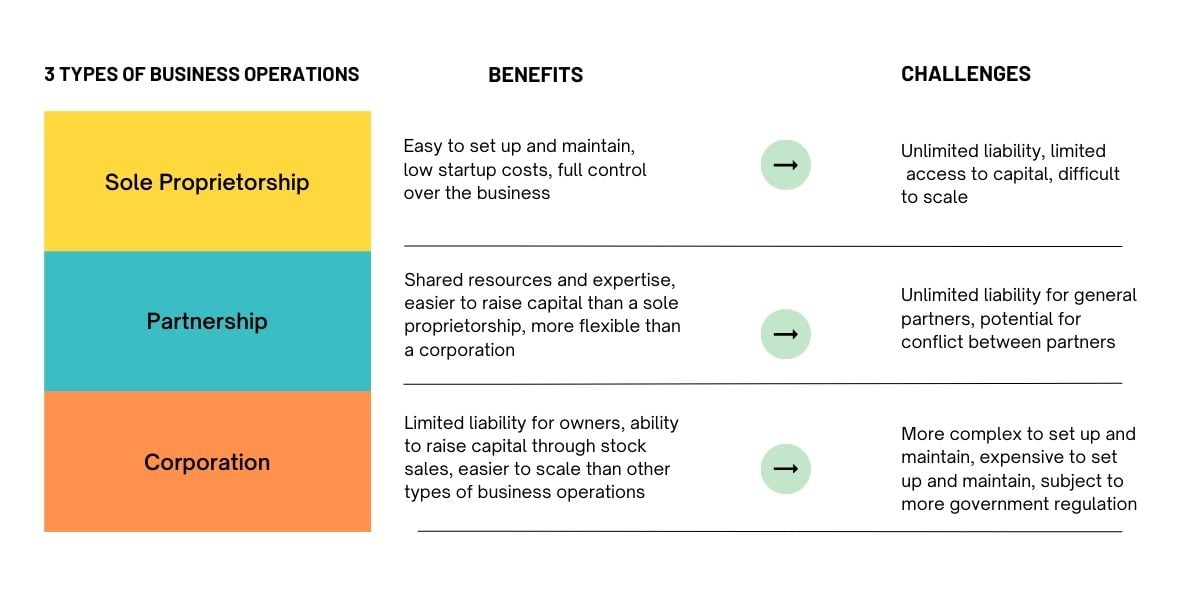
Each type of business operation has its own unique benefits and challenges. Here is a table that summarizes the key benefits and challenges of each type:
Choosing the Right Type of Business Operation for You
The best type of business operation for you will depend on your specific needs and goals. Here are a few things to consider when choosing a type of business operation:
- Liability: How much personal liability are you willing to assume?
Are you comfortable with assuming personal liability for your business's obligations and debts? Assessing your risk tolerance is crucial in deciding whether to opt for a sole proprietorship, partnership, or limited liability company (LLC).
- Capital: How much money do you have to invest in your business?
For example, how much financial resources do you possess to kickstart your venture? The type of business operation you choose can significantly impact your initial investment requirements. Sole proprietorships and partnerships typically demand less upfront capital compared to corporations.
- Scalability: How big do you want your business to grow?
Envision the future scale of your enterprise. Are you aiming for steady growth or envisioning rapid expansion? Understanding your growth trajectory aids in selecting a business structure that accommodates your scalability objectives, whether it's a small-scale endeavor or a multinational corporation.
- Flexibility: How much flexibility do you need in your business operations?
Evaluate the level of flexibility you desire in managing your business affairs. Sole proprietorships offer maximum autonomy but come with limited scalability, whereas partnerships and corporations provide enhanced operational flexibility but involve additional regulatory obligations.
By evaluating these considerations thoughtfully, you can determine the most suitable business operation that aligns with your entrepreneurial vision and sets the stage for success.
☀ Examples: ☀
John is a software developer who is starting his own consulting business. He is the only owner of the business, so he will be personally liable for all of the business's debts and liabilities if he chooses to operate as a sole proprietor. However, John is willing to assume some personal liability in order to have the flexibility and control of a sole proprietorship.
Mary is also a software developer, but she is starting a consulting business with her friend Jane. They decide to form a partnership. As general partners in the partnership, Mary and Jane will both have unlimited personal liability. However, they are comfortable sharing the risk of the business with each other.
Alex is a software developer who is starting a consulting business with two other developers. They decide to form a corporation. As shareholders in the corporation, Alex and the other developers will have limited liability, meaning that they are not personally liable for the corporation's debts and liabilities. This is one of the main reasons why they chose to operate as a corporation.
In each of these examples, the entrepreneur considered their personal liability tolerance when choosing a type of business operation. John was willing to assume some personal liability in order to have the flexibility and control of a sole proprietorship. Mary and Jane were comfortable sharing the risk of the business with each other as general partners in a partnership. And Alex and the other developers chose to operate as a corporation to take advantage of limited liability.
Most Common Ways to Raise Capital for the 3 Types of Business Operations
Raising capital for your small business is one of the most important steps in getting it off the ground. Whether you're starting a new business or expanding an existing one, you'll need to find a way to finance your growth.
There are many different ways to raise capital for a small business, and the best approach will vary depending on the type of business you have and your specific needs. Here is an overview of some of the most common ways to raise capital for the three main types of business operations:
☑️ Sole Proprietorship : As a sole proprietor, you are personally liable for all of your business's debts and liabilities. This means that you may have difficulty raising capital from traditional lenders, such as banks. However, there are a few options available to sole proprietors:
Bootstrapping:Bootstrapping is the process of funding your business with your own personal savings and cash flow. This is a good option for sole proprietors who have limited startup costs or who are able to generate revenue quickly.
Personal loans:Sole proprietors may also be able to obtain personal loans from friends and family members. This can be a good option for sole proprietors who need a relatively small amount of capital and who have good credit.
Crowdfunding: Crowdfunding is a way to raise capital from a large number of people, typically online. This can be a good option for sole proprietors who have a unique or innovative product or service.
☑️ Partnership
Partnerships have the same challenges as sole proprietorships when it comes to raising capital from traditional lenders. However, there are a few additional options available to partnerships:
Partner contributions: Each partner in a partnership can contribute their own money and assets to the business. This is a common way for partnerships to raise capital.
Business loans: Partnerships may also be able to obtain business loans from banks and other lenders. However, the partners may need to personally guarantee the loan, which means that they would be liable for the debt if the business defaults.
Investor financing: Partnerships may also be able to raise capital from investors. This can be a good option for partnerships that have high growth potential.
☑️ Corporation
Corporations have the easiest time raising capital from traditional lenders. This is because corporations offer limited liability to their owners, meaning that the owners are not personally liable for the business's debts and liabilities.

In addition to business loans, corporations can also raise capital through the following means:
Stock sales: Corporations can raise capital by selling shares of stock to investors. This is a common way for corporations to raise large amounts of capital.
Convertible debt: Convertible debt is a type of loan that can be converted into equity (ownership) in the company at a later date. This can be a good option for corporations that need to raise capital but are not ready to sell shares of stock.
Government grants: There are a number of government grants available to small businesses. Corporations may be eligible for these grants, depending on their industry and location.
No matter what type of business operation you have, there are a number of ways to raise capital. It is important to do your research and choose the best approach for your specific needs.
Here are some additional tips for raising capital for your small business:
✔ Have a solid business plan: Investors and lenders will want to see a well-written business plan that outlines your business model, financial projections, and marketing strategy.
✔ Be prepared to pitch your business: When you're meeting with potential investors or lenders, be prepared to pitch your business and explain why you need funding.
✔ Network with other entrepreneurs: Networking with other entrepreneurs is a great way to learn about different funding options and to meet potential investors.
✔ Use online resources: There are a number of online resources available to help small businesses raise capital. These resources include crowdfunding platforms, business directories, and government websites.
Raising capital for your small business can be a challenge, but it is essential for growth and success. By following the tips above, you can increase your chances of success.
Your Choice: Selecting the Right Operational Framework
While securing funding can be a hurdle, navigating it with these tips will set your small business on a stronger path to success. But before diving headfirst, remember that choosing the right business operation is a crucial step in your entrepreneurial journey.
Think of abusiness operation as the backbone of your company, defining the legal structure, financial management, and daily activities that keep your business running smoothly. It can significantly impact your:
- Liability: How responsible you are for debts and legal issues.
- Access to capital: Ease of obtaining funding, like loans or investments.
- Flexibility: Ability to adapt your business structure to changing needs.
- Scalability: Potential to grow and expand your business operations.
As a business owner or aspiring entrepreneur, take the time to research and understand the different types of business operations, such as sole proprietorships, partnerships, and corporations. Each has its own advantages and disadvantages, and the best choice for you depends on your specific needs and goals. Choosing the right structure is an investment in your business's future, laying a solid foundation for sustainable growth and success.
Choosing the right type of business operation is an important decision for any business owner or startup. The type of business operation you choose will affect your liability, access to capital, flexibility, and scalability.
If you are a business owner or startup founder, take the time to understand the different types of business operations and choose the one that is best for your needs. Choosing the right business operation is an investment in the future of your business.
Discover the Right Tools for Your Startup
Take our 2-minute quiz to find tools tailored to your specific needs and goals.
Take the QuizTakes only 2 minutes


