
Business Operations Defined: Blueprint for Success
Uncover key strategies to define business operations for efficiency and growth. 'Business Operations Defined: Blueprint for Success' for every entrepreneur.

Starting a new business is like embarking on an exciting adventure filled with many opportunities and challenges. One of the most important things that aspiring entrepreneurs need to understand is the concept of "business operations defined." This article will help you understand what business operations mean, why they are important, and how they can be the key to your entrepreneurial success.
Understanding Business Operations Defined
Business operations defined, in its simplest form, refers to the day-to-day activities and processes that a company engages in to produce and deliver its products or services. These activities can encompass a wide range of functions, including but not limited to:
🔹Production and Manufacturing: This refers to the processes involved in creating and assembling products. For example, a car manufacturing company would have production operations that include assembling the car parts, painting the cars, and conducting quality control checks.
🔹 Service Delivery: This involves effectively delivering services to meet client expectations. For instance, a consulting company would have service delivery operations that include conducting client meetings, providing strategic advice, and delivering reports or presentations.
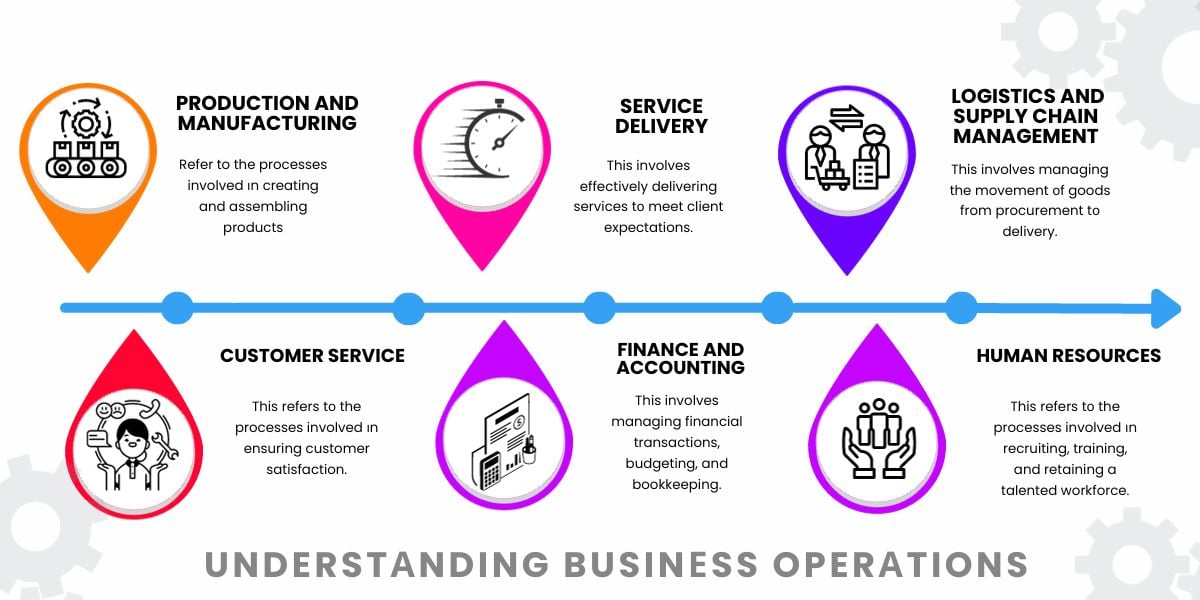
🔹 Logistics and Supply Chain Management: This involves managing the movement of goods from procurement to delivery. A retail company would have logistics and supply chain operations that include sourcing products from suppliers, managing inventory, and organizing transportation for the products to reach their retail locations.
🔹 Customer Service: This refers to the processes involved in ensuring customer satisfaction. For example, an e-commerce company would have customer service operations that include responding to customer inquiries, resolving complaints, and providing assistance with returns or exchanges.
🔹 Finance and Accounting: This involves managing financial transactions, budgeting, and bookkeeping. For instance, a financial services company would have finance and accounting operations that include processing client payments, tracking expenses, and preparing financial statements.
🔹 Human Resources: This refers to the processes involved in recruiting, training, and retaining a talented workforce. For example, a technology company would have human resources operations that include conducting job interviews, providing employee training programs, and implementing employee retention strategies.
Why Business Operations Defined Matters
In today's competitive world, businesses need to work hard to make their operations as efficient as possible. This means defining and improving their daily tasks. Business operations are the things a company does to make money and reach its goals.
Understanding and defining your business operations is not just a choice you make when you're planning your business; it's one of the most important things you can do to make sure your business is successful in the long term.

⏹️ Clear Expectations and Responsibilities
A robustly defined operational structure helps to outline specific tasks, roles, and responsibilities for each team member, ensuring that every employee is working towards a common goal. A clear understanding of expected tasks helps to minimize confusion, reduce redundancies, and avoid overlapping responsibilities, ultimately enhancing overall efficiency and productivity.
⏹️ Improved Decision Making
By defining your business operations, you will have a clear picture of all the steps and tasks that make your business work. This knowledge will help you make better decisions about how to use your resources, find problems, and make important choices. Also, a strong operational framework gives you the information you need to create Key Performance Indicators (KPIs), which are important for tracking your progress and reaching your business goals.
⏹️ Streamlined Communication and Collaboration
A well-structured operational plan promotes effective communication within teams and across departments. By clearly outlining your business operations, you provide employees and stakeholders with a frame of reference for decision making and an understanding of how their roles contribute to the overall success. Streamlined communication facilitates problem-solving, promotes innovation, and helps avoid unnecessary confusion.
⏹️ Efficient Resource Allocation
Defining business operations allows you to identify inefficiencies and areas for improvement within your organization. By understanding how each aspect of your business functions, you can allocate resources more judiciously to optimize strategic outcomes. Additionally, improving operational efficiency can result in cost savings that contribute to a healthier bottom line.
⏹️ Scalability and Adaptability
A well-defined operational plan provides a strong foundation for growth and expansion, enabling your organization to scale and adapt quickly in response to market changes and new opportunities. By fully understanding your company's inner workings, you will be better equipped to make strategic decisions that support long-term growth while maintaining a high level of operational efficiency.
⏹️ Competitive Advantage
In a world where things change quickly and there are a lot of competitors, a business that has clear business operations is better able to stand out and stay ahead. By having a good understanding of how your business works, you can better spot new trends, learn from other businesses that are doing well, and quickly fix problems. This will give your business an advantage and help it grow.
Case Study: Amazon - A Masterclass in Operations
Amazon, the e-commerce giant founded by Jeff Bezos, provides a compelling real-world example of the power of well-defined business operations.
From its inception, Amazon focused on optimizing its supply chain and logistics operations. This obsession with efficiency allowed them to offer an unprecedented level of convenience to customers through services like Amazon Prime's two-day shipping. By investing heavily in technology and innovation, Amazon streamlined its operations to deliver goods faster and more cost-effectively than traditional retailers.
Moreover, Amazon's commitment to customer service and the use of cutting-edge technologies like AI and data analytics have redefined online shopping. Their operations ensure a seamless shopping experience and personalized recommendations, leading to unparalleled customer satisfaction and loyalty.
Amazon's relentless pursuit of operational excellence has transformed it from an online bookstore into a global e-commerce and cloud computing behemoth, showcasing the transformative potential of business operations defined.
Strategies for Effective Business Operations
Now that you understand the significance of business operations, here are some strategies to help you optimize them for your new business:
❶ Process Mapping
Process mapping is a valuable tool for identifying and eliminating inefficiencies in business operations. By documenting each step in a process, you can identify bottlenecks, areas of duplication, and unnecessary steps. Once you have identified these areas, you can take steps to streamline the process and improve efficiency.
Example: A small business owner who sells handmade jewelry could use process mapping to identify the following inefficiencies in her order fulfillment process:
• Orders are often taken down incorrectly, leading to errors in fulfillment.
• There is no system for tracking inventory, so it is often difficult to know when materials are running low.
• Orders are not shipped in a timely manner, leading to customer dissatisfaction.
By identifying these inefficiencies, the business owner could take steps to streamline her order fulfillment process, such as:
Implementing an order entry system that captures all necessary customer information.
Implementing an inventory management system to track stock levels and reorder materials when necessary.
Establishing a shipping schedule and setting clear deadlines for order fulfillment.
❷ Invest in Technology
Technology can be a powerful tool for automating repetitive tasks, enhancing decision-making, and improving customer interactions. By investing in the right technology, businesses can improve efficiency, productivity, and customer satisfaction.
Example: A mid-sized manufacturing company could invest in the following technologies to improve its operations:
An enterprise resource planning (ERP) system to automate core business processes, such as accounting, inventory management, and customer relationship management (CRM).
A business intelligence (BI) platform to analyze data and gain insights into customer behavior, market trends, and operational performance.
A customer relationship management (CRM) system to track customer interactions, manage sales leads, and provide personalized customer service.
❸ Continuous Improvement
A culture of continuous improvement is essential for businesses that want to stay ahead of the competition. By encouraging employees to identify and implement operational enhancements, businesses can continuously improve their efficiency, productivity, and customer satisfaction.
Example: A large software company could foster a culture of continuous improvement by:
• Establishing a suggestion program where employees can submit ideas for operational improvements.
• Creating a culture of open communication where employees feel comfortable sharing their ideas and concerns.
• Providing training and resources to employees so that they can develop the skills necessary to implement operational improvements.
Aligning your operations with your customers' needs is essential for building customer loyalty and driving repeat business. By understanding your customers' needs and expectations, you can make informed decisions about how to improve your operations and deliver a superior customer experience.
Example: An online retailer could improve its customer-centric operations by:
• Conducting surveys and focus groups to gather feedback from customers.
• Analyzing customer data to identify trends and patterns in customer behavior.
• Implementing customer-centric initiatives, such as a free shipping policy or a 24/7 customer service hotline.
By implementing these strategies, businesses can optimize their operations and create a foundation for long-term success.
The Role of Technology in Business Operations
If you're an entrepreneur, start-up owner, or new business leader, you already understand the myriad challenges and roller-coaster nature of building a business. One of the most potent tools in your arsenal to conquer these challenges and streamline your business operations is technology. Harnessing the power of technology could potentially be the game changer that skyrockets your business to its next phase of growth.
The aim is to empower and motivate you to redefine your own business operations dynamically for greater success.

▪️ Embracing Automation: Doing More with Less
In this age of digital revolution, one of the most potent ways to enhance operational efficiency is by automating repetitive and time-consuming tasks. Automation allows you to streamline processes and free up your human resources for higher-level, strategic roles. By embracing tools that automate tasks like email marketing, data entry, and even customer service, you not only boost productivity but also set a path for scalability. For start-up owners constantly dealing with the challenge of limited resources, automation can be a life-saver.
▪️ Leveraging Artificial Intelligence 🤖
AI’s potential in transforming business operations is colossal. From chatbots providing 24/7 customer support, to AI-driven data analysis offering valuable insights into customer behaviour, AI has permeated every facet of modern businesses.
AI offers an unprecedented level of precision, personalization, and forecasting power - a game-changer for entrepreneurs seeking to understand and serve their customers better.
▪️ Decoding Data Analytics
Knowledge is power, and in the world of business, that knowledge often lies in the data you generate. Data analytics can provide valuable insights into market trends, customer preferences, and operational bottlenecks. By leveraging these insights, you can make informed business decisions that drive growth, enhance customer satisfaction, and optimize operations. As new business owners, navigating through vast amounts of data can be daunting, but with the right tools, it can turn into your most potent strategic weapon.
▪️ Implementing Project Management Software
Running a business can sometimes feel like juggling with multiple moving pieces. Project management software helps keep all these pieces in sync and ensures that your business processes are running efficiently.
Tools like Asana, Trello, or Jira provide you with an overview of ongoing projects, track progress, and encourage collaboration and communication, ensuring everything is running on time and within budget. For start-ups and new businesses, implementing such software can be the difference between astute project management and chaotic confusion.
Investing in Technology: Creating Future-Proof Businesses
Investing in technology is not just about adopting the latest trends. It's about choosing the tools that provide the most value to your business operations and align with your strategic goals.
Remember, every bit of software you decide to integrate into your business operations should solve a problem and add value to your business. With the right technological tools, you can build a formidable, future-proof business, ready to adapt and thrive in an ever-evolving market landscape.
Integrating technology in your business operations is not merely a survival strategy for today's digital world. It is an essential growth strategy for entrepreneurs who want to stand out, stay relevant, and drive sustained success. So, harness the power of technology, redefine your operations, and prepare to soar to new business heights.
You have embarked on the amazing journey of entrepreneurship, equipped with visions and aspirations. Let technology be your ally, enhancing and upgrading your operational efficiency, boosting your productivity and carving your path to success.
Making it Happen: Stir Your Business towards Success
Defining your business operations is akin to creating a blueprint for your company’s success. With your "business operations" deftly defined, you craft a roadmap that shows what your company does, how it does it, and how it can do it even better.
Act today, following these steps. Begin the process of defining your business operations, setting the stage for efficiency, growth, and fortitude. Embrace the journey, the learnings, and watch as your business prospers, reaching its fullest potential.

• Start defining your business operations: Think about all the things you need to do to keep your business running smoothly. This includes things like setting up your office, hiring employees, and marketing your products or services.
• Set goals for efficiency, growth, and resilience: What do you want to achieve with your business? Once you know your goals, you can start to make plans to reach them.
• Embrace the journey: Starting a business is not always easy. There will be ups and downs along the way. But if you're persistent and learn from your mistakes, you'll eventually reach your goals.
• Watch your business prosper: As your business grows, you'll start to see the fruits of your labor. Remember to keep learning and growing, and your business will reach its full potential.
From an ideation to a fully flourishing business, every step you take is a part of the unparalleled journey of entrepreneurship. Understanding the nuances of "business operations defined" is just one milestone, but an essential one that paves your path towards success.
Discover the Right Tools for Your Startup
Take our 2-minute quiz to find tools tailored to your specific needs and goals.
Take the QuizTakes only 2 minutes


