
Crafting Strong Customer Value Proposition: Enhancing Sales
Unleash your business's secret weapon: craft a compelling Customer Value Proposition and watch your sales soar. Learn the key components and unlock your unique selling advantage.

Starting a new business can be a thrilling journey, but it's also filled with challenges and uncertainties. In the ever - evolving landscape of entrepreneurship, one thing remains constant: the importance of a robust customer value proposition.
In this article, we will delve into why crafting a strong customer value proposition is vital for businesses, particularly startups, and how it can be a game-changer in achieving your sales goals.
Defining Customer Value Proposition
So, what exactly is a customer value proposition (CVP)? Simply put, it's the unique promise your business offers to your customers. It encompasses the value and benefits that customers can expect to receive from your products or services. A well-defined CVP communicates why your business is worth their time and money.
For startups, crafting a compelling CVP is essential because it serves as the foundation upon which your entire business strategy is built. It clarifies your purpose, targets your ideal customers, and differentiates you from competitors.
Key Components of a Strong Value Proposition
To excel in today's competitive business landscape, it's essential that you articulate a compelling Customer Value Proposition (CVP). A well-thought-out CVP acts as a North Star guiding all business decisions, from product design to marketing. It clearly communicates the unique value your company offers its customers, succinctly encapsulating why anyone should choose your offering over that of your competitors.
In crafting your CVP, consider these key components:
🔹 Clarity: It's important to ensure that your CVP is crystal clear and easy to understand. Avoid using industry jargon or overly complex language. Instead, employ simple verbiage that resonates with your target audience. For instance, a restaurant's CVP might insist on its use of "fresh, locally-sourced produce for a farm-to-table dining experience".
🔹 Relevance: Your CVP must effectively address the specific needs and desires of your potential customers. What problem does your product or service resolve for them? This answer should be based on comprehensive market research. Conduct surveys, interviews, and focus groups to mould your value proposition to fit their demands.
🔹 Uniqueness: Here's where you highlight your company's distinct identity. Express what really sets your business apart from competitors within the same industry or sector. Make your mission statement the backbone of this uniqueness. Let it shed light on the unique approach you're taking to solve your customers' problems.
🔹 Benefits: Emphasize the tangible benefits your potential customers will enjoy by conducting business with you. How will your product or service improve their lives or alleviate their pain points? These benefits should be succinctly communicated in your CVP, enticing your target market with potential improvements to their lives or business.
🔹 Proof: Once you've made your claims, it's crucial to substantiate them with evidence. Make use of customer testimonials, case studies, or compelling statistics gathered from market research. This will serve to convince your target market of the claimed benefits, enhancing credibility and customer trust.
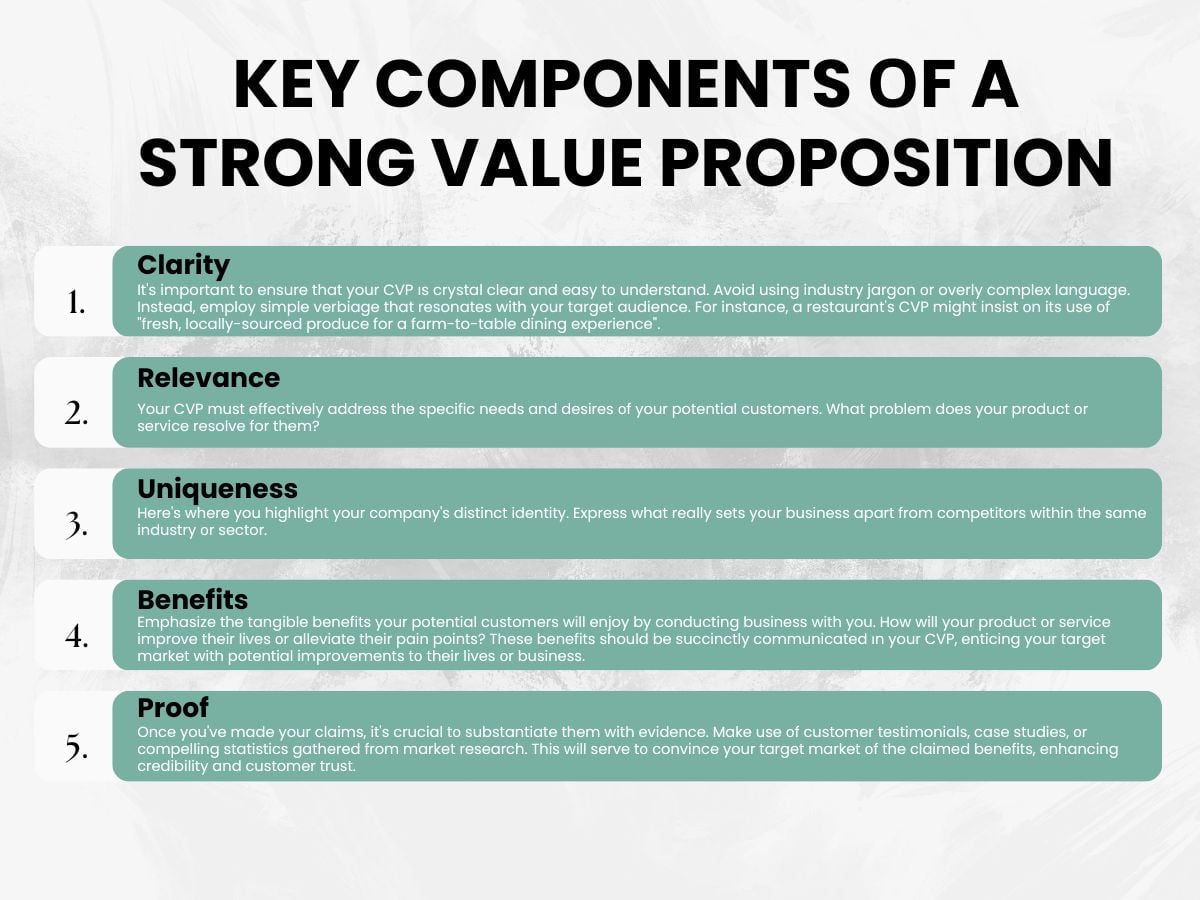
To summarise, a robust CVP will contain elements of clarity, relevance, uniqueness, clear benefits, and proof. These components work in harmony to effectively communicate the value your business brings to its customers.
By meticulously crafting your CVP, you position your business to stand out to your target market, attracting customers who see the unique value you provide. Remember, every component of your CVP should reflect the insights gleaned from your market research, revered mission statement, and a firm understanding of your target market's needs and wants.
Real-Life Examples
Let's look at some real-life examples of businesses that have successfully utilized their customer value proposition to achieve their sales goals:
1. Apple Inc.
Apple's CVP revolves around innovation, design, and simplicity. They promise products that are easy to use, aesthetically pleasing, and at the forefront of technology. This unique value proposition has allowed them to command premium prices and build a fiercely loyal customer base, resulting in consistently high sales.
2. Zappos
Zappos, the online shoe retailer, built its CVP on exceptional customer service and a vast selection of shoes. They offer free shipping and a 365-day return policy, eliminating the risk of online shoe shopping. This commitment to customer satisfaction has led to impressive sales growth and customer loyalty.
3. Dollar Shave Club
Dollar Shave Club disrupted the razor industry with its CVP of affordable, high-quality razors delivered to your door. Their humorous marketing campaigns further reinforce their value proposition. This unique approach helped them rapidly acquire customers and achieve their sales targets.
The Role of Differentiation
In a marketplace teeming with options, differentiation is the oxygen that fuels your success. Competitive analysis reveals the landscape, allowing you to pinpoint your niche and identify gaps your business can fill. But mere observation isn't enough; competitive advantage requires crafting a unique identity that shines through your CVP.
This is where your CVP truly becomes your secret weapon. By clearly articulating what sets you apart, you carve out a distinct section of the business landscape, a territory marked by your unique value. It's not just about features; it's about the emotional resonance you create.
Imagine a crowded coffee shop scene: every cup is brewed, every pastry is flaky, yet one cafe thrives. Why? Perhaps their beans are ethically sourced, their baristas are latte artists, or their atmosphere transports you to a Parisian corner cafe. This differentiation, woven into their CVP, becomes their competitive advantage.
So, whether your edge lies in exceptional quality, unmatched convenience, revolutionary technology, or a customer experience so personalized it feels like magic, make it the focal point of your CVP. Let it be the beacon that attracts your ideal customers, the anchor that secures your loyal base, and the engine that propels your business towards a thriving future. Remember, in a sea of sameness, differentiation is the lifeblood of success. Make it your mantra, weave it into your CVP, and watch your business blossom amidst the competition.
Developing a Sales Goals Template
Understanding the significance of a strong Customer Value Proposition (CVP) is a crucial step. However, the next challenge is integrating this understanding into your overarching business strategy. One of the best ways to do this is by aligning the CVP with your sales goals.
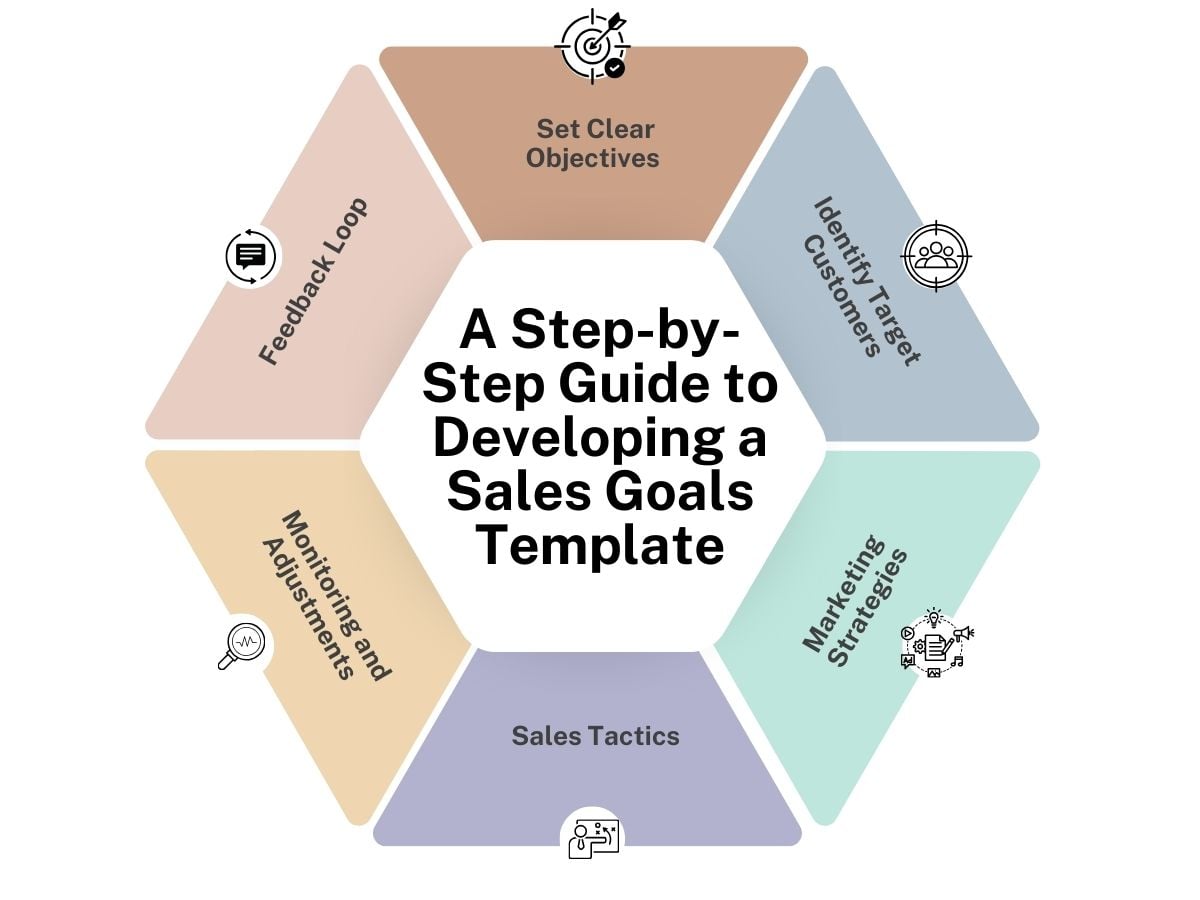
To help you conquer this task, here is a step-by-step guide to developing a sales goals template that fully incorporates your business' CVP:
☑️ Set Clear Objectives: Start by outlining your sales goals in the 'company description' section of your business plan. For your sales goals to be effective, they need to be clearly defined in measurable terms. This could be a revenue target or a specific number of units you aim to sell within a given period. Being specific about your sales targets not only gives your team a clear measure of success but also helps grab the interest of potential investors.
☑️ Identify Target Customers: It's essential to pinpoint who your ideal customers are and understand how your CVP appeals to their needs and desires. This step involves a comprehensive market analysis to identify the demographics, behaviors, and preferences of your perfect clients. Remember, your CVP should resonate well with your priority audience.
☑️ Marketing Strategies: In this part of the sales goals template, outline the various marketing strategies and channels that you'll utilize to reach your target audience. Be sure to integrate your CVP into all your marketing materials in a high-level way that communicates your company's unique values to desired customers.
☑️ Sales Tactics: Define the specific sales tactics that your team will use to convert leads into customers. These strategies could include a well-crafted follow-up process, presentation techniques, negotiation tactics, etc. Crucially, train your sales team to effectively communicate your CVP to potential buyers, imparting the unique value they stand to gain when choosing your business.
☑️ Monitoring and Adjustments: It's essential to establish a system that tracks your progress toward your sales goals. This could include weekly meetings, performance dashboards, or sales tracking software. Regularly review this data, and don't hesitate to make adjustments as needed to stay on course. Your sales strategies must remain fluid to adapt to evolving market conditions or customer preferences.
☑️ Feedback Loop: Last but certainly not least, create a mechanism that encourages customer feedback. Listen to your clients and use their input to continuously refine your CVP and your sales strategies. This continuous feedback loop ensures customer-centric business practices and uncovers new opportunities to provide even more exceptional value.
Creating a sales goals template is more than a planning exercise. It's a proven approach to aligning your team behind a shared vision, meeting your business objectives, and consistently delivering on your CVP. It's your roadmap to successfully scaling your business, making you an attractive choice for potential investors, and delighting your customers at every stage.
The Power of a Customer Value Proposition and Sales Goals Alignment
In the challenging world of entrepreneurship, crafting a strong customer value proposition is not just a nicety; it's a necessity. It's the compass that guides your business towards success, helping you attract and retain customers while achieving your sales goals. Real-life examples like Apple, Zappos, and Dollar Shave Club demonstrate the transformative power of a well-crafted CVP.
As you embark on the journey ofwriting a business plan, keep in mind the power of a well-aligned CVP and sales goals template for long-term success.
Your meticulously crafted business plan, with an excellent CVP at its core, should strictly adhere to the plan format that investors and potential partners expect. Remember, it's not merely about selling products or services; it's about creating value for your customers and delivering on your promises.
In the dynamic world of business, where competition is fierce, your customer value proposition is the anchor that keeps you steady. It's the promise you make to your customers and the reason they choose your business over others.
So, craft it carefully, nurture it, and let it be the driving force behind your entrepreneurial journey. Your sales goals template, coupled with a compelling CVP, will be your roadmap to success in the ever-evolving landscape of entrepreneurship, ensuring your business thrives both in the short and long term.
Discover the Right Tools for Your Startup
Take our 2-minute quiz to find tools tailored to your specific needs and goals.
Take the QuizTakes only 2 minutes


