
Operations Research for Startups: A Beginner's Guide
Decoding Business Success: Learn how operations research empowers startups to make data-driven decisions for growth. Explore applications and real-life examples.

Startups and entrepreneurs face numerous challenges when it comes to making effective business decisions. In a constantly evolving and competitive market, the ability to gather and analyze data is crucial for success. This is where operations research comes into play. In this article, we will explore the concept of operations research, its significance in the business world, and how it can enhance decision-making processes for startups and entrepreneurs.
What is Operations Research?
Operations research, often referred to as OR, is a discipline that utilizes mathematical and scientific approaches to solve complex business problems. It focuses on applying analytical methods and models to optimize processes and make data-driven decisions. Simply put, operations research provides a systematic framework for problem-solving within an organization.
Operations research (OR) is like a toolbox with lots of different tools to help businesses make better decisions and work more efficiently. It uses math, statistics, computers, and other tools to create models and plans that can help businesses use their resources better, make schedules, and make products.
One of the key characteristics of OR is its emphasis on data-driven decision-making. Rather than relying on intuition or guesswork, OR practitioners use data to analyze problems and identify the best course of action. This data can come from a variety of sources, including internal records, customer surveys, market research, and industry data. OR has been applied to a wide range of problems in industries such as:
Manufacturing: Optimizing production schedules, minimizing inventory costs, and improving product quality
Transportation: Planning routes, scheduling deliveries, and reducing fuel consumption
Finance: Managing investments, optimizing portfolios, and evaluating risk
Healthcare: Scheduling appointments, allocating resources, and improving patient care

Example:
A manufacturing company is facing a problem with production delays. The company's production process is complex and involves multiple steps, each of which is dependent on the completion of the previous step. The company wants to identify the bottlenecks in the production process and develop a plan to reduce delays.
An OR analyst could use a variety of techniques to analyze this problem, such as:
▪️ Developing a flowchart of the production process to identify bottlenecks
▪️ Using mathematical modeling to simulate different production scenarios
▪️ Collecting data on the time it takes to complete each step in the production process
▪️ Once the bottlenecks have been identified, the OR analyst can develop a plan to reduce delays. This plan might involve:
▪️ Rescheduling production steps to avoid bottlenecks
▪️ Investing in new equipment to improve efficiency
▪️ Cross-training employees to reduce downtime
By using OR techniques, the manufacturing company can improve its production efficiency and reduce delays, which will lead to lower costs and improved customer satisfaction.
Applying Operations Research in the Startup Ecosystem
🟨 Resource Allocation: Startups often face limited resources and need to allocate them effectively. Operations research can help identify the optimal allocation strategy, minimizing costs while maximizing productivity.
🟨 Supply Chain Management: Efficient supply chain management is a key factor in business success. Operations research techniques can optimize inventory levels, transportation routes, and delivery schedules, leading to cost savings and improved customer satisfaction.
🟨Pricing Strategies: Determining the right price for a product or service is critical for startups. Operations research models can analyze market demand, competition, and costs to develop optimal pricing strategies that maximize profitability.
🟨 Risk Analysis: Startups operate in uncertain environments and face numerous risks. Operations research can facilitate risk analysis, enabling entrepreneurs to assess various scenarios and develop contingency plans to mitigate potential losses.
Operations Research Techniques for Decision-Making:
🔷Optimization: Optimization models help identify the best possible solutions by considering constraints and objectives. Startups can use these models to optimize production schedules, resource allocation, and pricing decisions.
🔷Simulation: Simulation models allow entrepreneurs to test various business scenarios in a virtual environment. This helps in evaluating the potential outcomes of decisions and identifying potential bottlenecks or risks before implementing them in the real world.
🔷Forecasting: Accurate demand forecasting is crucial for startups. Operations research techniques can analyze historical data and market trends to generate reliable forecasts, aiding in inventory management and production planning.
Real-Life Examples
Several successful startups have harnessed the power of operations research to overcome challenges and achieve significant growth. For instance, Uber uses operations research to optimize driver routes and ensure efficient transportation services. Amazon relies on operations research techniques to optimize warehouse layouts and delivery schedules, enhancing the overall customer experience.
Benefits of Operations Research for Startups
Enhanced resource allocation, leading to cost savings: OR can help startups identify the most efficient way to use their limited resources, such as personnel, equipment, and finances. This can lead to significant cost savings and improved productivity.
Example: A manufacturing startup can use OR to optimize its production schedule, reducing downtime and maximizing machine utilization. This can lead to lower production costs and improved profitability.
Optimization of processes and workflows for improved efficiency: OR can identify bottlenecks and inefficiencies in a startup's processes and workflows. By streamlining these processes, startups can reduce waste, improve quality, and shorten turnaround times.
Example: A logistics startup can use OR to optimize its delivery routes, reducing fuel consumption and improving delivery times. This can lead to lower costs and increased customer satisfaction.
Data-driven decision-making and strategic planning: OR emphasizes the use of data to inform decisions, ensuring that startups base their choices on sound evidence rather than intuition or guesswork. This data-driven approach leads to more effective decision-making and better overall performance.
Example: A retail startup can use OR to analyze customer data and identify key customer segments. This information can be used to develop targeted marketing campaigns and improve customer acquisition and retention.
For instance, the startup could use OR to identify customers who are most likely to purchase a particular product and then target them with marketing campaigns for that product. Additionally, the startup could use OR to identify customers who are at risk of churning (i.e., stopping doing business with the company) and then take steps to retain those customers.
By using OR to analyze customer data, the retail startup can gain a deeper understanding of its target market and make more informed marketing decisions. This can lead to more effective marketing campaigns, increased customer acquisition and retention, and ultimately, improved profitability.
Increased agility and adaptability in a constantly changing market: OR can help startups adapt to changing market conditions and customer demands by providing insights into potential risks and opportunities. This adaptability can be crucial for survival in a competitive and dynamic business environment.
Example: A financial services startup can use OR to develop risk models that assess the potential for loan defaults or market fluctuations. This can help the startup make informed decisions about lending practices and investment strategies.
How to Integrate Operations Research into the Startup Journey
The daring journey of a startup is filled with potential roadblocks and challenges that require strategic decision-making and problem-solving. Enter Operations Research (OR), a discipline that offers scientific methods to answer complex business questions and make efficient decisions. Let's explore how you, as a startup founder, can integrate OR into your entrepreneurial journey.
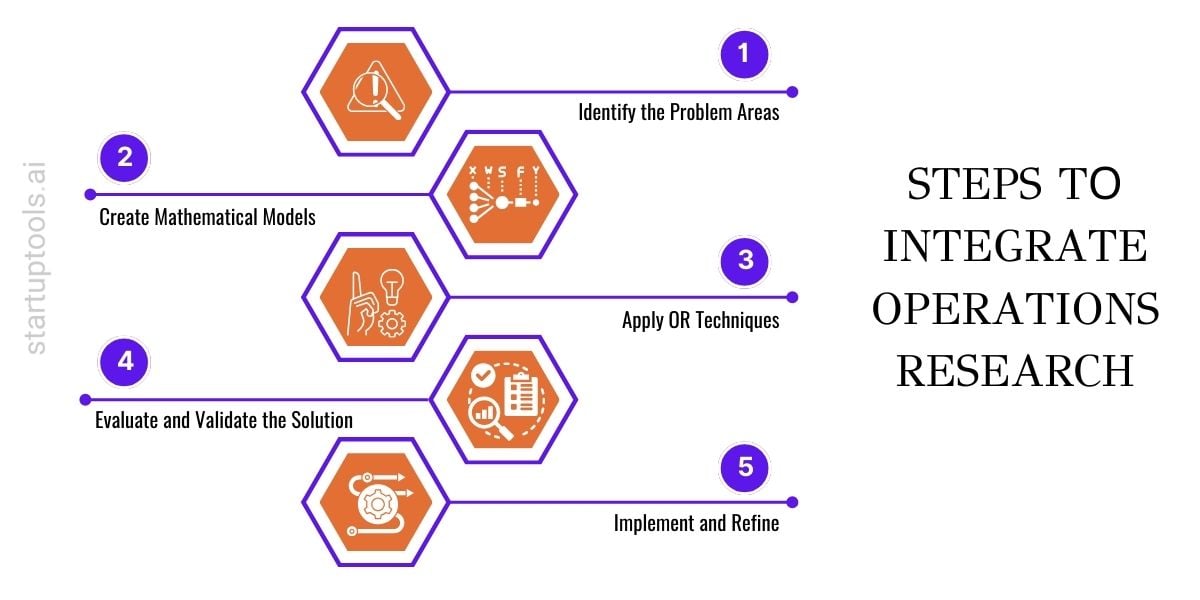
Steps to Integrate Operations Research
1. Identify the Problem Areas
Start your OR journey by identifying the key problem areas or process bottlenecks your startup is facing. These could range from inventory management issues to finding optimal pricing solutions. Having a clear understanding of problems will guide the application of OR.
Sample: Let's say your startup is grappling with order delivery times. Delays in delivery may lead to customer dissatisfaction and loss of business.
2. Create Mathematical Models
After identifying your problem areas, develop mathematical models for them. These models should represent your real-world problems and enable you to arrive at feasible and optimized solutions.
Sample: In the case of delivery times, you can create a mathematical model considering variables like distance, traffic, delivery load, and route options.
3. Apply OR Techniques
Use various OR techniques like regression analysis, decision analysis, linear programming, or network analysis to solve the problems. These techniques help you understand the relation between different elements impacting your challenge.
Sample: For delivery time optimization, you can use network analysis to calculate shortest paths or logistics optimization to distribute delivery load efficiently.
4. Evaluate and Validate the Solution
Evaluate the solution proposed by your OR model. It is important to validate this solution against your real-world operation before full implementation.
Sample: Pilot test your new delivery route or schedule and compare the effectiveness against your previous system.
5. Implement and Refine
Once you have validated the solution and found it effective, implement it across your startup operations. Keep refining your models as your business grows and evolves.
Sample: After witnessing successful results in your pilot test, integrate the new delivery system into your operations. Monitor and adjust it as required.
Advantages of Integrating Operations Research in Startups
Operations Research (OR) is an indispensable tool for startups in today's fast-paced and competitive business environment. By integrating OR in your entrepreneurial journey, you stand to gain remarkable advantages in optimizing processes, minimizing costs, enhancing services, and making evidence-backed decisions.
🔷 Optimized Processes
Startups often face multiple challenges in terms of streamlining operations and improving overall efficiency. With OR, you can analyze intricate processes and identify bottlenecks that hinder your startup's performance. The insights gained from implementing OR can lead to optimized workflows, resulting in substantial time and cost savings for your organization.
🔷 Reduced Costs
Efficient resource allocation is vital for startups operating on tight budgets. By employing OR techniques like linear programming and integer programming, startups can allocate resources optimally, thereby minimizing operational costs. OR also enables organizations to find cost-efficient strategies for managing inventory, production, and logistics processes.
🔷 Improved Services
Another advantage of leveraging OR is the ability to enhance the quality of services startups provide to their customers. By applying techniques such as queuing theory, startups can bolster their customer support and service systems. Further, startups can benefit from effective scheduling and resource allocation, leading to improved customer satisfaction, lower lead times, and higher customer retention.
🔷 Informed Decision-Making
One of the most critical aspects of entrepreneurship is making the right decisions under uncertain and dynamic conditions. With OR's predictive and analytical modeling capabilities, entrepreneurs can assess various decision alternatives and their potential outcomes systematically. This data-driven approach equips startups with the knowledge to make informed and strategic decisions that align with their long-term goals.
🔷 Enhanced Agility and Adaptability
Market conditions and business landscapes are continually changing, and it is essential for startups to be agile and adaptable. By regularly analyzing relevant data and updating models, OR helps startups identify emerging trends and respond to new opportunities or risks promptly. This increased adaptability and agility can provide startups with a crucial competitive edge in the market.
Embracing OR for Startup Success
In an unpredictable entrepreneurial world, it's crucial to be equipped with the most effective tools and strategies. Integrating Operations Research into your startup's DNA not only helps enhance efficiency, but also affords you the ability to navigate challenges and capitalize on opportunities. It's time to harness the potential of OR, embrace its data-driven approach, and elevate your startup to new heights of success.
Future Trends in Operations Research for Startups
The field of operations research (OR) is always changing, and startups can take advantage of new trends and developments in this area. Here are some of the key future trends in OR that can help startups improve their operations and decision-making processes:
Advanced analytics: Startups can use advanced analytics techniques to make sense of the large amounts of data they generate. Predictive and prescriptive analytics can be used to find patterns, forecast demand, allocate resources better, and improve efficiency.
Artificial intelligence (AI): AI is changing many industries, and startups can use it to automate tasks, make smart decisions, and create self-learning systems. AI-powered chatbots, virtual assistants, and recommendation engines can improve customer experience while reducing the need for human intervention.
Machine learning (ML): Startups can use ML algorithms to analyze historical data, find trends, and make accurate predictions. ML can find hidden patterns, detect anomalies, and make personalized recommendations. For example, e-commerce startups can use ML to improve product recommendations and targeted advertising campaigns.
Prescriptive analytics: Prescriptive analytics uses predictive modeling and optimization techniques to provide actionable insights. Startups can use prescriptive analytics to improve complex decision-making processes that involve many factors and constraints, such as supply chain optimization.
By taking advantage of these future trends in OR, startups can improve their operations, make better decisions, and grow their businesses.
Examples of OR Applications in New Businesses and Startups
◽ A delivery startup: Use OR to optimize routes, minimize delivery times, and reduce fuel consumption.
◽ An e-commerce company: Utilize OR to optimize inventory levels, predict demand, and personalize product recommendations.
◽ A manufacturing startup: Employ OR to schedule production, allocate resources, and identify bottlenecks in the production process.
◽ A financial services startup: Use OR to develop risk models that assess the potential for loan defaults or market fluctuations.
How Operations Research Amplifies Success
Here is a glimpse into how OR can help project your startup into the limelight:
🔷 Know Your Customers Intimately
With OR, you can delve into the preferences of your customers, understand their buying patterns, and gauge their shopping behavior. This customer knowledge aids in molding your strategies to meet their needs even better.
🔷 Targeted Marketing: Aim Right to Win the Game
Armed with OR, you can target your marketing efforts accurately at the right audience. By doing so, not only do you save precious funds, but your marketing message becomes much more impactful and effective.
🔷 Quality Customer Retention: The Key to Lasting Success
OR throws light on the most effective ways to ensure your customers keep coming back to you. By identifying these tactics, customer happiness becomes a mainstay for your business, leading to healthy customer retention.
🔷Swift Adaptation to Change: Ace the Trend Wave
With OR, brace yourself to swiftly adapt to market changes - be it unexpected price fluctuations or the entry of new competitors. Agility is a business's best friend, and OR ensures you stay nimble and ready to pivot.

As a retail startup in the highly competitive, ever-evolving marketplace of today, consider Operations Research your magic wand. By embracing OR, you'll gain the knowledge and insights you need to make informed decisions, outsmart your competition, and establish your lemonade stand as the undisputed leader in town. So, grab your OR toolkit and get ready to transform your dreams into reality!
So, embrace Operations Research. Let it unlock your startup's potential and illuminate your path to success!
Discover the Right Tools for Your Startup
Take our 2-minute quiz to find tools tailored to your specific needs and goals.
Take the QuizTakes only 2 minutes


