
Developing a Business Operations Plan: Blueprint for Success
Developing a business operations plan is crucial for success. It helps streamline operations, aligns goals, manages resources, and mitigates risks.

When embarking on a new business venture, a well-crafted business operations plan is your compass to navigate the complex world of entrepreneurship. In this guide, we'll explain what a "business operations plan" is and why it's important. We'll also give you examples of how real businesses use them to succeed.
Understanding the Business Operations Plan
Before we dive into the specifics, let's start with a clear understanding of what a business operations plan entails. A business operation plan is like a roadmap that guides you on how to run your business smoothly and efficiently. It acts as a roadmap, guiding your day-to-day operations, and plays a pivotal role in achieving your business objectives.

The Significance of a Business Operations Plan
◼️ Efficiency and Effectiveness: Efficiency refers to the ability to complete tasks with the least amount of resources. In business, this means using resources such as time, money, and labor to their best advantage. When businesses are efficient, they can produce more goods or services with the same amount of resources, or they can produce the same amount of goods or services with fewer resources. This can lead to lower costs and higher profits.
◼️ Empowerment: Employee Power: A well-written business operations plan is like a team handbook that explains who does what. This way, everyone knows their job and how it helps the company reach its goals.
Imagine you're playing a game of basketball. Each player has a specific role, like point guard, shooting guard, or power forward. If everyone knows their role and works together as a team, the team is more likely to win. The same is true for a business: when everyone knows what they're supposed to do and how their role fits into the bigger picture, the company can succeed.
A well-structured business operations plan is like a playbook for your basketball team. It outlines everyone's roles and responsibilities, so everyone knows what they're supposed to do. It also explains how each player's role contributes to the overall goal of winning the game.
When each team member knows what they should do and how it contributes to the team's goals, they will feel more excited and committed to the game. This can result in better coordination, higher scores, and a more pleasant team atmosphere.
◼️ Adaptability: A business operations plan is like a map that guides you on your business journey. But just like a map needs to be updated to show new roads and buildings, your business plan needs to be updated as your business grows and changes.
Imagine you're playing a game of Minecraft. You might start with a plan to build a house. But as you play, you might decide to add a garden, a pool, or even a castle. Your plan needs to be flexible so you can make changes as you go.
A dynamic business operations plan is like having a flexible map for your business. It allows you to anticipate changes in the market, industry trends, or customer preferences. This way, you can make adjustments to your plan and stay on track to reach your goals.
By incorporating scenario planning and risk assessment exercises, you can identify potential challenges and develop plans for dealing with them. This way, you'll be ready to handle anything that comes your way.
A proactive approach to adaptation means being prepared to change your plans as needed. This flexibility will help your business stay ahead of the curve and achieve long-term success.
◼️ Growth Facilitation: A comprehensive business operations plan outlines specific strategies for expansion, product development, and market penetration, providing a clear roadmap for growth.
A comprehensive business operations plan is like a map that shows you how to grow your business. It has specific strategies for expanding your business, making new products, and getting more customers. The plan also has measurable growth targets and actionable steps. This helps you make decisions and use your resources wisely to achieve your long-term growth goals.
◼️ Sustainability Enhancement: A well-defined business operations plan promotes sustainability by integrating environmentally friendly practices and resource conservation initiatives into the company's operations. This means using less energy, water, and other resources, and minimizing waste.
The plan also encourages the use of renewable energy sources and sustainable materials. This helps businesses reduce their environmental impact and save money in the long run.
◼️ Stakeholder Satisfaction: An operations plan for a business is like a contract that ensures that everyone is satisfied. This includes the investors, employees, customers, and partners of the business.
The plan makes sure that the decisions and actions of the business are in harmony with the interests of all of these people. This means that the business is making decisions that are good for everyone involved, and not just one group of people.
This can help the business build trust and relationships with its stakeholders, which can lead to long-term success.
Business Goals and Objectives
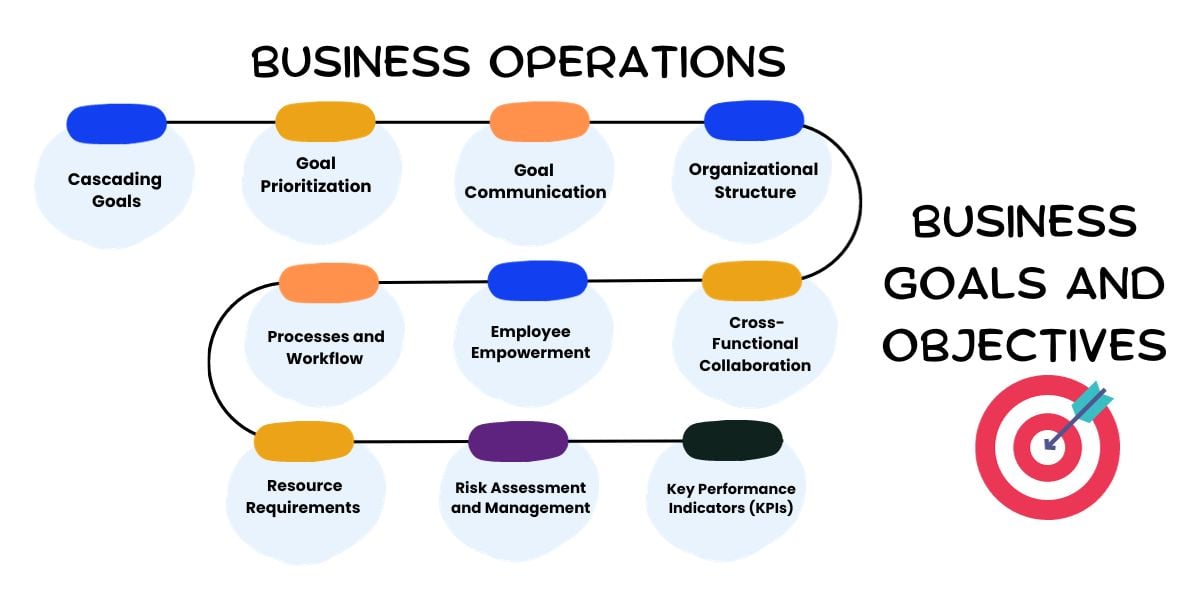
🔶 Cascading Goals: By breaking down long-term goals into smaller, more manageable short-term goals, cascading goals create a clear path for achieving the company's vision.
For example, a company might have a long-term goal of increasing its market share by 10%. This goal can be broken down into smaller, more manageable short-term goals, such as:
• Increase sales by 5% in the next quarter.
• Reduce customer churn by 2% in the next six months.
• Launch a new product line that is expected to generate $1 million in revenue in the next year.
🔶 Goal Prioritization: Prioritize goals based on their importance and urgency. This ensures that the company focuses its resources on the most critical objectives first. This approach helps to maximize productivity, minimize wasted effort, and increase the likelihood of achieving strategic targets.
For instance, a company might have a long-term goal of expanding into a new market. While this goal is significant, it may not be the most urgent at the moment. A more urgent goal might be to improve customer satisfaction, as this could directly impact the company's bottom line. By prioritizing the more urgent goal, the company can address a pressing issue while still keeping the long-term goal in mind.
🔶 Goal Communication: Communicate goals clearly and regularly to all employees. This alignment helps everyone understand the company's direction and how their work contributes to achieving the goals.
🔶 Organizational Structure: Adaptable Structure: Design an organizational structure that can adapt to changing market conditions and business needs. This flexibility allows the company to respond effectively to new challenges and opportunities.
🔶 Cross-Functional Collaboration: Encourage cross-functional collaboration by breaking down silos between departments. This integrated approach fosters innovation and efficiency.
🔶 Employee Empowerment: Empower employees to make decisions within their scope of responsibility. This approach fosters a sense of ownership and engagement, leading to increased productivity and innovation.
🔶 Processes and Workflow
• Process Documentation: Document all core processes in a clear and concise manner. This documentation provides a reference point for employees and ensures consistency in operations.
• Process Optimization: Regularly review and optimize processes to identify and eliminate inefficiencies. This continuous improvement enhances productivity and cost savings.
• Technology Integration: Integrate technology to automate tasks, streamline workflows, and improve communication. This strategic use of technology enhances efficiency and collaboration.
🔶 Resource Requirements
• Resource Forecasting: Forecast resource needs based on business growth projections and operational plans. This proactive approach ensures that the company has the necessary resources to achieve its goals.
• Resource Optimization: Optimize resource allocation to ensure that resources are used efficiently and effectively. This optimization eliminates waste and maximizes the value of the company's resources.
• Resource Management Tools: Implement resource management tools to track resource utilization, identify potential shortages, and make informed allocation decisions. These tools provide valuable insights for optimizing resource usage.
🔶 Risk Assessment and Management
• Proactive Risk Identification: Proactively identify potential risks that could impact the company's operations or goals. This early detection allows for timely mitigation strategies.
• Likelihood and Impact Assessment: Assess the likelihood and potential impact of each identified risk. This prioritization helps the company focus on the most significant risks first.
• Contingency Plans: Develop contingency plans for each identified risk. These plans provide a roadmap for responding to and minimizing the impact of potential disruptions.
🔶 Key Performance Indicators (KPIs)
• KPI Selection: Select KPIs that are relevant to the company's goals and objectives. These metrics should measure the effectiveness of operations and progress towards achieving goals.
• KPI Monitoring: Regularly monitor KPIs to track performance and identify areas for improvement. This data-driven approach allows for timely adjustments to operations and strategies.
• KPI Transparency: Communicate KPI results to employees and stakeholders. This transparency fosters accountability and engagement, driving continuous improvement.
Embark on a Path to Success
Imagine you're about to go on a big adventure, like hiking to the top of a mountain. You wouldn't just start walking without a map, right? A business operations plan is like a map for your business. It shows you where you're going, how you're going to get there, and what you might need along the way.
A well-defined business operations plan is like a special guide that helps you make good decisions and stay on track. It shows you how to deal with challenges, like when the weather changes or you run into unexpected obstacles. It also helps you see opportunities, like finding a hidden waterfall or discovering new trails.
So, if you want to be a successful entrepreneur, make sure you have a good business operations plan. It will be your guiding light, helping you navigate the ever-changing landscape of business and transform uncertainty into clarity.
With a comprehensive business operations plan, you'll empower your team, unleash their potential, and foster a culture of innovation. Embrace technology, integrate it into your plan, and watch your business thrive. Remember, customer-centricity is the cornerstone of success. Align your operations with their needs, prioritize satisfaction, and you'll reap the rewards.
Challenges are inevitable, but they are also stepping stones to growth. Embrace them, adapt your plan, and emerge stronger. Perseverance is your guiding light. Let it illuminate your path, fuel your determination, and propel you towards your entrepreneurial dreams.
So, embark on your journey with confidence, armed with the power of a well-structured business operations plan. It's your blueprint for success, your roadmap to a flourishing business.
Discover the Right Tools for Your Startup
Take our 2-minute quiz to find tools tailored to your specific needs and goals.
Take the QuizTakes only 2 minutes


