
Developing an Effective Marketing Plan for New Products
Leverage your product's success with a robust marketing plan. This guide highlights key steps like targeting, branding, adaptability, and efficient resource usage.

Launching a new product is an exciting venture for entrepreneurs and individuals starting a new business. But without a well-crafted marketing plan, even the most innovative product may struggle to find its target audience and achieve the desired success.
In this comprehensive guide, we will explore the strategies and practical tips necessary for developing a successful marketing plan for a new product. By following this step-by-step framework, you can ensure that your marketing efforts are relevant, engaging, and effective.
Emphasizing the Role of a Marketing Plan
In the intensely competitive landscape of global business, a thoughtful and comprehensive strategy - a cornerstone of an effective business planning format- is not just an expectation but a necessity. More than a guide, a marketing plan serves as an essential toolkit. It is this strategic device that empowers businesses to captivate their target audience effectively, standing out amidst the competition.
A marketing plan's elegance lies in its capacity to provide clarity and illuminate the path towards the business's goals. It assists in identifying target customers, pinpointing their needs, preferences, and aspirations. In addition, market trends, often volatile and fickle, become decipherable through the lens of a well-crafted marketing plan, enabling businesses to ride the wave of market dynamics rather than getting swept away by them.
Through comprehensive competitor analysis, the marketing plan aids in discerning the relative strengths and weaknesses of market players. This crucial insight paves the way for drafting informed, strategically sound business moves.
Furthermore, the marketing plan steers businesses in creating potent messaging and formidable branding strategies, the war cries that differentiate a brand in the crowded marketplace. It can even assist in protecting your intellectual property, ensuring that your unique ideas and products stay just that - unique.
Ultimately, a compelling marketing plan establishes you at the helm of your product's destiny. It instills a level of control, guiding the effective channeling of resources, safeguarding against wastage, and optimizing efficiency. In essence, it acts as the rudder, steering the business ship through the swirling waters of market trends, competition, and consumer behavior toward the beacon of success.
A sound marketing plan interlaces the threads of precise goal setting, strategic market research, meticulous competitor analysis, targeted audience identification, and resonant messaging into a cohesive whole. Your marketing plan thus becomes more than just a component of your business model. It metamorphoses into an astutely designed contrivance for growth and success, reflecting your aspiration to not just navigate, but conquer the challenging business environment.
The Blueprint: Creating a Marketing Plan Step-by-Step
- Begin with Clearly Defined Goals
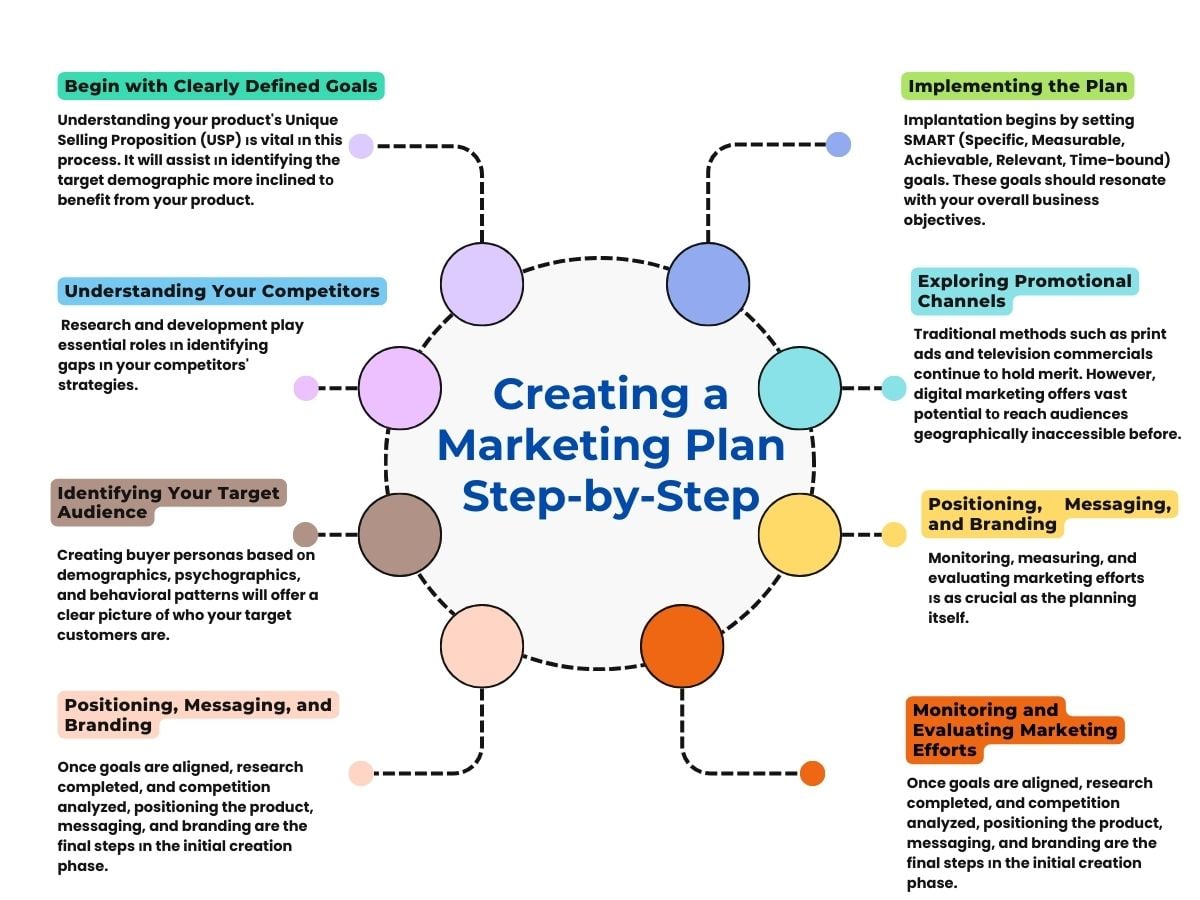
Embarking on a journey to create a marketing plan begins with identifying clear objectives and goals. Understanding your product's Unique Selling Proposition (USP) is vital in this process. It will assist in identifying the target demographic more inclined to benefit from your product. With this foundation, you can map out the path your product needs to follow to realize its full potential.
- The Power of Market Research
Following the initial setup, you'll need in-depth market research. Utilize both primary and secondary data sources to gain insights into consumer behaviors, industry trends, and customer preferences. This information is vital as it allows you to glean what potential customers want and how your product can meet these needs. It furthermore gives you a clear picture of where your product sits in the market and potential opportunities for differentiation.
- Understanding Your Competitors
In any marketing plan, understanding your competition is a crucial step. Here, research and development play essential roles in identifying gaps in your competitors' strategies. Discovering these gaps can be a potential goldmine, offering opportunities for differentiation and segmentation. Clearly define what sets you apart, and embrace it in your messaging and branding strategy.
- Identifying Your Target Audience
Creating buyer personas based on demographics, psychographics, and behavioral patterns will offer a clear picture of who your target customers are. Understanding these buyer personas forms the basis for building a strong relationship with your customers and meeting their specific needs, leading to a more personalized marketing plan.
- Positioning, Messaging, and Branding
Once goals are aligned, research completed, and competition analyzed, positioning the product, messaging, and branding are the final steps in the initial creation phase. The aim should be to develop compelling messaging and a strong brand identity that shifts your product from being 'one among many' to 'the one.'
- Implementing the Plan
Implantation begins by setting SMART (Specific, Measurable, Achievable, Relevant, Time-bound) goals. These goals should resonate with your overall business objectives. Next, ensure you have a realistic budget that effectively allocates resources to both traditional and digital marketing channels.
- Exploring Promotional Channels
The ever-evolving digital landscape has redefined promotion, giving businesses access to a wide range of channels. Traditional methods such as print ads and television commercials continue to hold merit. However, digital marketing offers vast potential to reach audiences geographically inaccessible before. A well-rounded marketing plan explores all possibilities—from SEO and PPC advertising to social media marketing, email campaigns, and influencer collaborations.
- Monitoring and Evaluating Marketing Efforts
Monitoring, measuring, and evaluating marketing efforts is as crucial as the planning itself. Use analytics tools to measure web traffic, engagement, conversion rates, and monitor social media metrics to observe brand sentiment, reach, and engagement. Regularly review performance to identify what's working and what needs adjustment.
Avoid Common Mistakes
Creating a new product's marketing plan can pose potential challenges and pitfalls. Avoiding common errors can elevate your marketing plan from good to great. Here are some guidelines, alongside additional insight, to help you navigate the process effectively:
- Avoid Widespread Targeting:
Having a specific, well-defined target audience is more effective than trying to appeal to everyone. Cast a net that is too wide, and you'll dilute your message and waste resources.
- Bridge Clear, Customer-Centric Messaging:
Ensure that your messaging resonates with your target customers and communicates the value of your product clearly. Avoid technical jargon and keep the emphasis on customer benefits.
- Leverage the Power of Branding:
A strong brand identity can significantly increase customer loyalty and recognition. Invest time in creating a unique, memorable brand that reflects the values and vision of your product.
- Stay Flexible and Adaptable:
Market dynamics are ever-changing, and rigid plans are prone to failure. Keep a flexible approach, be ready to adapt to new trends and adjust your plan based on performance data and customer feedback.
Bear in mind that producing an effective marketing plan for a new product is a pivotal skill for any entrepreneur poised to make an impact in the business arena. With the insights, techniques, and pragmatic advice we've provided, you're now equipped to build a lucrative marketing plan tailored to your specific product and target customers.
Remember to frequently monitor the progress of your strategy and adjust as required; adapting to change is an integral aspect of marketing success. Ensure the integration of these aspects with your existing business planning format, from intellectual property to consistent branding, to create a cohesive and robust strategy that caters effectively to your market demands.
Elucidating the Key Elements of a Good Marketing Plan
When you have a well-structured marketing plan in place, you take control of your product's destiny, channeling resources intelligently and ensuring optimal efficiency.
The following elements are vital to a successful marketing plan:
✅ Clearly Defined Goals:
Begin the process by setting concrete objectives and goals that align with your product's Unique Selling Proposition.
✓ Start with your business strategy and your product's unique selling points. Translate these into specific, measurable objectives. For example, increasing market share by X% in X months, or acquiring X new customers in a certain period.
✅ In-Depth Market Research:
Carry out comprehensive market research, analyzing primary and secondary data sources to gain insights into consumer behaviors, industry trends, and customer preferences.
✓ Use surveys, interviews, and focus groups for primary data. For secondary data, explore market reports, research papers, and public datasets. Look for patterns and trends that help you understand your market.
✅ Competitor Analysis:
Understand your competition and identify gaps in their strategies, which can be golden opportunities for differentiation and segmentation.
✓ Look at your competitors' product offerings, marketing strategies, and customer feedback. Identify their strengths and weaknesses, and find areas where your product can fill gaps.
✅ Target Audience Identification:
Develop buyer personas based on demographics, psychographics, and behavioral patterns to gain a clear picture of your target customers.
✓ Define your ideal customer using specific demographic data (age, location, etc.), psychographic data (values, interests, etc.), and behavioral data (buying habits, brand interactions, etc.). Craft multiple personas to cover different segments of your target market.
✅ Product Positioning, Messaging, and Branding:
Develop compelling messaging and a strong brand identity that sets your product apart from the competition, positioning it as 'the one.'
✓ Consider what makes your product unique, who your product benefits, and why your product matters. Formulate this into a clear, concise message that resonates with your target audience.
✅ Implementation with SMART Goals:
Set Specific, Measurable, Achievable, Relevant, and Time-bound goals that resonate with your overall business objectives. Ensure you have a realistic budget to allocate resources across traditional and digital marketing channels.
✓ Break your long-term goals down into actionable steps. Apply the SMART framework to each goal, ensuring they're realistic and time-bound. Allocate your marketing budget across different strategies and channels based on efficacy, cost, and target audience.
✅ Exploration of Promotional Channels:
A successful marketing plan explores all promotional channels available, including traditional methods (print, TV ads) as well as digital marketing strategies (SEO, PPC, social media marketing, email campaigns, influencer collaborations).
✓ Identify which channels your target audience frequents. Test multiple channels to see which yield the best engagement and return on investment. Allocate your resources accordingly.
✅ Monitoring and Evaluating Marketing Efforts:
Regularly measure and review the performance of your marketing strategies, using analytics tools and social media metrics to identify the most effective initiatives and make necessary adjustments.
✓ Before launching any campaign, determine how you'll track its success (KPIs). Use tools like Google Analytics, social media analytics, and campaign tracking software to assess performance. Periodically review and adjust strategies based on these findings.
Mastering the Art of Marketing Planning
Creating a marketing plan for a new product bears potential challenges and mistakes. Shying away from widespread targeting, ensuring clear, customer-centric messaging, recognizing the power of branding, and being flexible to adjust your plan in tune with changing market dynamics can make the difference between a good and great plan.
As we draw this comprehensive guide to a close, remember that crafting an effective marketing plan for a new product is an essential skill for any entrepreneur wanting to make a splash on the business scene. With these insights, strategies, and practical tips, you are now equipped to construct a successful marketing plan tailored to your specific product and target market. Always remember to keep tabs on your strategy's progress and adapt when necessary.
If you're reading this as a budding entrepreneur excited about your new venture, embrace the process of marketing planning with open arms. Yes, it might feel overwhelming, especially if this is your first time. But trust the process. Understand that every step you take now draws you closer to the success story you dreamt of and worked tirelessly towards.
Knowing your product, understanding your customers, choosing the right promotional channels, and measuring your success are critical factors that condition your venture's future. Equip yourself with a robust marketing plan, and you align yourself with the giants in your industry. Don't just exist in the marketplace; be a thought leader, a trendsetter, a success story in the making. Your journey begins now.
If you're reading this as a budding entrepreneur excited about your new venture, embrace the process of marketing planning with open arms. Yes, it might feel overwhelming, especially if this is your first time. But trust the process. Understand that every step you take now draws you closer to the success story you dreamt of and worked tirelessly towards.
Knowing your product, understanding your customers, choosing the right promotional channels, and measuring your success are critical factors that condition your venture's future. Equip yourself with a robust marketing plan, and you align yourself with the giants in your industry. Don't just exist in the marketplace; be a thought leader, a trendsetter, a success story in the making. Your journey begins now.
Discover the Right Tools for Your Startup
Take our 2-minute quiz to find tools tailored to your specific needs and goals.
Take the QuizTakes only 2 minutes


