
Sales Goals Guide & Templates for Business Success
Learn how to set effective sales goals with proven templates and strategies to boost performance, align teams, and drive long-term business success.

Setting and achieving sales goals is at the heart of every successful business. Whether you're an experienced entrepreneur or just starting a new business venture, having a clear plan in the form of a "Sales Goals Template" can be a game-changer.
In this comprehensive guide, we'll explore the importance of sales goals, how to create an effective sales goals template, and practical tips for success.
Why Are Sales Goals Important?
Sales goals serve as the roadmap for your business. They provide direction, motivation, and a clear vision for what you want to achieve. Here are some key reasons why sales goals are crucial for entrepreneurs:

Imagine driving across a vast, unfamiliar landscape. Without a map or destination in mind, you'd likely wander aimlessly, wasting time and fuel. Sales goals are like a GPS for your business, steering you towards your desired outcome. They provide direction, motivation, and a clear vision for what you want to achieve, serving as the cornerstone of your marketing strategy.
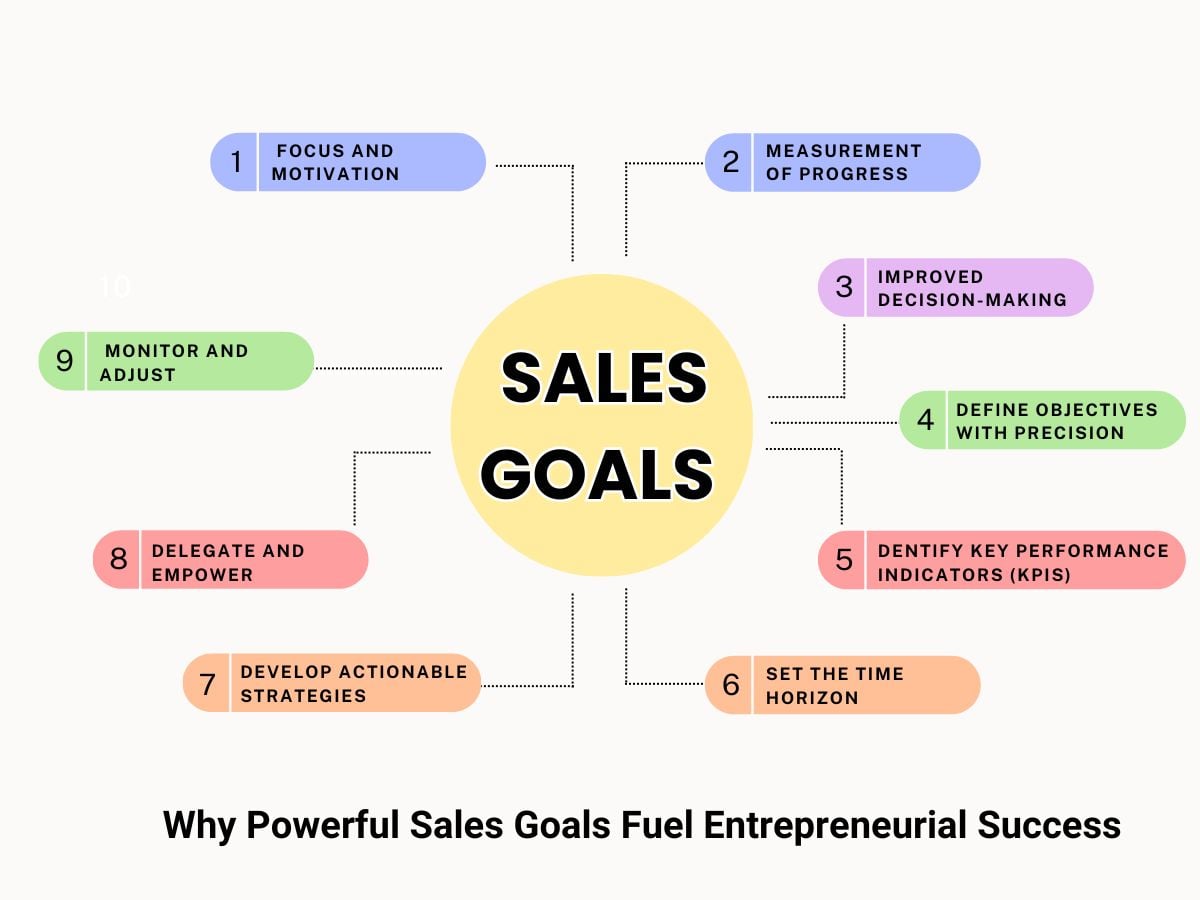
Why Powerful Sales Goals Fuel Entrepreneurial Success
✅ Focus and Motivation:
Example: Instead of feeling overwhelmed by a vague objective of "increased sales," set a concrete goal of "acquiring 20 new business clients each quarter." This tangible target gives your team a bullseye to aim for, fostering focused action and unwavering motivation.
Example: Celebrate milestone achievements along the way. Reaching 10 new clients in the first two months might earn a team lunch or an afternoon outing, reinforcing the importance of staying on track and driving towards the overall goal.
✅ Measurement of Progress:
Tracking progress is the engine that drives continuous improvement in your business planning format. Just like a navigator relies on a compass, measuring sales goals keeps you on track and helps you adapt to changing market winds.
Two key elements power effective measurement:
Data Collection: Implement tools like a CRM system or a simple spreadsheet to capture vital metrics like lead generation, conversion rates, and average deal size. These numbers are your fuel, providing vital insights into what's working and what needs tweaking.
Data Analysis: Don't just collect data; dissect it! Analyze your campaigns and messaging. Is your social media content resonating with your target audience? Does your website have a clear call to action that guides prospects towards conversion? Use data-driven insights to bridge the gap between lead generation and sales, refining your approach for improved performance.
Imagine the scenario: your lead generation activities aren't yielding enough qualified prospects. Data analysis can pinpoint the culprit, whether it's social media content that's missing the mark or a website lacking a clear call to action. By understanding where the gap lies, you can use data-driven insights to refine your strategy and bridge the gap, propelling your sales goals forward.
Remember, effective measurement isn't just about hitting numbers; it's about using data to identify and capitalize on opportunities for growth. Embrace data as your compass, and watch your business planning format steer you towards a thriving future.
Example: Track your progress toward your goal by implementing a CRM system or a simple spreadsheet. Monitor key metrics like lead generation, conversion rates, and average deal size. This data allows you to see what's working, identify areas for improvement, and adapt your marketing strategy accordingly.
Example: If your lead generation activities aren't yielding enough qualified prospects, analyze your campaigns and messaging. Maybe your social media content isn't resonating with your target audience, or your website lacks a clear call to action. Use data-driven insights to refine your approach and bridge the gap between lead generation and conversion.
✅ Improved Decision-Making:
Example: With defined sales goals, you can prioritize tasks and allocate resources effectively. Knowing you need to acquire 20 new clients might lead you to prioritize attending industry trade shows or investing in targeted online advertising campaigns.
Example: Avoid resource drain by focusing on activities that directly contribute to your sales objectives. Instead of attending every networking event, choose those that cater specifically to your ideal client demographic.
Remember, effective sales goals are SMART: Specific, Measurable, Achievable, Relevant, and Time-bound. When you set SMART goals, you empower your team, track your progress, and make informed decisions that propel your business towards success. So, grab your map, chart your course, and let your sales goals guide you to a thriving business landscape.
We've established that sales goals are your business's roadmap to success, but how do you build that map? Let's dive into crafting a supercharged sales goals template that ignites your team and propels your business forward.
✅ Chart Your Course: Define Objectives with Precision
First, grab your metaphorical sextant and pinpoint your desired sales destination. Do you seek a 20% revenue surge in the next quarter? Aiming to dominate a new market niche? Specificity is key. Avoid vague wishes like "increased sales"; instead, chart a course with SMART goals: Specific, Measurable, Achievable, Relevant, and Time-bound.
Example: "Secure intellectual property rights for our revolutionary widget by Q3, enabling us to capture a 30% market share within two years." This goal is laser-focused, quantifiable, and sets a clear timeline for achieving market dominance.
✅ Plot Your Waypoints: Identify Key Performance Indicators (KPIs)
Think of KPIs as the buoys guiding your sales ship. They track your progress towards your objectives. Revenue, conversion rates, and customer acquisition costs are common metrics, but don't forget innovation-centric KPIs like:
R&D investment as a percentage of revenue: This measures your commitment to developing cutting-edge intellectual property, a crucial advantage in today's competitive landscape.
Patent applications and approvals: Track your progress in securing legal protection for your unique selling propositions, safeguarding your market edge.
New product launches: Monitor the success of your R&D efforts by measuring the impact of new offerings on sales and market share.
✅ Set the Time Horizon: Choose Your Sprint Length
Short-term goals (monthly or quarterly): These are your sprints, perfect for igniting focus and achieving quick wins. A monthly goal of securing 10 new clients in a niche market keeps your team's adrenaline pumping and provides a tangible target to strive for.
Long-term goals (annual or multi-year): These are your marathons, building a strategic roadmap for the future. Aiming to break into a new industry within three years necessitates long-term planning, steady progress, and the sustained commitment to innovation that fuels enduring success.
Remember, choosing the right sprint length is key. Short-term goals provide immediate motivation and keep your team engaged, while long-term goals offer direction and inspire ambitious vision.
✅ Fuel Your Engines: Develop Actionable Strategies
Now, it's time to fill your tank with high-octane strategies. This is where your marketing muscle comes into play. Craft targeted campaigns, launch strategic sales promotions, and implement lead generation tactics like SEO optimization or content marketing. Don't forget the R&D engine:
Invest in research and development: Allocate resources to creating the next game-changing product or service. Remember, your intellectual property is your rocket fuel.
Foster a culture of innovation: Encourage brainstorming, experimentation, and calculated risk-taking within your team. Nurturing a creative environment breeds fresh ideas that propel your sales goals forward.
✅ Assign Crew Roles: Delegate and Empower
Just like a high-performing spacecraft crew, your sales team requires a clear division of roles to achieve lift-off and reach your ambitious goals. Forget about a chaotic scramble in the cockpit! Delegate responsibilities clearly, ensuring each team member understands their vital part in achieving your sales objectives.
Imagine this: your marketing team takes ownership of crafting targeted social media campaigns that generate high-quality leads, while your sales team focuses on converting those leads into loyal customers. By assigning clearly defined roles, you create a sense of ownership, foster accountability, and prevent the confusion that can stall your sales engine.
Remember, empowering your team with the right responsibilities is like handing them the controls to their individual rockets. Each member, equipped with the necessary skills and resources, contributes to the collective mission of propelling your business towards stratospheric success. So, chart your course, assign roles strategically, and watch your empowered team blast your sales goals into the stars!
✅ Monitor and Adjust: Navigate with Agility
Remember, even the best maps need occasional updates. Regularly monitor your progress, analyze data, and identify areas for improvement. Don't be afraid to adjust your course if needed. Flexibility is key to navigating the ever-changing sales landscape.
By incorporating these elements, you'll craft a dynamic sales goals template that serves as your guiding star, propelling your business towards stratospheric success. So, chart your course, fuel your engines, and prepare for lift-off!
Remember, your intellectual property is the rocket fuel that propels your sales goals. Invest in R&D, cultivate innovation, and watch your business soar to new heights!
Key elements for a Winning Sales Goals Template: Beyond Basics
Staying flexible and celebrating milestones are crucial, but to truly master your sales goals template, consider these additional key elements:

1. Foster Collaboration: Don't silo your template. Involve your team in crafting and monitoring the plan, leveraging their diverse perspectives and fostering ownership. Remember, a united crew navigates the sales galaxy more effectively.
2. Data-Driven Decisions: Don't fly blind. Utilize data analytics to identify sales trends, customer preferences, and campaign performance. Let data be your North Star, guiding your strategies and optimizing your goals for maximum impact.
3. Embrace Innovation: Don't get stuck in a rut. Encourage your team to explore new markets, test unconventional tactics, and develop bold sales initiatives. Remember, intellectual property is your rocket fuel – invest in R&D to constantly refine your unique selling propositions and stay ahead of the curve.
4. Continuously Improve: Don't settle for complacency. Regularly review your template, analyze results, and identify areas for improvement. Embrace a growth mindset, constantly tweaking and perfecting your blueprint for success.
5. Reward and Recognize: Don't let achievements go unnoticed. Acknowledge and celebrate individual and team contributions that propel your sales goals forward. Recognition fuels motivation and reinforces the vital role everyone plays in the mission.
By incorporating these key elements, your sales goals template transcends a mere document and transforms into a dynamic ecosystem of collaboration, innovation, and continuous improvement. It becomes the living instrument that guides your team towards a triumphant landing on the peak of sales success. So, chart your course, empower your crew, and embrace the ever-evolving journey towards achieving your most ambitious goals.
Remember, with a well-crafted and adaptable sales goals template as your launchpad, the sky's the limit for your business's stratospheric ascent!
Discover the Right Tools for Your Startup
Take our 2-minute quiz to find tools tailored to your specific needs and goals.
Take the QuizTakes only 2 minutes


