
Small Business Management Structure: A Practical Guide
Unlock the secrets of small business success with the right management structure. Explore roles, responsibilities, and real-world examples."

The appropriate management structure can make all the difference in the complex world of entrepreneurship, where fantasies of success collide with the realities of running a business.
Enter the "Small Business Management Structure," a well-defined structure containing the keys to effective operations, growth, and long-term success.
This article delves into this structure in depth, providing light on its characteristics, benefits, functional areas, roles, and real-world examples in order to equip entrepreneurs and aspiring business owners with a thorough guide to navigating the shifting landscape of small business administration.
Defining the Small Business Management Structure
At its core, the small business management structure is a well-thought-out framework that outlines how a company organizes its various functional areas to achieve its objectives. Unlike larger corporations with complex hierarchies, small businesses often adopt a functional management structure that emphasizes specialization and efficiency. This structure brings together experts in specific areas, facilitating streamlined operations and focused decision-making.
Exploring Functional Areas in Small Businesses
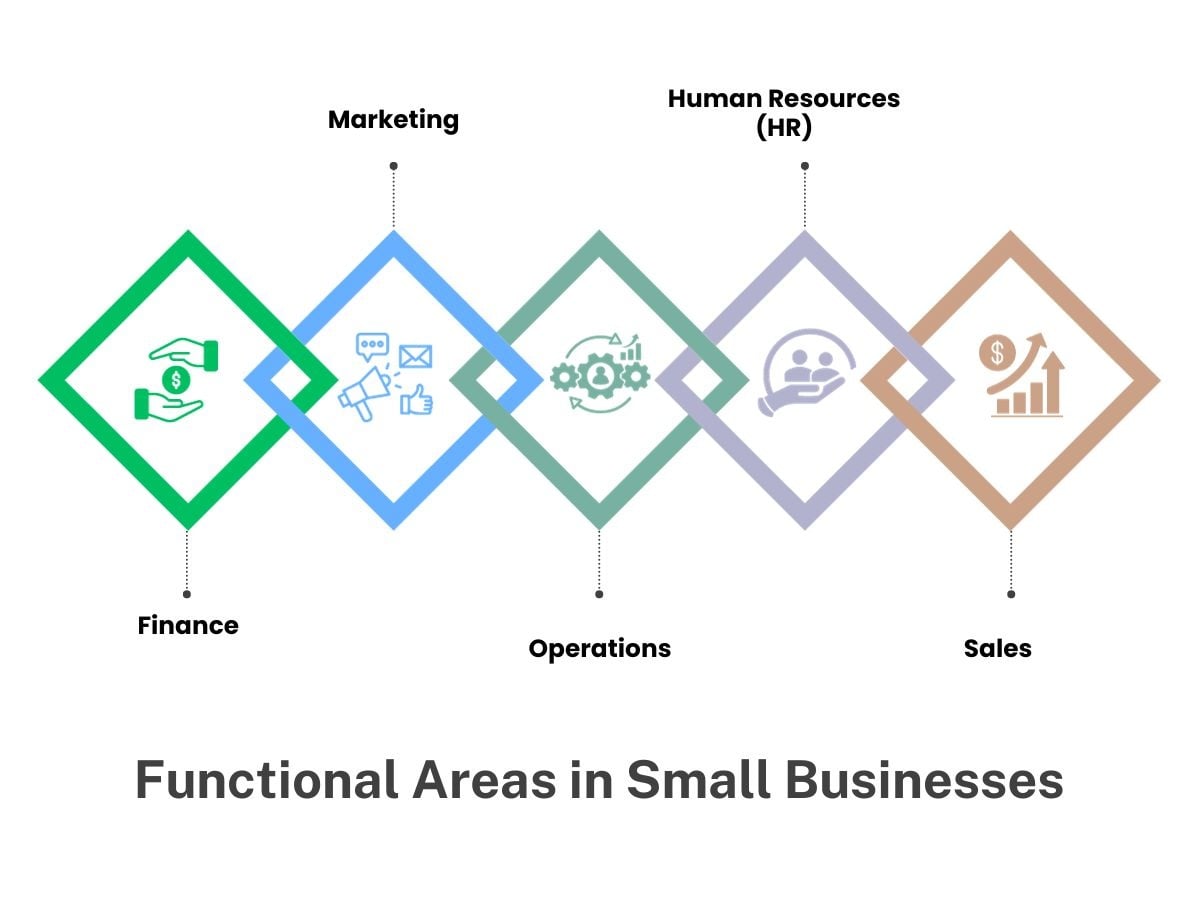
One of the essential facets of the small business management structure is its division into specific functional areas. Each segment plays a crucial role and has a unique purpose, all aimed at ensuring the smooth operation and sustainable growth of the organization:
🔷 Finance:
The lifeblood of any business lies in its finance department, which oversees crucial tasks like budgeting, accounting, and financial planning. The finance department isn't just a number-crunching function; it's the guardian of the company's financial wellbeing. Its strategic insights guide business decisions, help manage cash flow, and direct investments to ensure fiscal sustainability. From exploring new growth avenues to securing future business stability, the finance department rests at the heart of your business's operational success.
🔷 Marketing:
The marketing team is the company's creative powerhouse. It is their responsibility to amplify the allure of the company's products or services. They accomplish this by understanding the target market, analyzing consumer behavior, and devising innovative strategies to captivate customer attention and allegiance. These marketing maestros spin stories around your offerings, map customer journeys, and build robust brand identities, driving customer engagement and loyalty.
🔷 Operations:
The operations department is your business's backbone, ensuring seamless day-to-day functions. It supervises production, manages the supply chain, and controls logistics. More than just a managerial role, the operations team breathes life into your products or services. Through its commitment to efficiency and quality, it assures that your offerings reach customers on time and in prime condition, thereby upholding your brand's credibility and reputation.
🔷Human Resources (HR):
The HR department cultivates the business's most valuable asset – its people. It controls recruitment, manages personnel, and provides training and development opportunities. The human resources team is instrumental in transforming a group of individuals into a cohesive team aligned with your company's values and goals. They ensure that you have the right mix of talent required to propel your business forward.
🔷 Sales:
The sales team is your company's growth engine, focusing on generating revenue and driving profitability. They navigate the marketplace, track down opportunities, and convert leads into customers. These tenacious trailblazers nurture relationships with potential and existing customers, playing a pivotal role in your company's expansion journey. Through their persistent efforts, new territories are conquered, clients are satisfied, and your company's financial future is secured.
Roles and Responsibilities of Functional Managers
Functional managers hold important positions within a small business management structure. Their tasks include:
✔️ Setting departmental goals and objectives
Description: These managers are responsible for establishing the goals and objectives of their respective departments, which should align with the company's overall strategies.
Example: For instance, a marketing manager may set a goal to increase the company's social media followers by 20% within a three-month period as part of the marketing plan communication.
✔️ Developing strategies to achieve these goals
Description: Functional managers create strategies to achieve the defined goals and communicate them to their teams. Strategies can vary greatly depending on the department, but they should always support the company's larger objectives.
Example: The marketing manager might implement content marketing and engage influencers to help achieve the goal of increasing social media followers.
✔️ Managing resources and budgets
Description: Functional managers are in charge of managing their department's resources, including human resources, and maintaining budgets to ensure efficiency and fiscal responsibility.
Example: A functional manager might allocate funds towards a marketing communication plan to effectively promote products or services.
✔️ Overseeing day-to-day operations and teams
Description: Functional managers oversee the day-to-day work within their departments and guide their teams towards achieving set objectives.
Example: A marketing manager might direct her team to create an effective campaign, targeting audiences on specific social media platforms, and scheduling blogposts.
✔️ Reporting progress and results to senior management
Description: Functional managers report their department's progress and results to the company's senior management. These updates are critical for evaluating overall company performance.
Example: The marketing manager may present a report showcasing the department's progress in attracting more followers, engagement analytics, as well as key messages resonating with the target audience.
Real-Life Examples of Success
Several successful companies have leveraged the small business management structure to achieve remarkable results:
Apple Inc.: Apple's management structure emphasizes specialization in design, engineering, and marketing. This focus on functional areas has led to groundbreaking innovations, such as the iPhone and Mac.
Procter & Gamble (P&G): P&G's functional management structure allows them to manage a vast portfolio of consumer brands efficiently. Their approach has made them a global leader in the consumer goods industry.
Challenges and Strategies
Small business management structures come with several benefits, but they also face challenges, such as communication bottlenecks and siloed thinking. However, businesses can effectively tackle these obstacles by adopting the following strategies:
🟦 Foster open communication channels
Challenge: Communication bottlenecks can arise when team members experience difficulty exchanging vital information, hampering the effectiveness of the marketing strategy and other business operations.
How-to:
- Create platforms for employees to communicate openly, such as chat applications or online forums.
- Schedule regular meetings that encourage open dialogue and the sharing of ideas.
- Utilize tools like project management software to keep everyone informed about updates and progress.

🟦 Encourage cross-functional collaboration
Challenge: Siloed thinking occurs when team members from different departments lack interaction, which can lead to a disjointed return on investment and weak integration between various aspects of the business.
How-to:
- Organize cross-functional team meetings to brainstorm ideas and collaborate on projects.
- Create joint ventures for departments to work together on specific initiatives, like launching a new product or creating an effective marketing campaign.
- Maintain shared goals and objectives across departments to foster a sense of unity and collaboration.
🟦 Provide training and development opportunities
Challenge: Employees need to stay updated on current trends and practices to ensure their skills remain relevant and transferable within the ever-evolving business landscape.
How-to:
- Offer training sessions and workshops covering the latest industry trends and tools, such as up-to-date marketing strategies, creating engaging blog posts, and Google Analytics.
- Encourage team members to attend conferences or webinars that can expand their knowledge and skills.
- Implement mentorship programs that pair experienced team members with newer employees to facilitate knowledge sharing.
Practical Tips for Implementation
As an entrepreneur looking to execute the small business management structure, let's explore some valuable and practical tips:
🔶 Start with a Clear Vision:
Begin by clearly defining your business goals and objectives. Visualize the desired return on investment and how you plan to achieve it. For instance, if your goal is to introduce innovative products or services to a specific target market, designate functional areas that will be critical for accomplishing these objectives such as product development, marketing, and sales. Constantly review these objectives to ensure they remain relevant and adapt to the time and market's changing dynamics.
🔶 Hire the Right Talent:
Focus on recruiting professionals who can proficiently manage each functional area. Seek individuals who not only bring the needed expertise but also demonstrate alignment with your business's culture, values, and goals. For example, if establishing a strong online presence is important, hire a digital marketing expert who can craft and execute aneffective marketing strategy.
🔶 Establish Clear Reporting Lines:
Set up a well-defined hierarchy where functional managers report directly to you or a top-level executive. This established chain of command simplifies decision-making processes and enforces accountability. For instance, in a marketing team, having the social media manager report directly to the marketing director ensures that key decisions are informed, effective and align with the business's overall strategy.
🔶 Regularly Review and Adjust:
Business dynamics change over time, requiring your management structure to evolve as well. Regularly assess and modify your structure to accommodate changes in business objectives, resources, market demands, and growth plans. For instance, as the business grows, you may need to divide a marketing department into more specialized units such as content development, SEO, and social media. This way, you can better manage the capabilities and focus of your team.
Charting Your Course to Small Business Triumph
Embarking on the exciting journey of entrepreneurship is a challenging, yet rewarding, pursuit. Every decision you make, from refining your marketing communication strategies to introducing innovative products or services, profoundly impacts your venture's trajectory.
The small business management structure serves as your compass here, guiding you towards undeniable success in a competitive marketplace. This approach enhances operational efficiency, fosters specialization, and encourages good communication that reflects in your external marketing initiatives, including your digital marketing efforts. By mastering its nuances, drawing insights from successful real-life models, and meeting inherent challenges head-on, you fortify your small business with the resilience and dynamism it needs to soar to unprecedented heights.
Always keep in mind that the right structural approach can mean the difference between navigating the choppy seas of entrepreneurship with a clear vision and drifting aimlessly in an ocean of uncertainty.

To enhance the entire process, creating a communication plan is also significant. This plan serves as a roadmap for ensuring everyone, within and across your organization, is on the same page, moving towards shared goals, and contributing to your venture's overall success.
And as you continue on your voyage of entrepreneurship, remember these inspiring words from Richard Branson.
"Business opportunities are like buses, there's always another one coming. So, take the rejection in stride. The important thing is not to give up; learn from it. Decide to make the next time around better."
Let these words serve as your guide—encouraging you, bolstering your confidence, and reminding you that even in the face of adversity, persistence and resilience will pave your path towards small business success.
Discover the Right Tools for Your Startup
Take our 2-minute quiz to find tools tailored to your specific needs and goals.
Take the QuizTakes only 2 minutes


