
Business Operations Team Structure: Roles & Examples
Building a successful business requires a strong operations team structure. This article outlines key considerations for creating a high-performing team, including roles, responsibilities, and communication channels.

Starting a new business is an exciting journey filled with opportunities and challenges. One crucial aspect that entrepreneurs often overlook is the establishment of an effective business operations team structure. This fundamental framework can make or break your business's success.
In this comprehensive guide, we will delve into the importance of a well-defined business operations team structure, explore various types of structures, and provide real-life examples, practical tips, and best practices to help entrepreneurs navigate this critical aspect of their business.

The Foundation of Success: Business Operations Team Structure
A well-structured business operations team is like a well-oiled machine. It ensures that every part of your business functions smoothly and efficiently. Let's explore the key elements that make up an effective business operations team structure:
Clear Roles and Responsibilities
The first and most crucial element is defining clear roles and responsibilities for each team member. This ensures that everyone knows their job and understands how their work contributes to the overall success of the business. Clear roles and responsibilities reduce confusion, increase accountability, and boost productivity.
Real-life Example: Consider Amazon's Fulfillment Center Operations. They have a clear division of labor, with employees responsible for specific tasks such as picking, packing, and shipping. This division ensures that each step of the process is efficient and error-free.
Communication and Collaboration
Effective communication is the lifeblood of any team structure. Team members must be able to communicate seamlessly with each other and with other teams within the organization. Collaboration tools and regular meetings play a significant role in fostering open communication channels.
Real-life Example: Slack, a widely used communication tool, helps teams collaborate in real-time, whether they are working from the same office or remotely. It enables quick exchanges of information and updates, making the team more responsive.
Leadership and Decision-Making
A strong leadership hierarchy is essential for making timely and informed decisions. Clear leadership roles ensure that there is someone responsible for guiding the team and making critical choices when necessary.
Real-life Example: Apple's leadership structure under Steve Jobs exemplified effective decision-making. Jobs was known for his hands-on approach, and his leadership played a pivotal role in Apple's product development and innovation.
Flexibility and Adaptability
Business environments are dynamic, and your team structure should be flexible enough to adapt to changing circumstances. This adaptability allows your business to stay competitive and respond to new challenges.
Real-life Example: During the COVID-19 pandemic, many businesses had to quickly adapt their operations. Restaurants shifted to takeout and delivery models, demonstrating how flexibility in team structures can be a game-changer during unforeseen crises.
Advantages of a Well-Defined Team Structure
Now that we've discussed the key elements of an effective business operations team structure, let's delve into the advantages and benefits of having such a structure in place:
🔶 Improved Efficiency
An organized team structure minimizes redundancy, streamlines processes, and ensures that tasks are completed more efficiently. This efficiency translates into cost savings and higher productivity.
🔶 Enhanced Accountability
Clear roles and responsibilities make it easier to hold team members accountable for their work. When everyone knows what is expected of them, they are more likely to take ownership of their tasks and deliver results.
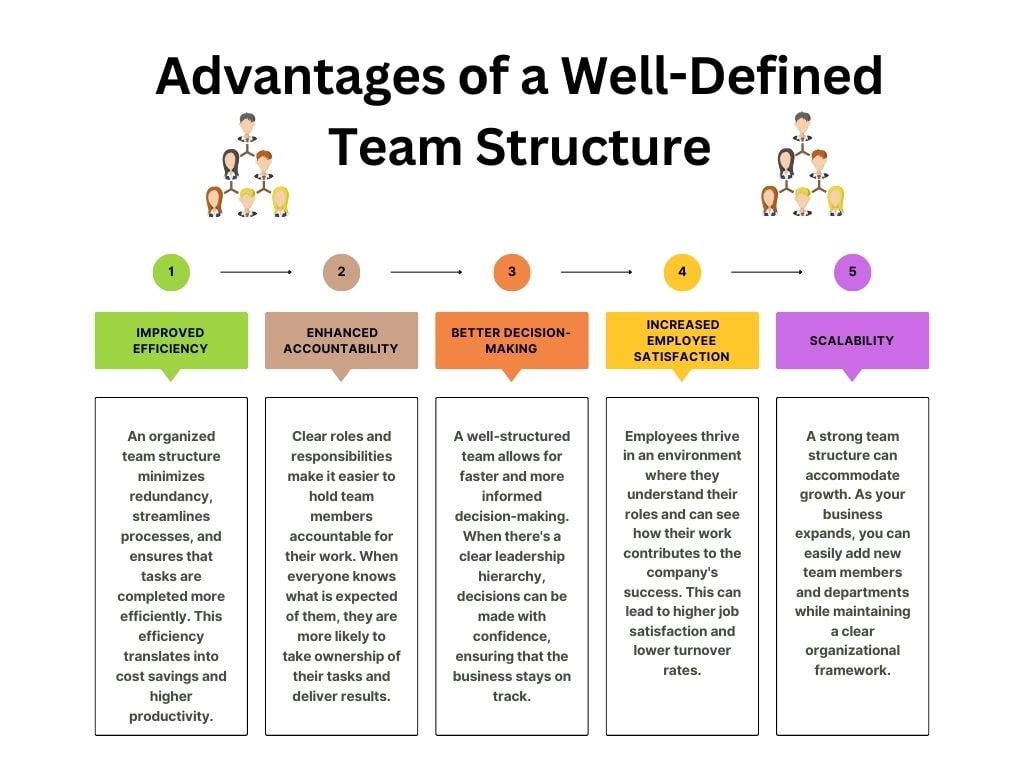
🔶 Better Decision-Making
A well-structured team allows for faster and more informed decision-making. When there's a clear leadership hierarchy, decisions can be made with confidence, ensuring that the business stays on track.
🔶 Increased Employee Satisfaction
Employees thrive in an environment where they understand their roles and can see how their work contributes to the company's success. This can lead to higher job satisfaction and lower turnover rates.
🔶 Scalability
A strong team structure can accommodate growth. As your business expands, you can easily add new team members and departments while maintaining a clear organizational framework.
Types of Business Operations Team Structures
There is no one-size-fits-all approach to team structure, as the best choice depends on your business's specific needs and goals. Here are some common types of team structures and their applicability in different business contexts:
☑️ Functional Team Structure
In a functional team structure, employees are grouped based on their areas of expertise or function, such as marketing, finance, or operations. This structure is suitable for small businesses with a limited number of products or services.
Real-life Example: A small accounting firm may use a functional structure, with separate teams for tax preparation, auditing, and consulting.
☑️ Divisional Team Structure
In a divisional team structure, teams are organized around different products, services, or geographic regions. This structure is ideal for larger companies with diverse product lines or multiple locations.
Real-life Example: General Electric (GE) uses a divisional structure, with separate divisions for aviation, healthcare, power, and more, each with its own leadership and resources.
☑️ Matrix Team Structure
The matrix team structure combines aspects of both functional and divisional structures. Employees have dual reporting relationships – they report to both a functional manager and a product or project manager. This structure is suitable for complex projects or organizations with multiple product lines.
Real-life Example: Many technology companies use a matrix structure for software development projects. Developers report to a functional manager (e.g., software development) and a project manager responsible for a specific product.
☑️ Hybrid Team Structure
A hybrid team structure is a customized approach that combines elements of various structures to meet the unique needs of the business. This structure offers flexibility but requires careful planning.
Real-life Example: An e-commerce company may have a hybrid structure, combining functional teams for marketing, finance, and customer service with a divisional structure for different product categories.
Challenges and Mistakes to Avoid
While establishing a business operations team structure is essential, it's not without its challenges and potential pitfalls. Here are some common issues to be aware of:
⚠️ Lack of Clarity
A vague or poorly communicated team structure can lead to confusion among team members, resulting in inefficiency and frustration.
⚠️ Resistance to Change
Introducing a new team structure can face resistance from employees accustomed to the old way of doing things. Proper change management and communication are critical to overcome this challenge.
⚠️ Overcomplication
Avoid making your team structure overly complex. Complexity can hinder decision-making and slow down processes.
⚠️ Neglecting Communication
Effective communication is key to the success of any team structure. Failing to prioritize communication can lead to misunderstandings and conflicts.
⚠️ Ignoring Feedback
Don't overlook the importance of gathering feedback from team members. They can provide valuable insights into the effectiveness of the structure and suggest improvements.
Best Practices for Optimizing Business Operations Team Structure
To create and maintain an efficient team structure for your business operations, consider implementing these best practices:
✔ Start with a Clear Vision
Define your business's mission, goals, and objectives. Your team structure should align with these strategic priorities.
✔ Assess Your Current State
Evaluate your existing team structure and identify areas for improvement. Gather input from employees to understand their needs and concerns.
✔ Tailor Your Structure
Select a team structure that best suits your business's size, industry, and goals. Be open to adapting or customizing structures as needed.
✔ Communicate Effectively
Ensure that your team members understand their roles and responsibilities. Foster open lines of communication and encourage feedback.
✔ Invest in Leadership Development
Develop strong leaders who can guide your teams effectively and make informed decisions.
✔ Embrace Technology
Use technology and collaboration tools to facilitate communication and streamline processes within your team structure.
✔ Continuously Improve
Regularly review and refine your team structure as your business evolves. Seek feedback from employees and be willing to make necessary adjustments.
✔ Monitor and Measure
Establish key performance indicators (KPIs) to track the effectiveness of your team structure and make data-driven improvements.
Bridging the Gap: Strategies for Aligning Operations Team Goals with Overall Business Objectives
In any successful business, the alignment between the operations team's goals and the overall business objectives plays a crucial role. When these goals are harmonized, the operations team can contribute significantly to the attainment of broader organizational milestones.
Let us explore explore effective strategies to bridge the gap and ensure seamless cooperation, collaboration, and alignment within the operations team and the broader business objectives.
1. Clear Communication and Transparency:
One of the primary strategies for aligning operations team goals with overall business objectives is to foster clear communication and promote transparency throughout the organization. When team members understand the bigger picture and the role their operations play in achieving it, they are better equipped to align their goals accordingly.
Regular town hall meetings, newsletters, and open-door policies can facilitate this exchange of information and promote a shared understanding of objectives.
2. Creation of SMART Goals:
The operations team should establish Specific, Measurable, Achievable, Relevant, and Time-bound (SMART) goals that directly contribute to the overall business objectives. These goals should be communicated clearly to team members, creating a sense of purpose and direction. By quantifying objectives and establishing milestones, the operations team stays on track and can measure its progress towards broader organizational goals.
3. Collaboration and Cross-departmental Alignment:
Operations teams do not work in isolation. They must actively collaborate with other departments such as sales, marketing, finance, and human resources to ensure synergy in pursuit of business objectives. Regular meetings, joint task forces, and shared decision-making processes help foster collaboration and enable the operations team to respond effectively to the needs of different stakeholders.
4. Performance Tracking and Accountability:
To ensure alignment, it is important to implement performance tracking mechanisms that hold individuals and teams accountable for their contributions to the overall business objectives. Key performance indicators (KPIs) and regular performance reviews provide metrics against which the operations team's progress and achievements can be assessed. This facilitates course correction, identifies areas for improvement, and ensures that everyone is aligned towards the desired outcomes.
5. Continuous Learning and Development:
To foster alignment, organizations should support the continuous learning and development of the operations team. Offering training programs, workshops, and mentoring opportunities can enhance team members' skillsets and keep them abreast of industry trends and best practices. This enables the team to be agile and adaptive, effectively aligning their goals with changing business needs.
6. Celebrating Achievements and Successes:
Recognizing and celebrating achievements, both big and small, goes a long way in bolstering alignment between the operations team and broader business objectives. Regularly acknowledging team members' contributions, whether through company-wide announcements or team-specific rewards, cultivates a sense of pride and motivation. This reinforces the connection between individual and team goals with the overall success of the organization.
Align Your Ops Team, Achieve Business Dreams:
Aligning operations team goals with overall business objectives is pivotal for driving success and sustainable growth. By fostering clear communication, SMART goal setting, collaboration, performance tracking, continuous learning, and celebrating achievements, businesses can create a harmonious relationship between operations and wider organizational objectives. When goals are aligned and everyone understands their role, a powerful synergy is formed, propelling the organization towards even greater success.

The business operations team structure is the backbone of your business's success. By establishing clear roles, fostering communication, and adapting to changing circumstances, you can create an efficient and effective team structure that drives growth and innovation.
Whether you opt for a functional, divisional, matrix, or hybrid structure, the key is to align your team with your business's goals and continuously strive for improvement.
Remember that a well-structured team is not a static entity; it evolves with your business to ensure long-term success. So, invest the time and effort to build a strong foundation for your business operations team, and watch your entrepreneurial dreams become a reality.
Discover the Right Tools for Your Startup
Take our 2-minute quiz to find tools tailored to your specific needs and goals.
Take the QuizTakes only 2 minutes


