
Transform Your Startup: Mastering Process Improvement
Unlock success with small business process improvement. Learn how to enhance efficiency, drive growth, and overcome challenges.

Running your own business is like solving a big, exciting puzzle. To do well and succeed, you need to look at all parts of your business and make them the best they can be. This is important for small businesses where you might not have a lot of resources. One of the most important tools to help your business grow and last a long time is called "process improvement".
In this article, we’ll be your guide through understanding small business process improvement. We'll explain what it is, why it’s so important, the key parts you need to know about, and how to use it effectively.
We'll also share some real-life examples of businesses that found ways to do things better. Plus, we'll explore how marketing strategies can help in the process. With this guide, you'll have all the tips and tools to make your business more efficient and even more successful!
Understanding Small Business Process Improvement
Small business process improvement is more than a buzzword; it's the cornerstone of operational excellence. It involves identifying, analyzing, and optimizing your business processes to enhance efficiency, reduce costs, and deliver better value to customers. In essence, it's the fine art of making your business run like a well-oiled machine.
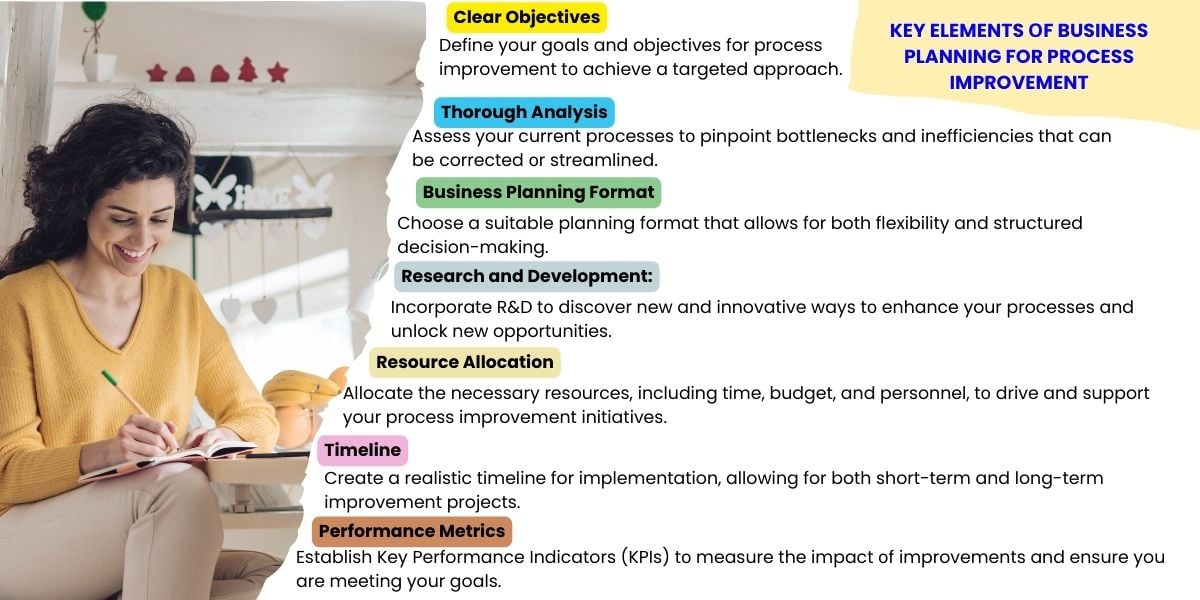
Key Elements of Business Planning for Process Improvement
Effective process improvement in small businesses begins with robust business planning. Here are the key elements to consider:
- Clear Objectives:
Define your goals and objectives for process improvement to achieve a targeted approach.
- Thorough Analysis:
Assess your current processes to pinpoint bottlenecks and inefficiencies that can be corrected or streamlined.
- Business Planning Format:
Choose a suitable planning format that allows for both flexibility and structured decision-making.
- Research and Development:
Incorporate R&D to discover new and innovative ways to enhance your processes and unlock new opportunities.
- Resource Allocation:
Allocate the necessary resources, including time, budget, and personnel, to drive and support your process improvement initiatives.
- Timeline:
Create a realistic timeline for implementation, allowing for both short-term and long-term improvement projects.
- Performance Metrics:
EstablishKey Performance Indicators(KPIs) to measure the impact of improvements and ensure you are meeting your goals.
Strategies for Improving Business Processes in Small Enterprises
Let's explore some effective strategies for small business process improvement:
Small Business Process Mapping:
Create visual representations of your workflows to identify inefficiencies and areas for optimization. These maps help you visualize the entire process, making it easier to pinpoint potential bottlenecks and areas for improvement.
✅ Standardization:
Streamline and standardize your processes to minimize variation, ensure consistency, and enhance productivity.
✅ Automation:
Implement technology solutions to automate repetitive tasks, allowing your employees to focus on more strategic, value-added activities.
✅ Employee Engagement:
Empower employees to share their feedback and ideas on improving processes. Their insights and perspectives can be invaluable for identifying possible improvements.
✅ Continuous Improvement:
Make process improvement a part of your company culture by regularly reviewing and updating your processes, utilizing data-driven decision-making, and adopting a growth mindset.
✅ Customer Satisfaction:
Always focus on the needs and preferences of your customers as you continuously look for ways to enhance their experience and satisfaction levels.
Update your marketing strategies regularly, ensuring they align with your overall process improvement goals and contribute to maximizing customer acquisition, retention, and revenue growth.
Remember, the key to successful small business process improvement is a combination of mindful planning, consistent execution, and relentless pursuit of efficiency and effectiveness. With these strategies in place, you'll be well on your way to strengthening your small business and laying the groundwork for future success.
Real-Life Examples of Small Business Process Improvements
To illustrate the impact of process improvement, consider these real-life examples:
1. Restaurant Efficiency:
A small restaurant improved its table-turnaround time by optimizing kitchen processes.
The result: increased customer satisfaction and higher revenue.
2. E-commerce Fulfillment:
An online store revamped its order fulfillment process with automation.
The result: faster order processing and reduced errors.
The Indispensable Role of Marketing Strategy in Process Improvement
The marketing strategy forms a key pillar that upholds the structure of the process improvement framework, especially when it comes to customer-centric operations. When the marketing strategy is interweaved with process improvement objectives, the thread that connects a business and its customers is not just strengthened—it's made responsive to the pulling forces of market dynamics. This synergy can yield:
🔹 Improved customer acquisition and retention:
A fitting marketing strategy promotes customer acquisition by ensuring potential customers understand the value of your offerings. For instance, you could make improvements to your online booking process to enhance user experience. By making this process more intuitive and user-friendly, your conversion rates increase, and you attract and retain more customers.
🔹 Enhanced customer journey and experience:
An optimized business process, complemented by a strategic marketing plan, can provide a seamless and enjoyable customer journey. Let's say you're a clothing retailer. Showcasing real-time inventory, a quick and secure checkout process, and personalized recommendations—these are all improvements that can be made to your online shopping process that enhance the overall customer experience.
🔹 Better alignment of marketing campaigns with operational capabilities:
Effective marketing strategies enhance process improvement by ensuring that your marketing efforts are in sync with your operational abilities. For example, a marketing campaign promoting a new high-speed delivery service must go hand in hand with actual operational changes to fulfill those promises. By upgrading your supply chain and delivery process, not only do you satisfy customer expectations created by marketing, but you also enhance your reputation as a reliable and customer-focused business.
A finely tuned marketing strategy not only supports effective process improvement, but it can also lead to better operational capabilities, improved customer experience, and ultimately, increased business growth and success.
Addressing Obstacles in Process Improvement for Small Businesses
COVID-19’s massive impact on the global economy has made one thing clear: Process improvement is essential for small businesses to adapt, survive, and thrive.
However, it is often laced with challenges. Common barriers consist of inadequate resources, resistance to change, and a lack of expertise or experience in process improvement. However, these obstacles aren't insurmountable. With strategic planning, a focus on improving the customer experience, and smart execution, small businesses can conquer these challenges:
Limited Resources:
Small businesses often work within tight budgetary confines and might lack the manpower or resources necessary to undertake extensive process improvements. This hurdle can be overcome by prioritizing improvements based on their potential impact on key business aspects, such as the customer experience.
High-impact, low-cost improvements should take precedence. This approach to business planning helps focus resources where they can generate the maximum return on investment (ROI).
Resistance to Change:
Change often stirs discomfort and apprehension, causing resistance, especially when it involves the way daily tasks are performed.
Overcoming this resistance necessitates open, honest dialogues about the benefits of the proposed changes for both the business and its employees. Continuous training, support, and a culture that fosters acceptance of change can ameliorate this resistance. Additionally, it's essential to actively involve employees in the change process. Their input and engagement could be invaluable for successful implementation, fostering a sense of ownership and commitment.
Lack of Expertise:
Process improvement requires a certain level of expertise in analyzing, mapping, and redesigning processes. For small businesses that lack this in-house expertise, seeking external assistance or consulting can be beneficial. Experts can bring new perspectives, insights, and knowledge about best practices to the project, facilitating the development of a detailed and effective process improvement plan.
Enhancing Marketing Plans and Customer Experience
Crafting and executing an effective marketing plan is not just an advantage, it is a necessity when aiming for business improvement. Infusing the customer experience into your marketing plan can create a sense of synchrony between your process improvement agendas and the desires, requirements, and preferences of your target audience. It’s about aligning business operations with a customer-centric approach and creating experiences that bring forth customer satisfaction and loyalty.
When working on the respective sections of your marketing plan, always remember to think about how it directly or indirectly impacts the customer experience across all touchpoints:
In the Market Analysissection, assess your customer's needs and wants and critically analyze how your current business operations fulfill them.
In the Competition analysissection, reflect on how your competitors are fulfilling these needs and see if there is a gap or unique niche that your business can fill.
In the Product Line and Services section, consider if your goods or services are catering efficiently to your customer requirements.
In the Sales Strategy section, reflect on how you can enhance the purchase experience and post-purchase service.
In your Intellectual Property section, recognize the role of copyrights, patents, or trade secrets in safeguarding your unique value proposition that contributes to superior customer experience.

Pro Tip:
A successful marketing plan is equal parts customer knowledge and flexibility. Regularly reassess your marketing plan in sync with evolving customer behaviors and market trends. Leverage analytics and feedback to continuously enhance the customer experience and ensure your business stays relevant and competitive.
In the end, resilience, strategic planning, and execution coupled with a relentless focus on customer experience can lead to significant improvements driving small business success. Remember, implementing effective process improvement is akin to advancing on a long journey. Keep your business planning format flexible, revisit and adjust them often, and most importantly—put customer service and the overall experience at the heart of any improvements.
As a business owner, it's essential to constantly monitor, evaluate, and adjust your business operations, strategies, and processes with an eye for potential enhancements. Positive improvement draws the line between a successful business and an ordinary one. So, endeavor to incorporate regular process improvements into your business ethos, and watch your small business bloom into greatness.
Simple Steps for Implementing Process Improvements
For small businesses starting on their process improvement journey, follow this easy-to-understand, step-by-step guide:
✔️ Identify Target Processes:
Pick specific processes to work on first. Choose these processes based on their potential impact on your business and how easy it will be to make improvements.
✔️ Analyze Current State:
Take a close look at how things are working right now. Write down the steps in the process and find areas where things can be better.
✔️ Design Future State:
Think of new ideas that can fix the problems you found. Make a plan with steps for a better process that solves these issues.
✔️ Implement Changes:
Put your new plan into action. Make sure everyone who is part of the process knows what to do and has the right training.
✔️ Monitor and Adjust:
Keep an eye on how well the new process is working. Compare the results to the goals you set earlier. If things aren't going as hoped, think about what changes need to be made and try again.
By following these steps, small businesses can work on improving their processes one at a time. This will help make things run more smoothly, save time and money, and keep customers happy.
Continuously measure performance against established KPIs and make adjustments as needed.
Empowering Startups and New Business Owners: Embrace the Journey to Success
In the dynamic world of entrepreneurship, effective business process improvement can be the key to unlocking your startup's potential, driving efficiency, growth, and long-term success. The journey of a new business owner involves continuous refinement—guided by well-defined objectives, data-driven decisions, and a steadfast pursuit of excellence. Adopting a robust business planning format and crafting a compelling marketing plan are instrumental in your path forward.
While embarking on your entrepreneurial adventure, it's essential to find motivation and inspiration, even during the most challenging moments. To keep your spirit high, remember the words of actress and comedian Lily Tomlin: "The road to success is always under construction." Embrace every stage of the journey, overcome obstacles, and learn invaluable lessons along the way.
As a new business owner or startup founder, your ambition and determination are powerful forces. Channel this energy into consistently refining operations, implementing suitable strategies, and fostering innovation from within your organization. Persistently prioritize process improvement, and witness your startup thrive. With dedication, resilience, and an unwavering commitment to growth, you'll be well on your way to creating a flourishing, lasting entrepreneurial legacy.
Discover the Right Tools for Your Startup
Take our 2-minute quiz to find tools tailored to your specific needs and goals.
Take the QuizTakes only 2 minutes


