
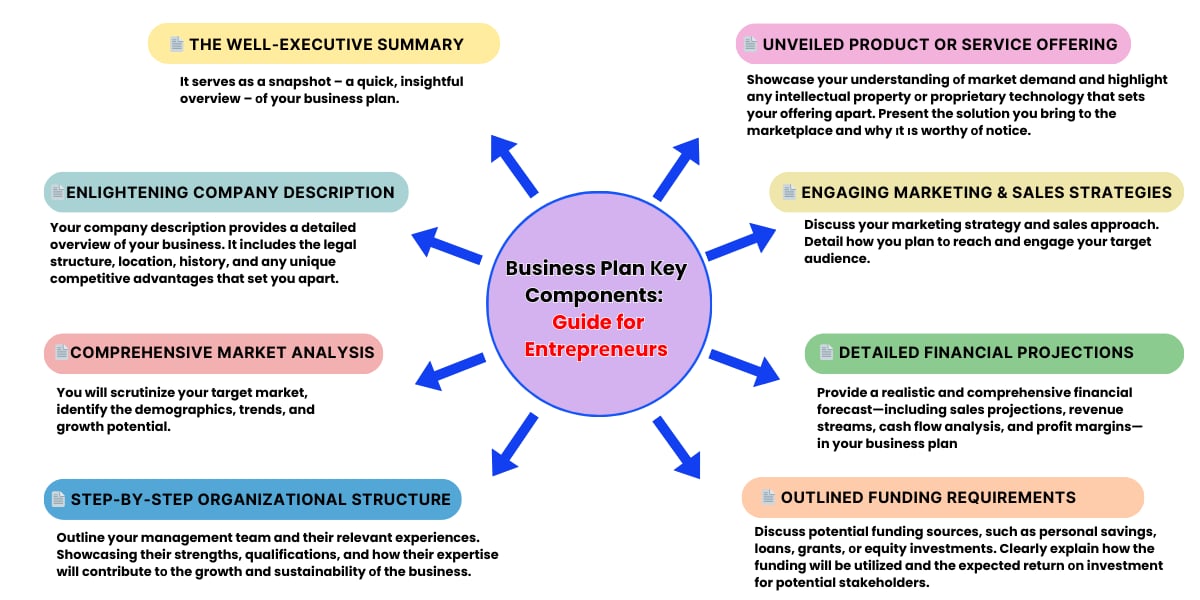
Business Plan Key Components: Guide for Entrepreneurs
Discover the essential components of a business plan for entrepreneurs and learn how to tailor them to specific industries for success.

As an aspiring entrepreneur, you may have been told about the critical role a well-crafted business plan plays in your business journey. However, comprehending the key components that should be included in a business plan can be an overwhelming task.
In this detailed guide, we'll explore the essential modules that should be incorporated into your business plan, offering practical advice, industry-specific insights, and a thorough business planning format to help entrepreneurs design a comprehensive and effective roadmap to success.
Breaking Down the Business Plan: Key Elements to Ensure Success
Embarking on the entrepreneurial path requires more than a ground-breaking idea; it demands a solid game plan for success. A comprehensive, well-thought-out business plan functions as the critical blueprint vital in shaping and defining your venture. This guide delves into the key elements of a business plan, breaking them down piece by piece to illuminate their importance in ensuring your entrepreneurial success.
📄 The Well-Executive Summary
An executive summary is more than just a traditional introduction. It serves as a snapshot – a quick, insightful overview – of your business plan and should succinctly describe your business's mission, vision, and core objectives. This segment is critical as it acts as the first impression and should entice potential investors or stakeholders to continue reading. Think of it as a film trailer: captivating, intriguing, and promising enough to get the audience interested.
Real Life Example:
Consider Square, a mobile payment company co-founded by Jack Dorsey. Its executive summary might have read something like this:
"Square aims to empower businesses of all sizes by revolutionizing transaction processing with a simple, elegant tool that enables secure, fast, and reliable mobile payments."
This brief yet impactful statement, while hypothetical, exemplifies how you effectively convey your business's core proposition.
📄 Enlightening Company Description
Your company description provides a detailed overview of your business. It includes the legal structure, location, history, and any unique competitive advantages that set you apart. Highlight your company's vision, values, and the problem your product or service aims to solve. This section is where you give life to your entity, helping stakeholders understand why your business deserves their trust and investment.
Real Life Example:
Airbnb, a marketplace for lodging and tourism activities, began its journey with a clear and compelling company description such as:
“Airbnb is an online platform that connects people looking to rent their homes with people who are looking for accommodations. Airbnb’s user-friendly platform bridges the gap between homeowners and travelers worldwide."
📄 Comprehensive Market Analysis
A thorough market analysis is a must-have in your business plan. Here, you will scrutinize your target market, identify the demographics, trends, and growth potential. This segment showcases your understanding of the industry landscape and outlines your target customers. Incorporate meticulous market research and data analysis to justify your business's potential for success and to demonstrate your command of the business environment.
Real Life Example: Uber, the globally recognized ride-sharing service, would have required a substantial market analysis:
"The traditional taxi industry is ripe for disruption. By providing a user-friendly ride-hailing app that ensures safety, affordability, and convenience, we can meet the growing demand for reliable transportation services. Key competitors include traditional taxi services and emerging ride-sharing apps."
📄 Step-by-Step Organizational Structure
Outline your management team and their relevant experiences. Showcasing their strengths, qualifications, and how their expertise will contribute to the growth and sustainability of the business. Describe the roles and responsibilities of key team members to help potential investors understand who's who in your organization's hierarchy. This step aids in establishing credibility and shows that your business is controlled by capable hands.
Real Life Example:
Google's early organizational structure emphasized the unique roles of its key team players:
"The team will be led by co-founders Larry Page, CEO, and Sergey Brinn, President, who will oversee all operations. Together, they bring strong technical expertise and visionary thinking that will guide Google's innovation-first approach."
📄 Unveiled Product or Service Offering
This section is where your core product or service takes the wheel. Emphasize its unique selling proposition (USP) and how it fulfills the needs of your target market. Showcase your understanding of market demand and highlight any intellectual property or proprietary technology that sets your offering apart. This part is your chance to shine – to present the solution you bring to the marketplace and why it is worthy of notice.
Real Life Example:
Evernote, a popular note-taking app, might have pitched their product like this:
"Our flagship product, Evernote, is a software suite that allows individuals and businesses to capture, organize, and find information across multiple platforms. Evernote looks to address the growing demand for productivity tools that keep pace with our mobile, always-connected lifestyles."
📄 Engaging Marketing and Sales Strategies
Discuss your marketing strategy and sales approach. Detail how you plan to reach and engage your target audience. Incorporate proven strategies and tactics, such as digital marketing, social media advertising, partnerships, and traditional advertising methods. Include any success stories or case studies demonstrating effective customer acquisition and retention. This section underscores how you'll make your business seen and how to make your business plan work in real practice.
Real Life Example:
Facebook, during its early days, implemented clear marketing strategies:
"Our initial marketing strategy will focus on university campuses - launching one school at a time to generate buzz and build demand. As usage proliferates, we will explore online advertising and strategic partnerships with media outlets as additional revenue streams."
📄 Detailed Financial Projections
Provide a realistic and comprehensive financial forecast—including sales projections, revenue streams, cash flow analysis, and profit margins—in your business plan. Use historical data, market analysis, and industry benchmarks to justify your projections. Highlight your break-even point, and discuss your plans for business growth and scalability. This component provides evidence that your business idea is not just feasible but also financially promising.
Real Life Example:
Amazon, in its infancy, would require robust financial projections:
"Our five-year financial projection involves operating at a loss as we relentlessly pursue market share over immediate profitability. We will finance our growth through equity investments and reinvested profits to further enhance our marketing efforts and improve our infrastructure."
Remember that every business is unique and that your business plan should reflect the nuances of your market, type of business, product or services, and team structure. Incorporating the key components of a business plan, supported by real-world examples, aspiring entrepreneurs can better visualize and structure their own plans, offering more control over the exciting journey toward entrepreneurial success.
📄 Outlined Funding Requirements
Your funding requirements section should outline how much capital is required to start and sustain your business. Discuss potential funding sources, such as personal savings, loans, grants, or equity investments. Clearly explain how the funding will be utilized and the expected return on investment for potential stakeholders. Understanding and justifying the funding needed to realize your business idea adds to the credibility and robustness of your business plan.
Real Life Example - Airbnb
In their early years, when seeking funding, the founders of Airbnb might have drafted a funding requirements section along these lines:
"To effectively launch and establish Airbnb, we have calculated a need for an initial investment of $600,000. These funds will be carefully allocated to achieve our critical initial goals.
Estimated allocation includes:
$200,000 for technology development, which includes perfecting our online platform for user-friendly accommodation listing and exploring, secure payment gateway, and innovative features that set us apart from any competition.
$150,000 for marketing and promotional activities to penetrate the market, including digital advertising, partnerships with travel agencies, incessant social media presence, and localized promotional events.
$100,000 to cover the operational costs for the first year, including salaries of the core team members, office rent, and utility bills.
-The remaining $150,000 will be kept as a contingency fund to address unforeseen expenses or to fuel faster growth.
"In terms of our funding sources, we are looking at a combination of founder input, venture capital investment, and possibly a small business loan. We can offer investors not only a strong return on investment, but also the opportunity to empower worldwide travelers and homeowners alike by revolutionizing the way we approach temporary accommodation."
Your funding requirements section should aim to convey similar thoroughness and robust reasoning while also addressing the specifics of your business, inspiring confidence in potential investors about the careful planning and promising potential of your venture.
Tailoring Business Plan Components to Specific Industries
Different industries have unique considerations and challenges which should be tackled while creating your business plan. For example, a tech startup may prioritize intellectual property protection and scalability, while a brick-and-mortar retail business may focus on location analysis and inventory management.
Tips and Best Practices for Crafting a Business Plan
Writing a business plan is a monumental task which when done strategically can lead to incredible results. Here are some tips and best practices to ensure your business plan is effective and purposeful:
☑️ Clarity and Concision:
Your business plan should be precise and maintain a clear format throughout, without professionally relevant details being omitted or overlooked.
☑️ Use of Headers, Subheadings, and Bullet Points:
Enhance the readability of your document by organizing your thoughts and points under appropriate headers and subheadings. Use bullet points for listing details to make the text easy to skim through.
☑️ Incorporate Visuals:
To illustrate complex data and make it more comprehensible, use charts, graphs, and visuals. Visual aids can often convey information more powerfully than text.
☑️ Feedback is Crucial:
Seek feedback from mentors, industry experts, or business consultants to refine your business plan. Their expertise can provide crucial insights and improvements.
Regular Updates: As your business evolves, so should your business plan. Updating the document regularly keeps it relevant to the current condition and future aspirations of your business.
Incorporate Marketing and Sales Strategies: A business plan should encapsulate your marketing plans and strategies. Detail how you plan on reaching and attracting your target audience.
☑️ Don't Forget the SWOT Analysis:
SWOT (Strengths, Weaknesses, Opportunities, and Threats) analysis is an essential tool in forming your business plan. It gives you a realistic understanding of your business, the market, and potential challenges.
☑️ Keep it Industry-Specific:
The components of your business plan should align with the industry your business operates in. Tailor these components to tackle industry-specific aspects and challenges.
☑️ Real-Life Examples:
Incorporate real-life examples to enhance the effectiveness of your business plan. Relatable anecdotes and success stories make your plan more tangible and impactful.
Constructing a business plan is not just a starting step; it's a fundamental strategy for any entrepreneur aiming at success. It gives your business a roadmap – guiding internal decision-making and attracting potential investors. A well-incorporated vision, marketing strategy, SWOT analysis, industry-oriented tweaks, and relatable business examples can make your business plan a leading light through the dynamic and often challenging landscape of entrepreneurship.

Embarking on Your Entrepreneurial Journey
The process of venturing into the world of entrepreneurship and starting your own business, while exhilarating, can also be complex and challenging. Crafting a comprehensive business plan with meticulously outlined components is an essential first step that aids in understanding your business idea better, strategizing its successful execution, mapping out your financial needs, and ultimately, securing potential investors' trust.
Let these real-world examples guide you and provide a blueprint as you develop your own unique business plan. Their paths to success showcase their precise planning, profound understanding of market dynamics, and unwavering commitment.
No matter the industry or the concept, the heart of your business is your vision, and your business plan is the roadmap that brings this vision to life. As a budding entrepreneur, you're not just starting a business; you're bringing an innovative idea into the world, and your business plan is your first real chance to cement that foundation.
Remember this: every successful business from Airbnb to Uber, Square to Google, started with someone daring to dream, just like you're doing right now. Keep dreaming, keep daring, but above all, start planning because your entrepreneurial journey begins now.
Remember - on the road to success, preparation is key. Think deeply about each component discussed in this guide as you embark on your journey. Good luck, and here's to your future success!
Discover the Right Tools for Your Startup
Take our 2-minute quiz to find tools tailored to your specific needs and goals.
Take the QuizTakes only 2 minutes


