
Business Planning for Small Businesses: A Roadmap to Success
Master the art of business planning for small businesses with valuable insights and practical tips. Achieve success in a competitive industry.

In the fast-paced world of entrepreneurship, strategic decision-making and long-term vision are the cornerstones of a successful small business. Business planning plays a pivotal role in transforming abstract ideas into tangible results.
This article aims to provide valuable insights and guidance on essential aspects of business planning. It equips entrepreneurs in the general industry with the knowledge needed to thrive in today's competitive landscape.
The Importance of Business Planning
Business planning is the compass that charts the course for your small business. It serves as a strategic roadmap, helping you set objectives, identify target markets, and allocate resources effectively.
The business planning process can help you clarify your goals and determine the steps needed to achieve them. It can also help you set targets to increase profitability and growth for your company.

Key Components of a Comprehensive Business Plan
a) Thorough Market Research: Understand your target market's dynamics, trends, and consumer preferences. This will enable you to identify opportunities and tailor your offerings accordingly.
b) Competition Analysis: Analyze your competitors' strengths, weaknesses, pricing strategies, and marketing techniques. This knowledge helps you differentiate your business and carve out your unique value proposition.
c) Financial Projections: Develop realistic financial projections by analyzing costs, sales forecasts, and cash flow. This enables you to anticipate financial needs, secure funding, and ascertain the viability of your business.
d) Marketing Strategies: Create a comprehensive marketing plan that encompasses pricing, promotion, distribution, and branding. Effective marketing strategies ensure that your business reaches its target audience and maximizes its profitability.
e) Operational Planning: Detail the operational aspects of your business, such as logistics, supply chain management, and production processes. This empowers you to streamline operations, maximize efficiency, and minimize risks.
f) Risk Assessment: Identify potential risks and challenges that may affect your business. By anticipating these obstacles, you can develop contingency plans and mitigate potential threats effectively.
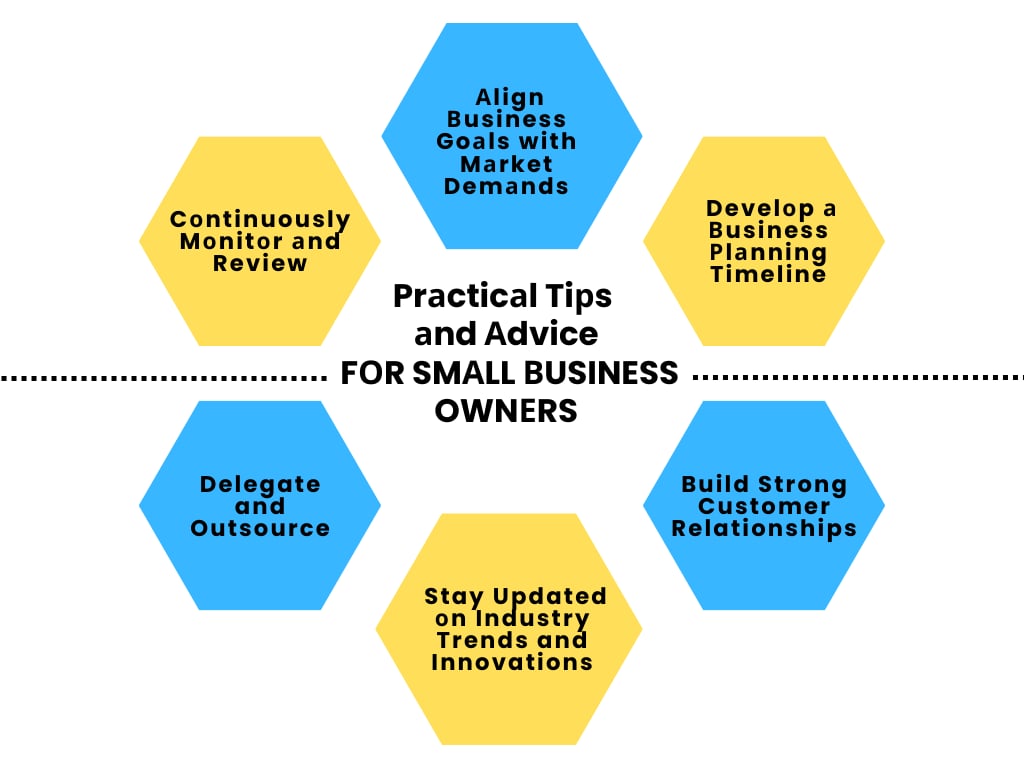
Practical Tips and Advice for Small Business Owners
✔️ Align Business Goals with Market Demands: Regularly review and amend your business plan to stay in sync with market trends. This agility allows you to adapt your strategies and seize opportunities as they arise.
✔️ Develop a Business Planning Timeline: Create a timeline that outlines key milestones and deadlines for achieving your business objectives. This provides a structured approach to business planning and ensures that you remain on track.
✔️ Continuously Monitor and Review: Track the progress of your business plan, regularly assessing its effectiveness and making necessary adjustments. This iterative approach allows you to refine your strategies and pivot when required. It is important to stay adaptable and responsive to changes in the market or internal factors that may influence your business's success.
✔️ Build Strong Customer Relationships: Nurture and maintain strong relationships with your customers. Regularly communicate with them, listen to their feedback, and provide exceptional customer service. This will not only help you retain existing customers but also attract new ones through positive word-of-mouth.
✔️ Stay Updated on Industry Trends and Innovations: It is crucial to stay informed about the latest trends and innovations in your industry. Attend industry conferences, read trade publications, and network with other professionals in your field. This knowledge will help you stay competitive and adapt to changes in the market.
✔️ Delegate and Outsource: As a small business owner, it is important to delegate tasks and outsource functions that are not your core competency. This allows you to focus on strategic decision-making and growing your business. Identify areas where you can bring in external expertise or hire employees to handle specific tasks, freeing up your time to focus on what you do best.
A Crucial Step in Business Planning
One of the fundamental aspects of business planning is identifying and analyzing your target market. Understanding your target audience is crucial for developing effective marketing strategies, tailoring your products or services, and ultimately achieving business success.
Tips for identifying and analyzing your target market:
🔸 Conduct Market Research: Begin by conducting comprehensive market research to gather data and insights about your potential customers. Utilize various research methods, including surveys, interviews, and focus groups, to understand their demographics, lifestyles, behaviors, and purchasing habits.
🔸 Define Your Niche: Determine the specific segment or niche within the broader market that aligns with your business objectives. By narrowing down your target market, you can develop a more focused and customized approach to meet their unique needs.
🔸 Analyze Competitors: Look into your competitors' customer base and analyze their strategies. Study their target market, customer profiles, and marketing tactics. This analysis can help you identify gaps in the market or opportunities to differentiate yourself by catering to underserved customer segments.
🔸 Create Buyer Personas: Develop detailed buyer personas representing your ideal customers. Buyer personas are fictional representations of your target audience, including key details such as demographics, preferences and motivations. Creating buyer personas helps you understand your customers on a deeper level and guides your marketing efforts to resonate with them.
🔸 Utilize Data Analytics: Leverage data analytics tools to gain insights from your website, social media channels, and customer interactions. Analyze data such as customer demographics, browsing behavior, and purchase history to identify patterns and trends. This data-driven approach enables you to refine your target market assumptions and make informed decisions.
🔸 Identify Customer Needs and Preferences: Get in touch with your customers, directly or indirectly, to find out what they want and need, what they're good at, and what they wish they could change. Use this information to adapt and improve your offerings, ensuring they align with the desires of your target audience.
🔸 Stay Current on Trends: Keep up with market trends, emerging technologies, and changes in consumer behavior. Stay ahead of the competition by adapting your strategies and offerings accordingly.
Why is identifying the target market important?
Knowing your target market allows you to focus on the people who will want what you have to offer. By defining your target market, you gain insights into their specific needs and preferences, enabling you to develop products or services that cater to those demands more effectively.

Identifying the target market is important for small business owners for the following three reasons:
1. Efficient use of resources: When small business owners identify their target market, they can focus their marketing efforts and resources on reaching that specific group of customers. This ensures that their marketing messages and strategies are most likely to resonate with the target audience, resulting in more effective marketing campaigns and efficient use of resources.
2. Tailoring products and services: Understanding the target market allows small business owners to customize their products and services to better meet the specific needs and preferences of their customers. By knowing their target audience's demographics, interests, and buying behaviors, business owners can develop products and services that match their customers' preferences, leading to greater customer satisfaction and loyalty.
3. Competitive advantage: Identifying the target market gives small business owners a competitive advantage by enabling them to differentiate themselves from competitors. By focusing on a specific market segment, they can develop unique selling propositions and value propositions that cater to their target audience's specific needs. This allows them to stand out in the market and attract customers who are less likely to be swayed by competitors offering generic products or services.
Business planning is the backbone of small business success. A well-crafted and properly executed plan allows entrepreneurs to navigate the challenging business landscape with a clear vision and direction. As the old saying goes, failing to plan is planning to fail.
In the words of Benjamin Franklin, "By failing to prepare, you are preparing to fail." This holds true for any small business looking to achieve success in a competitive marketplace. A properly constructed business plan provides entrepreneurs with a roadmap to guide their efforts, while also highlighting potential pitfalls and offering strategies to overcome them.
As with any journey, the first step is often the most important. Business planning is the first step towards building a successful small business. By focusing on key elements such as market analysis, customer research, and financial planning, entrepreneurs can gain a thorough understanding of their business and its potential.
As the great business guru Peter Drucker once said, "Plans are only good intentions unless they immediately degenerate into hard work." Successful business planning is not a one-time event; it requires continual refinement and adaptation to changing market conditions and customer demands.
Successful business planning requires entrepreneurs to be tenacious and persistent, willing to adapt to overcome obstacles and challenges.
Small business owners who prioritize business planning and are willing to adapt their strategy can succeed against the complexities of the marketplace. Management consultant Michael Porter said, "The essence of strategy is choosing what not to do." A well-executed plan allows entrepreneurs to focus on what matters most while achieving their goals and fulfilling their dreams.
Discover the Right Tools for Your Startup
Take our 2-minute quiz to find tools tailored to your specific needs and goals.
Take the QuizTakes only 2 minutes


