
Essential Stages of Business Planning
Launch your business like a rocket! This guide explores the essential stages of business planning, from market research to marketing, helping you build a strong foundation for success.

Entrepreneurship has become the cornerstone of economic development and social progress globally. In this dynamic business world, a well-rounded blueprint is pivotal: enter the stages of business planning—a process that lays the foundation for a successful business venture.
Utilizing core components like marketing strategy and target market identification, the process of business planning paves the way to success.
Every stride in the direction of success commences with a plan; and the business realm is no exception to this universal truth. Business planning is a systematic procedure to define clear cut business goals and strategies, to understand market scenarios, and to devise utilizing efficient resources.
This in-depth article takes a comprehensive look into the crucial steps of business planning and its immense benefits to budding entrepreneurs and business enthusiasts.

Mastering the Stages of Business Planning
From understanding your target audience – like discovering the coolest alien species to hang out with – to crafting a marketing strategy that makes your customers shout "Wowzers!", these stages are your roadmap to reaching your entrepreneurial goals.
Stage 1: Market Research and Market Analysis - Spy Mission!
Imagine you're a secret agent uncovering market secrets! You use surveys, interviews, and online tools to learn about:
• Hot Trends: What products and services are people buzzing about?
• Customer Clues: What problems do people have that your business can solve?
• Rival Rogues: Who are your competitors, and what are their strengths and weaknesses?
By knowing the market landscape, you can choose the perfect launchpad for your business.
Stage 2: Defining Business Goals - Set Your Sights!
Think of goals as your rocket's boosters, propelling you towards success.
• Aim High: Define SMART goals - Specific, Measurable, Achievable, Relevant, and Time-bound.
• Financial Fix: Set goals for sales, revenue, and profitability.
• Happy Crew: Don't forget goals for customer satisfaction and employee engagement.
Clear goals give your business direction and help you track your progress like a pro!
Stage 3: Financial Planning - Fuel Your Mission!
Imagine creating a treasure map, but instead of gold, it shows you income, costs, and cash flow. This is your financial plan!
• Map the Money: Use tools like spreadsheets and forecasts to predict financial performance.
• Cost Control: Identify ways to keep your rocket fuel (money) in the tank.
• Funding Frenzy: Plan how you'll get the resources needed to launch your business.
A rock-solid financial plan ensures your mission stays on track and doesn't run out of steam!
Stage 4: Sales and Marketing Strategy - Spread the Word!
This is where you craft your secret message to attract customers. Think of it like building a cool spaceship communication system:
• Target the Tribe: Who are you trying to reach with your awesome products or services?
• Marketing Mania: Choose the right channels like social media, online ads, or even flyers to connect with your target audience.
• Value Proposition Power: Show customers why your offering is the coolest spaceship in the galaxy!
An effective marketing strategy makes your business shine brighter than any supernova!
Stage 5: Operational Planning - Smooth Sailing!
Imagine your intellectual property (IP) - your unique recipes, innovative processes, or creative designs - as the precious cargo on your spaceship. Operational planning is like building the secure navigation system and efficient engines that ensure this cargo reaches its destination safely and profitably.
• Production Pitstop: This is where you map out the production process with laser focus on protecting your IP. Think secure recipes, confidential software, and streamlined workflows to prevent leaks and maintain your competitive edge.
• Delivery Dash: While speed is crucial, so is secure delivery of your valuable IP. Plan robust packaging, encrypted data transfers, and reliable distribution channels to safeguard your innovations as they reach customers.
• Sales System: Convert leads into loyal fans not just with compelling marketing, but also with a secure sales system. Train staff on handling confidential information, implement secure payment gateways, and build trust with transparent policies to earn lasting customer loyalty.
Operational planning goes beyond just optimizing tasks; it's about safeguarding your most valuable assets - your intellectual property. By building airtight procedures, robust security measures, and a strong culture of IP protection, you can steer your business towards smooth sailing and sustainable success. Remember, a well-protected cargo is the key to reaching your entrepreneurial destination with all your treasures intact!
Stage 6: Monitoring and Evaluation - Check Your Course!
Just like astronauts constantly check their instruments, you need to monitor your business regularly.
• Track Your Numbers: Look at sales figures, customer feedback, and website traffic to see what's working and what's not.
• Tweak and Tune: Adapt your plan based on your findings. Remember, the best spaceships can adjust course mid-flight!
• Market Maestros: Keep an eye on changing trends and customer needs so your business stays ahead of the curve.
• Monitoring and evaluation ensure your business keeps soaring towards its goals!
Remember, each stage is like a puzzle piece building your business spaceship. Start small, learn as you go, and adapt your plan like a true entrepreneur! With smart planning and a dash of creativity, your business will reach for the stars and beyond!
Building Sales and Marketing Rockets: Fueling Success with Research and Development
In the competitive marketplace, a stellar sales and marketing strategy isn't just a nice-to-have, it's your launchpad to success. But unlike assembling a pre-packaged rocket kit, crafting an effective strategy requires research and development, delving into key elements to understand your target audience and dominate the competition.
1. Mapping the Market Landscape:
First, think of yourself as a mission control operator, meticulously gathering data and analyzing your target market. Dig deep into research and development reports, customer surveys, and social media trends to understand their needs, desires, and pain points. This intelligence helps you laser-focus your efforts on the right audience, avoiding costly marketing misfires.
2. Decoding the Competitive Landscape:
No space explorer worth their salt launches without studying their competitors. Conduct a SWOT analysis, meticulously mapping out your competitors' strengths, weaknesses, opportunities, and threats. This critical research and development exercise unveils potential blind spots to exploit and areas where you can differentiate your offering.
3. Launching Your Unique Selling Proposition (USP):
Think of your USP as your rocket's powerful engine. It's what sets you apart from the crowd. By identifying what makes your product or service unique and valuable to your target audience, you can craft compelling messaging that resonates and drives conversions.
4. Building Brand Recognition:
Your brand is your spaceship's sleek design, recognizable from any star system. Consistent branding, encompassing your logo, tagline, packaging, and social media presence, is a vital aspect of research and development. Invest in building a memorable and credible brand identity that fosters trust and loyalty among your customers.
5. Measuring the Impact: Return on Investment and Beyond:
A successful marketing strategy isn't just about flashy campaigns; it's about measurable ROI. By implementing precise tracking and analytics tools, you can see how your efforts are translating into sales and customer engagement. This research and development loop allows you to optimize your strategy for maximum impact, reducing customer acquisition costs and maximizing returns on your marketing investment.
Remember, a successful sales and marketing strategy is built on a foundation of continuous research and development. By investing in understanding your market, competitors, and customers, you can craft a powerful launching pad that propels your business to new heights. So, ignite your engines, explore the market landscape, and prepare for blastoff!
Why Planning Makes Your Business Rocket Soar!
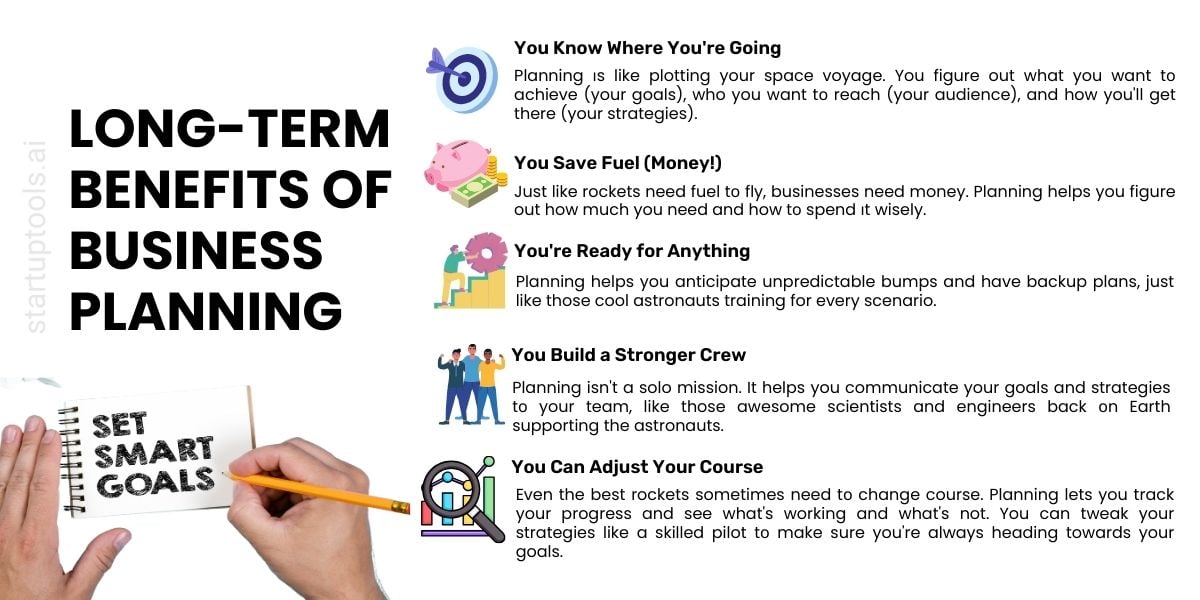
Ever wish you had a magical roadmap to success for your awesome business idea? Well, guess what? There actually is one – and it's called business planning! It might sound boring, but think of it like building a rocket ship for your dreams. With a good plan, you can blast off to success and avoid crashing back to Earth.
But why is planning so important? Here are some long-term benefits that are even cooler than rocket fuel:
🔹 You Know Where You're Going: Planning is like plotting your space voyage. You figure out what you want to achieve (your goals), who you want to reach (your audience), and how you'll get there (your strategies). No more wandering around aimlessly in the business galaxy!
🔹 You Save Fuel (Money!): Just like rockets need fuel to fly, businesses need money. Planning helps you figure out how much you need and how to spend it wisely. You won't waste precious cash on useless tools or wrong marketing tactics.
🔹 You're Ready for Anything: The galaxy can be unpredictable, full of asteroids (problems) and black holes (challenges). Planning helps you anticipate these bumps and have backup plans, just like those cool astronauts training for every scenario.
🔹 You Build a Stronger Crew: Planning isn't a solo mission. It helps you communicate your goals and strategies to your team, like those awesome scientists and engineers back on Earth supporting the astronauts. Everyone knows what they need to do, and the whole team works together to make the business rocket soar.
🔹 You Can Adjust Your Course: Even the best rockets sometimes need to change course. Planning lets you track your progress and see what's working and what's not. You can tweak your strategies like a skilled pilot to make sure you're always heading towards your goals.
Remember, even the coolest space adventures started with a good plan. So, grab your pencil and notebook, chart your course, and get ready to launch your business dream into the stratosphere! With a little planning, your business can be the brightest star in the galaxy!
Mission Control: Monitoring Your Business Success!
Remember building your business rocket in the stages of business planning? You researched the market, mapped your target audience, and launched with a powerful marketing strategy. But blasting off isn't enough – you gotta steer your business to success, right? That's where Monitoring and Evaluation come in, your mission control center for business growth!
Think of your target market as a group of friendly aliens on another planet. You sent them cool messages about your awesome products (your marketing campaign), but did they receive it? Did they like it? Did they blast off in their little spaceships to buy from you? Monitoring and Evaluation are like sending probes to gather intel and see if your marketing messages hit the target.

How do you monitor? You use tools like website traffic meters, social media analytics, and even good old-fashioned surveys. These tools tell you if your target audience is even seeing your messages, how they're reacting, and if they're taking action (like buying your stuff!).
Evaluation is like analyzing the data from your probes. Did you reach the right aliens? Did your messages resonate? Are they lining up outside your spaceship store? If not, it's time to adjust your course! Maybe you need different messages, different channels, or even a different target planet (market segment).
Remember, business isn't a one-and-done launch. It's an ongoing space adventure! By constantly monitoring and evaluating your marketing efforts, you can adapt your strategies, target the right audience more effectively, and keep your business rocket soaring towards growth and success. So, buckle up, young entrepreneur, and prepare for interstellar marketing adjustments!
Charting a Path to Business Success: The Lifecyle of Effective Business Planning
Business planning is a lifecycle, not a one-time event—integrating market research, goal setting, financial planning, marketing strategy, operational planning, and continuous monitoring and evaluation. Encapsulating this lifecycle effectively within a business plan leads to long-term benefits, fostering success and growth.
The stages of business planning highlighted in this article act as steppingstones towards a robust business model. The ability to evolve and adapt this model according to the dynamic business environment will drive the success of any business endeavor. The development of an astute marketing strategy and understanding of your target market is bound to augment the profitability of a prudent entrepreneur.
In conclusion, the roadmap to successful entrepreneurship is an awareness of the importance of business planning stages, a well-defined marketing strategy, and a clear understanding of your target market. Let's forge ahead and set the path to successful business planning!
Discover the Right Tools for Your Startup
Take our 2-minute quiz to find tools tailored to your specific needs and goals.
Take the QuizTakes only 2 minutes


