
Business Planning for Small Businesses: Roadmap to Success
Discover the importance of business planning for small businesses. Learn key components, tips, funding options, and the role of continuous planning.

In the fast-paced world of entrepreneurship, strategic decision-making and long-term vision are the cornerstones of a successful small business. Business planning plays a pivotal role in transforming abstract ideas into tangible results. This article aims to provide valuable insights and guidance on essential aspects of business planning, equipping entrepreneurs in the general industry with knowledge needed to thrive in today's competitive landscape.
Key Reasons Why Business Planning is Essential for Small Businesses
Business planning is the compass that charts the course for your small business. It serves as a strategic roadmap, helping you set objectives, identify target markets, and allocate resources effectively. By articulating your vision and outlining the steps to achieve it, business planning becomes the foundation for growth, profitability, and sustainability.
★ Direction and Vision: A business plan helps small businesses define their goals, objectives, and long-term vision. It provides a roadmap for success and ensures that the business stays focused and on track.
★ Financial Management: A well-thought-out business plan includes financial projections, budgets, and cash flow analysis. This enables small businesses to effectively manage their finances, allocate resources, and make informed decisions about investments, expenses, and pricing strategies.
★ Attracting Investors and Securing Funding: Potential investors and lenders often require a comprehensive business plan to assess the viability of a small business. A clear and well-articulated plan increases the chances of attracting external funding and demonstrates the business's potential for growth and profitability.
★ Mitigating Risks and Uncertainties: Business planning involves conducting market research, competitor analysis, and identifying potential risks and challenges. By anticipating potential obstacles and developing contingency plans, small businesses can be better prepared to navigate uncertainties and mitigate risks effectively.
★ Marketing and Competitive Edge: A business plan outlines the target market, customer profiles, and marketing strategies. It helps small businesses differentiate themselves from competitors and develop unique value propositions, leading to increased market share and customer loyalty.
★ Employee Alignment and Collaboration: Small businesses benefit from business planning by ensuring that all employees are aligned with the company's goals. A well-communicated plan allows employees to understand their individual roles and contributions, fostering collaboration and boosting overall productivity.
★ Monitoring Progress and Performance: Small businesses can monitor their progress and determine if they are meeting their goals by regularly checking and analyzing their business plan. This enables timely corrective actions, strategic adjustments, and continuous improvement, ensuring long-term success.
★ Scalability and Growth: A business plan allows small businesses to identify factors that contribute to growth and scalability. A well-designed plan can help businesses seize growth opportunities and adapt to changing market conditions.
★ Operational Efficiency: Business planning entails defining operational processes, workflows, and resource allocation. By streamlining operations, eliminating redundancies, and identifying areas for improvement, small businesses can increase operational efficiency, optimize productivity, and maximize profitability.
★ Succession Planning and Exit Strategy: An essential aspect of business planning is developing a succession plan and exit strategy. Small businesses can ensure a smooth transition and maximize the value of the business when the time comes to retire or sell it.
Business planning is crucial to the success of small businesses. It provides direction, financial management, funding opportunities, and risk mitigation. Business planning enables small businesses to navigate the competitive landscape, adapt to changes, and achieve their long-term objectives.
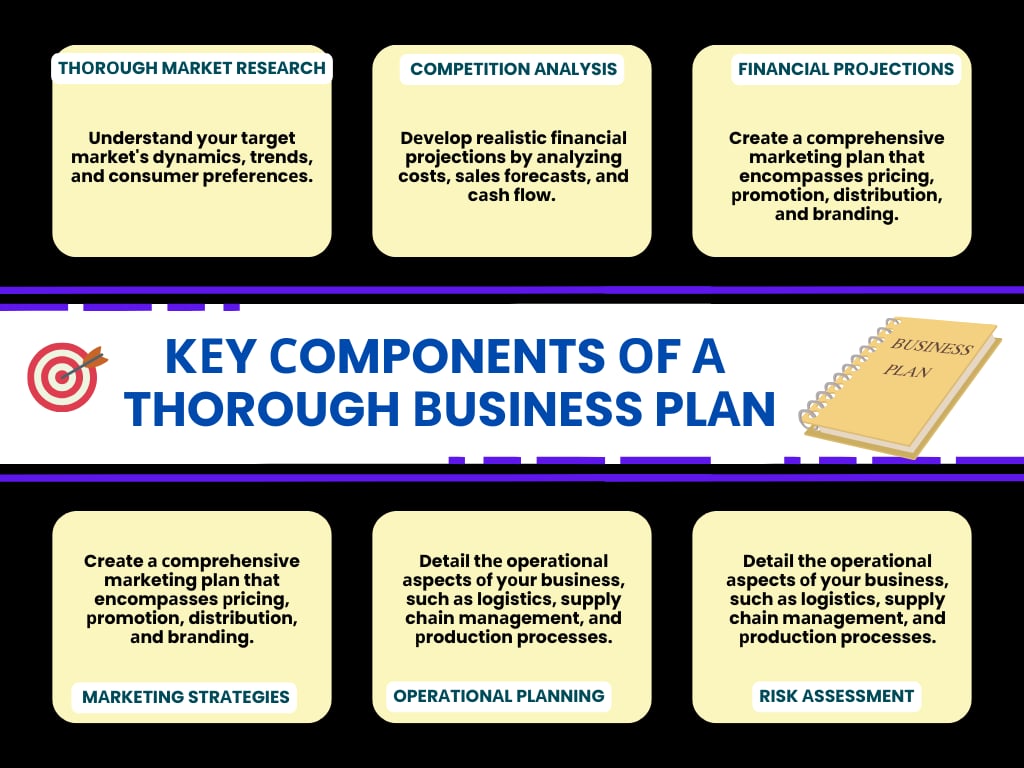
Key Components of a Thorough Business Plan
🔹 Thorough Market Research: Understand your target market's dynamics, trends, and consumer preferences. This will enable you to identify opportunities and tailor your offerings accordingly.
🔹 Competition Analysis: Analyze your competitors' strengths, weaknesses, pricing strategies, and marketing techniques. This knowledge helps you differentiate your business and carve out your unique value proposition.
🔹Financial Projections: Develop realistic financial projections by analyzing costs, sales forecasts, and cash flow. This enables you to anticipate financial needs, secure funding, and ascertain the viability of your business.
🔹 Marketing Strategies: Create a comprehensive marketing plan that encompasses pricing, promotion, distribution, and branding. Effective marketing strategies ensure that your business reaches its target audience and maximizes its profitability.
🔹 Operational Planning: Detail the operational aspects of your business, such as logistics, supply chain management, and production processes. This empowers you to streamline operations, maximize efficiency, and minimize risks.
🔹 Risk Assessment: Identify potential risks and challenges that may affect your business. By anticipating these obstacles, you can develop contingency plans and mitigate potential threats effectively.
Practical Tips and Advice for Small Business Owners
Running a small business can be both thrilling and challenging. As a small business owner, you have the opportunity to pursue your passions while taking charge of your own destiny. However, navigating the complexities of entrepreneurship requires careful planning and strategic decision-making. In this blog post, we will share some practical tips and advice to help small business owners thrive in today's competitive market.
A. Define Your Target Audience
For any business, it's essential to understand your target audience. Define your ideal customer profile based on demographics, interests, and purchasing behavior. This knowledge will help you to personalize your marketing efforts and make sure that you are delivering the right solutions for your customers.
To identify your target audience for business operations, start by:
✔️ analyzing your current customer base and identifying any common characteristics among them.
✔️ conducting market research to determine the needs, pain points, and preferences of your target audience and create buyer personas based on your findings.
✔️ Use your buyer personas to guide your marketing strategies, product development, and customer engagement efforts so that all aspects of your business operations are tailored to your target audience.
Create a Comprehensive Business Plan
A well-defined business plan serves as a roadmap for success. Outline your business objectives, strategies, and financial projections. Include sections on marketing, operations, and finances to ensure you have a clear vision of your business's future direction.
B. Prioritize Financial Management
Managing your finances is crucial for the sustainable growth of your business. Establish a budget and closely monitor your income, expenses, and cash flow. Consider hiring a professional accountant to help you optimize tax benefits, track financial performance, and plan for long-term profitability.
To prioritize financial management, consider the following top three points:
☑ Budgeting:
Create a comprehensive budget that outlines your anticipated income and expenses. This will help you allocate resources effectively, track your financial performance, and make informed decisions.
☑ Cash Flow Management:
Monitor and manage your cash flow by tracking your inflows and outflows of cash. Ensure that you have enough liquidity to cover your expenses and make necessary investments. Implement strategies to optimize cash flow, such as managing receivables and payables efficiently.
☑ Financial Analysis:
Regularly analyze your financial statements, including income statements, balance sheets, and cash flow statements. This will help you identify trends, analyze profitability, and make adjustments to improve your overall financial performance. Seek opportunities to improve your financial position and minimize risks through strategic financial analysis.
C. Build Strong Relationships
Nurturing relationships with customers, suppliers, and industry peers is essential. Make it a priority to provide exceptional customer service, maintain regular communication, and go the extra mile to exceed expectations. Networking events and industry associations can also offer valuable connections and support.
Embrace Digital Marketing Strategies
In today's digital age, having a strong online presence is non-negotiable. Create a professional website, optimize it for search engines, and establish robust social media profiles. Engage with your online audience by providing valuable content, running targeted ad campaigns, and promptly responding to customer inquiries.

To embrace digital marketing strategies, consider the following top three points:
🔸 Develop a Strong Online Presence:
Create a professional website that showcases your products or services and provides valuable information to potential customers. Optimize your website for search engines to improve its visibility. Establish and maintain an active presence on social media platforms relevant to your target audience. Engage with your audience through regular posting, responding to comments, and sharing relevant and engaging content.
🔸 Implement Search Engine Optimization (SEO):Use SEO techniques to improve your website's visibility in search engine rankings. Do some research to find the words that people use when looking for things related to your business? Then, use those words in your website's words, titles, and web addresses so that your website comes up when people search for those words.
Enhance your website's user experience and loading speed to provide a positive browsing experience for visitors.
🔸Think about using something called Pay-per-Click Advertising. This means putting ads on websites like Google or social media. It's a way to show your ads to the people you want to see them.
Create targeted ad campaigns based on audience demographics, interests, and behaviors. Keep an eye on how well your ads are doing and see if you need to make any changes. You might need to aim your ads at different people or change how much money you're spending. The goal is to get the most out of the money you're putting in.
Don't forget to keep an eye on how your digital marketing is doing. Use special tools to see what's working and what's not. This will help you find patterns and figure out if your marketing is successful or not. Then, you can use this information to make better choices and improve your strategies.
D. Stay Competitive by Continuously Learning
As a small business owner, it's vital to stay updated on industry trends, innovations, and best practices. Attend conferences, workshops, and webinars to gain insights, cultivate new skills, and connect with industry influencers. Sharpening your knowledge will keep you competitive and enable you to make informed decisions to drive business growth.
Small businesses that prioritize continuous learning typically experience improved overall business performance1. By empowering employees with the necessary knowledge and skills, businesses can achieve higher levels of productivity, efficiency, and customer satisfaction2. Additionally, learning can help drive operational excellence, improve decision-making, and support strategic business planning. This, in turn, contributes to long-term business growth and sustainability.
E. Leverage Technology and Automation
Invest in technology that helps your business run more smoothly. This could be tools that help you organize and complete projects, software that helps you keep track of your customers, and programs that help you manage your finances.
Automating tasks that you do over and over again will save you time, so you can think more about important parts of your business.
F. Seek Support and Mentoring
Building a support network is invaluable for small business success. Join local business associations, chambers of commerce, and online communities to connect with like-minded entrepreneurs. Seek out mentors who have faced similar challenges and can offer guidance based on their experience.
The Power of Effective Business Planning
Running a small business can certainly be challenging, but with careful planning and determination, success is within reach. By developing a strong business plan tailored to your goals, market research, and financial considerations, you lay a solid foundation for your small business.

Effective business planning helps you make informed decisions, set achievable targets, and adapt to changing circumstances. By staying focused and continuously assessing and adjusting your strategies, you increase your chances of achieving your entrepreneurial dreams.
The key to overcoming the fear of starting a small business is recognizing the value of proper planning. When you have a well-thought-out business plan in place, you gain confidence and clarity about your goals and the steps to achieve them.
Planning allows you to identify potential risks, allocate resources effectively, and make informed decisions. To start a successful business, you need to plan carefully. But if you have the courage to take that first step and start, you may turn your passion into a thriving business!
Discover the Right Tools for Your Startup
Take our 2-minute quiz to find tools tailored to your specific needs and goals.
Take the QuizTakes only 2 minutes


