
Crafting a Business Plan to Start: Winning Strategy
Discover the winning strategy for crafting a business plan to start your venture successfully. Essential tips and insights for entrepreneurs.

Starting a new business is an exhilarating journey, filled with dreams and aspirations. However, to turn those dreams into reality, it's imperative to create a well-crafted business plan that not only outlines your vision but also captures the interest of potential customers and investors.
In this comprehensive guide, we will explore the crucial aspects of creating an effective business plan to start any business successfully. Whether you're launching a service-based venture, a product-based enterprise, or an online-based business, this article has you covered.
The Power of a Well-Crafted Business Plan
A well-crafted business plan is your roadmap to success. It's not just a document; it's a strategic tool that can attract potential customers and investors. Here's why it's crucial:
⏹ Guidance: A business plan provides clarity on your business objectives, strategies, and operational plans. It ensures that every aspect of your business is well-defined and aligned with your goals.
⏹ Investor Attraction: Investors look for businesses with a clear vision and potential for growth. A comprehensive business plan showcases your commitment, market understanding, and potential return on investment.
⏹ Customer Appeal: A business plan that clearly communicates your value proposition and customer-centric approach can attract customers by addressing their specific needs and pain points.
Now, let's dive into the essential components of a winning business plan.
Identifying and Analyzing Target Customers
Understanding your target customers is the foundation of any successful business plan. Effective techniques for doing so include:
Market Research
Conduct thorough market research to identify your target market's size, demographics, preferences, and behaviors. Use surveys, focus groups, and industry reports to gather data.
Customer Profiles
Create detailed customer profiles (buyer personas) to represent your ideal customers. Define their age, gender, interests, and pain points. This helps tailor your offerings to their needs.

Understanding Your Target Market's Needs and Pain Points
Identify the specific needs and pain points your target customers face. Your business plan should address how your products or services will provide solutions to these challenges.
Example 1: Eco-Friendly Bakery (Company Description:
Baking delicious treats with sustainable ingredients and innovative packaging.**)
Target Customers: Health-conscious millennials and families concerned about environmental impact.
Needs: Access to delicious baked goods free from artificial additives and excessive packaging.
Pain Points: Difficulty finding treats that are both tasty and environmentally friendly. Concerns about food waste and excessive packaging.
Your Competitive Edge: Offer delectable cookies, cakes, and pastries made with organic ingredients and packaged in biodegradable materials. Highlight responsible sourcing, composting initiatives, and carbon-neutral delivery options.
Example 2: Interactive Language Learning App (Company Description:
Gamified language learning platform with personalized instruction and immersive virtual experiences.)**
Target Customers: Busy professionals and travelers seeking an engaging and effective way to learn a new language.
Needs: Efficient and enjoyable language learning method that fits into their busy schedules. Immersive experience to practice and apply their skills.
Pain Points: Traditional learning methods are boring and time-consuming. Lack of real-world application opportunities.
Your Competitive Edge: Develop an AI-powered app that personalizes learning paths and engages users with interactive games, virtual reality scenarios, and live conversations with native speakers. Emphasize the convenience and effectiveness of gamified learning.
These examples demonstrate how to:
• Clearly define your target customer and their needs.
• Identify specific pain points your business can address.
• Showcase your unique selling proposition and competitive edge.
By understanding your target market's deepest desires and frustrations, you can craft a business plan that resonates with them and sets you apart from the competition. So, grab your magnifying glass and go spelunking – uncover the hidden treasures of your customers' needs and pave the way for a brilliant business!
Hook Investors with Brilliance: Tailoring Your Business Plan for Success
Landing the support of investors can be the rocket fuel that propels your startup into the stratosphere. But in a crowded galaxy of entrepreneurial hopefuls, how do you make your business plan stand out among the twinkling stars? The answer lies in tailoring your plan to appeal to investors at a high level, showcasing your competitive advantage and the unique value proposition of your type of business.
- Spotlight Your UVP - Be the Brightest Star:
Investors are like seasoned space hunters, always on the lookout for the next big cosmic phenomenon. Your Unique Value Proposition (UVP) is your beacon, outlining what makes your business unique and why it's destined for success.
Don't bury it in technical jargon; present it clearly, concisely, and with irresistible impact. Show them why, when faced with a universe of choices, customers will gravitate towards your planet like hungry asteroids drawn to a rich asteroid field.
- Paint a Picture of Profitability - Fueling the Engines:
Investors aren't just stargazing; they're calculating potential returns on their investment. Show them how your business plan translates into a financially-viable rocket ship, ready to blast off and generate handsome profits. Don't just throw around numbers; present clear, realistic financial projections that demonstrate your understanding of the market, future growth potential, and a concrete path towards profitability.
- Highlight Your Competitive Advantage - Be the Lone Star:
The cosmos is teeming with competitors, but your business plan should be a declaration of your dominance. Clearly articulate your competitive advantage – the secret sauce that sets you apart from the herd. Whether it's cutting-edge technology, unparalleled customer service, or a unique niche in the market, show investors why you're not just another shooting star, but a supernova destined to outshine the rest.
Remember, investors are seeking the next celestial marvel, so give them a reason to marvel at your business plan. By showcasing your UVP, crafting a compelling financial narrative, and highlighting your competitive advantage, you can transform your plan from a dusty document into a launchpad for a stellar entrepreneurial journey.
Market Opportunity
Highlight the market opportunity by presenting the size of the addressable market and your potential market share. Investors want to know the growth potential.
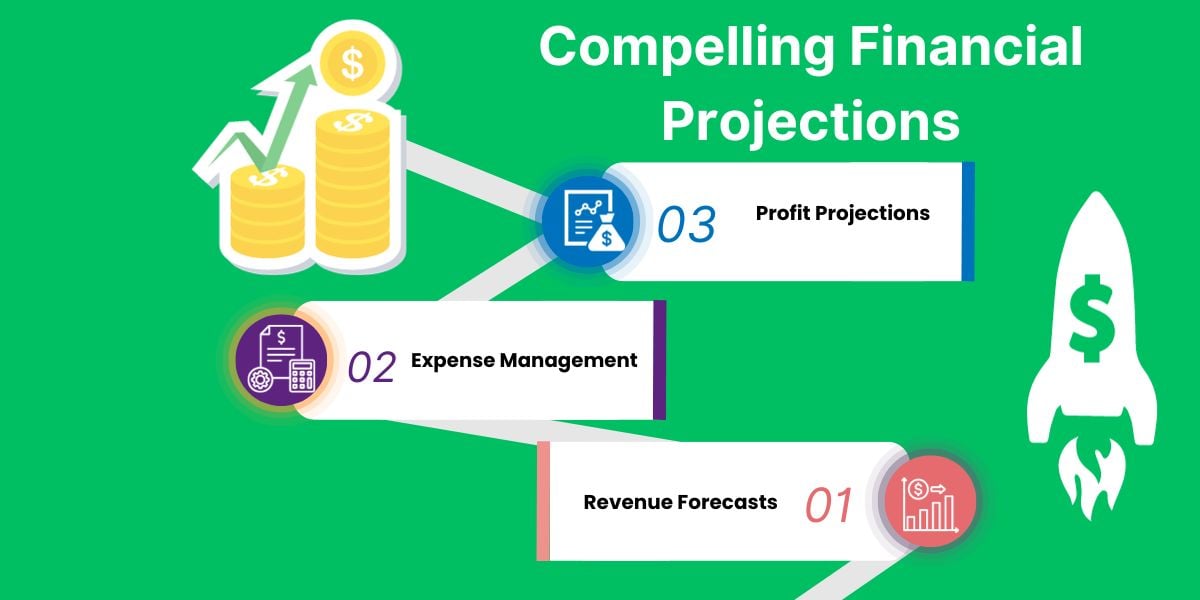
Creating Compelling Financial Projections
Financial projections are a critical part of your business plan. Ensure they are realistic and compelling:
✔️ Revenue Forecasts
Project your revenue based on market research and realistic sales expectations. Include best-case and worst-case scenarios to demonstrate preparedness.
✔️ Expense Management
Detail your expense management strategies. Show investors that you can control costs effectively while scaling the business.
✔️ Profit Projections
Present realistic profit projections that reflect your growth strategy. Balance ambition with feasibility to build investor confidence.
Types of Businesses and Their Business Plans
Different businesses require different types of business plans. Here are examples of how business plans may vary by industry:
• Service-Based Business: Focus on detailing your service offerings, client acquisition strategy, and the expertise of your team.
• Product-Based Business: Emphasize product development, manufacturing processes, distribution, and competitive analysis.
• Online-Based Business: Highlight your online presence, digital marketing strategies, and e-commerce capabilities.
Essential Components of a Market Analysis
A robust market analysis is a cornerstone of your business plan:
Identify your competitors, analyze their strengths and weaknesses, and explain how your business will differentiate itself.
• Industry Trends
Stay current with industry trends and provide insights into how your business is positioned to capitalize on these trends.
• Market Size Estimation
Estimate the total addressable market size, your target market share, and how you plan to capture it.
Presenting the Business Plan Professionally: A Crucial Step for Success
In the final section of your business plan, it's essential to present your document professionally to make a lasting impression on potential investors and stakeholders. Paying attention to the presentation enhances your credibility and communicates your commitment to your venture. Here's a closer look at each aspect of this critical step:
✅ Formatting Your Business Plan
Formatting plays a significant role in making your business plan visually appealing and easy to navigate. Ensure your business plan adheres to a clear and organized structure. Use professional fonts, appropriate font sizes, and consistent formatting throughout the document.
Business Planning Format: Follow a standardized business planning format that includes sections like executive summary, market analysis, financial projections, and marketing strategy. This not only makes your plan more accessible but also shows your attention to detail.
✅ Crafting a Persuasive Pitch
Your ability to deliver a persuasive pitch is crucial when presenting your business plan to potential investors and stakeholders. This is your chance to summarize your plan succinctly and convince your audience of the viability of your business.
Elevator Pitch:Develop an elevator pitch that can be delivered in a short amount of time, typically within 30 seconds. It should highlight the most critical aspects of your business plan, including your unique value proposition and the potential for growth.
✅ Leveraging Visuals and Storytelling
Incorporating visuals and storytelling techniques into your business plan can greatly enhance its impact on the reader. Visuals help break up dense text and make complex information more accessible, while storytelling creates an emotional connection.
• Visual Aids: Include charts, graphs, images, and infographics to illustrate key points and data in your plan. Visual aids not only make the plan more engaging but also help convey information more effectively.
• Narrative Approach:
Use storytelling techniques to weave a compelling narrative throughout your plan. Share the journey of your business, the problems you're solving, and the impact you aim to make.
A well-crafted story can captivate your audience and make your plan more memorable. Presenting your business plan professionally is the final step in the business planning process. It involves meticulous formatting, a persuasive pitch, and the creative use of visuals and storytelling.
Blast Off with Confidence: Securing Your Future with a Stellar Business Plan
Congratulations, young entrepreneur! You've navigated the crucial stages of business planning, building a roadmap for your dream to take flight. But your journey doesn't end here. Your carefully crafted business plan is now your launchpad to secure a competitive edge, attract potential investors, and propel your venture towards long-term success.

Think of it as your secret weapon:
✓ Competitive Edge: By deeply understanding your target market, analyzing your rivals, and honing your unique selling proposition, you'll carve a niche in the marketplace, leaving competitors trailing in your stardust.
✓ Investor Magnet: A meticulously crafted business plan, complete with compelling financial projections and a clear vision for the future, will leave potential investors starry-eyed with excitement. It's your chance to showcase your potential and secure the fuel needed to launch your ambition to the next level.
✓ Long-Term Trajectory: Your business plan isn't just a snapshot; it's a dynamic blueprint for growth. Regularly revisiting and fine-tuning your plan ensures you stay agile, adaptable, and always on course towards your long-term goals, even amidst the shifting winds of the market.
So, don't relegate your business plan to a dusty shelf. Use it as your guiding star:
✓ Present with Panache: Whether pitching to investors or wooing customers, your plan provides a captivating narrative of your vision. Share it with passion, confidence, and a sprinkle of entrepreneurial magic!
✓ Adapt and Evolve:
Remember, the market is a living, breathing ecosystem. Monitor your progress, track key metrics, and adapt your plan as needed. Your business plan should be a dynamic document, continually evolving alongside your venture.
✓ Celebrate Milestones: Each stage of your journey is a victory. Track your progress, acknowledge your achievements, and use them to fuel your motivation as you reach for the next milestone.
The universe of entrepreneurship is yours to explore. With a well-crafted business plan as your compass, you're equipped to navigate the challenges, seize opportunities, and leave your mark on the world.
So, ignite your engines, young spacefarer, and prepare for takeoff! The cosmos awaits your brilliant business ventures!
Discover the Right Tools for Your Startup
Take our 2-minute quiz to find tools tailored to your specific needs and goals.
Take the QuizTakes only 2 minutes


