
Creating the Perfect Business Plan: Powerful Templates
Create a winning business plan with templates! Learn key sections, types, and benefits of using them. Seek feedback for success.

Are you looking to start a new business or take your existing one to the next level? If so, you might be wondering how to create a business plan that inspires confidence and supports your vision.
A business plan is a document that outlines the goals, strategies, operations, and financial projections of a business. It serves as a roadmap that helps you navigate the opportunities and challenges of your market, communicate with stakeholders, and track your progress over time.
But creating a business plan from scratch can be a daunting and time-consuming task. That's where business plan templates come in handy. In this article, we will explore the essential elements of business plan templates and how to utilize them effectively.
What is a business plan template?
A business plan template is a pre-designed document or software that provides a framework for creating a business plan. It typically includes sections such as an executive summary, company description, products or services, market analysis, strategy or implementation, organization or team, and financial projections.
A business plan template can save you time and effort by providing a structure for your ideas, research, and analysis, as well as presenting a professional and standardized format for potential investors, partners, or lenders. A good business plan template should be flexible, customizable, and relevant to your industry, market, and goals.
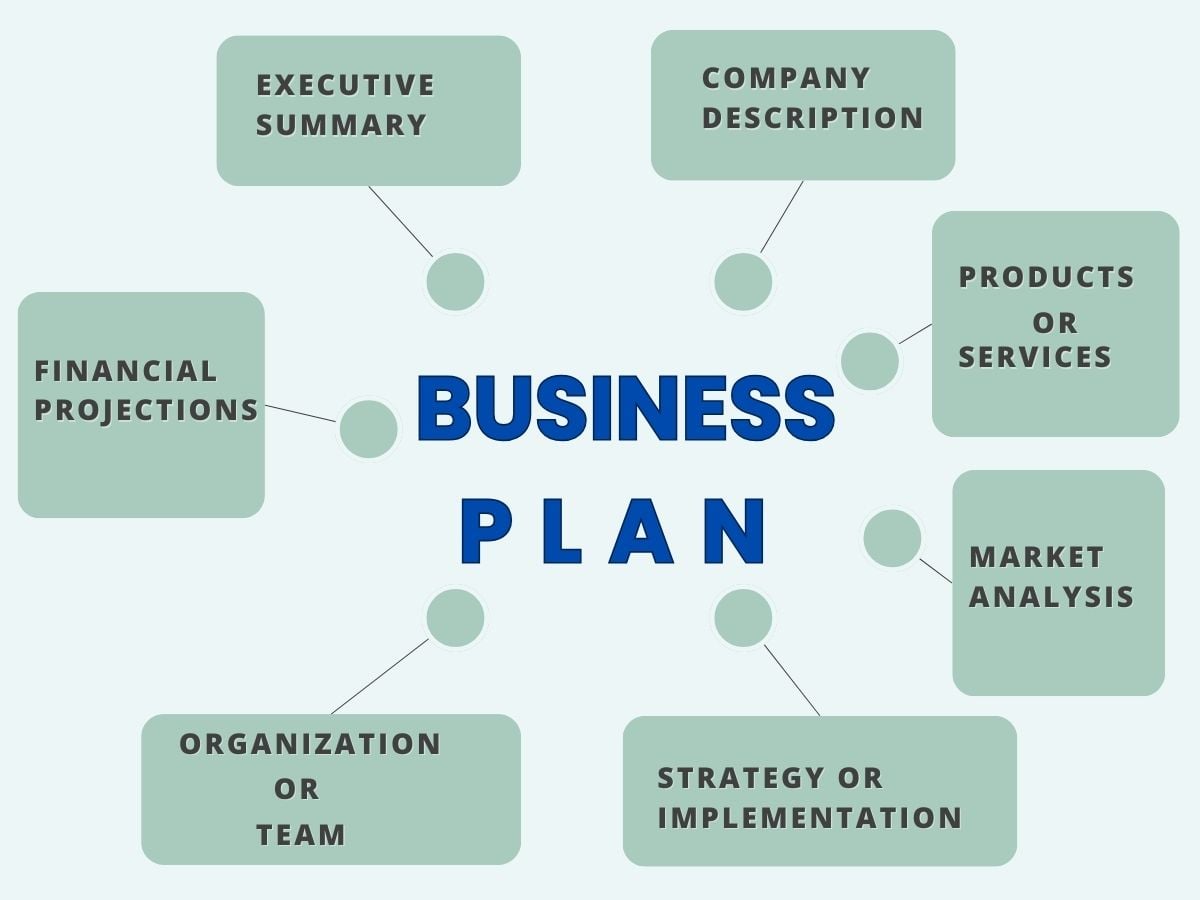
Essential elements of a business plan using templates:
Here are the key sections of a business plan that you can develop using business plan templates:
☑️ Executive summary:
A brief summary of your business idea, value proposition, competitive advantage, target market, and financial projections. This section should capture the reader's attention and motivate them to learn more about your business.
☑️ Company Description:
An overview of your company's legal structure, mission, vision, values, history, location, facilities, and leadership team. This section should highlight the unique aspects of your business and the factors that differentiate it from competitors.
☑️ Products or Services:
A detailed description of your products or services, their features, benefits, pricing, distribution, and intellectual property. This section should demonstrate the value and potential of your offerings to your target audience.
☑️ Market Analysis:
A comprehensive analysis of your market, industry, competition, trends, opportunities, and challenges. This section should provide insights into the customer needs, preferences, behaviors, and demographics, as well as the regulatory, economic, and technological factors that affect your business.
☑️ Strategy or Implementation:
An action plan that outlines the steps you will take to achieve your goals, such as product development, marketing, sales, operations, and financing. This section should describe your competitive positioning, marketing mix, pricing strategy, sales channels, and other strategies.
☑️ Organization or Team:
A profile of your company's organizational structure, human resources, management team, advisors, and partners. This section should demonstrate the qualifications, experience, and expertise of your team and how they contribute to your business success.
☑️ Financial Projections:
A forecast of your expected revenues, costs, profits, cash flow, and other financial variables over a certain period, such as three to five years. This section should demonstrate the viability, scalability, and profitability of your business and how you plan to use the funds to achieve your goals.
Different types of business plan templates and their respective uses:
There are many different types of business plan templates available, depending on your industry, audience, and purpose. Here are some common ones:
✔️ Pitch Decks:
A visual presentation that summarizes your business plan in a concise and compelling way, often used for pitching to investors, partners, or clients. Pitch decks typically feature slides with titles, images, graphs, and short descriptions that highlight the key points of your business plan.
✔️ One-Page Summaries:
A condensed version of your business plan that fits on a single page, often used for quick reference or as a teaser to attract interest. One-page summaries should include the most important and relevant information about your business, such as your value proposition, target market, revenue streams, and differentiation.
✔️ Traditional Multi-Page Documents:
A comprehensive and detailed version of your business plan that provides a deep dive into each section and includes supplementary data, tables, and appendices. Traditional multi-page documents require more time, effort, and research than other formats, but they offer more depth, specificity, and credibility.
✔️ Online Tools:
A digital platform that provides business plan templates, examples, tutorials, and feedback. Online tools can be free or paid, and they often offer user-friendly interfaces, cloud storage, collaboration features, and integration with other business tools.
Examples of well-known business plan templates or software:
Here are some examples of business plan templates and software that entrepreneurs can use:
LivePlan: A web-based platform that offers customizable business plan templates, financial forecasting tools, industry benchmarks, and collaboration features. LivePlan has helped more than a million entrepreneurs create business plans that cater to their specific industries and funding needs.
SCORE Business Plan Template: A free business plan template provided by SCORE, a non-profit organization that offers mentorship and education to small business owners. The SCORE Business Plan Template includes all essential sections of a business plan and provides tips and examples for each one.
BPlans: A website that offers hundreds of free business plan templates, guides, articles, and calculators. BPlans also provides premium content, such as sample business plans, SWOT analysis, and market research reports, for a fee.
Emphasizing the importance of tailoring the business plan template: While using a business plan template can save you time and effort, it's important to remember that one size does not fit all. Each business is unique in its goals, customers, products, and challenges, and a generic business plan template might not capture the nuances and complexities of your venture. Therefore, it's essential to tailor the business plan template to your specific needs and context.

Here are some tips on how to do so:
A. Reflect on your mission, vision, values, and goals.
Why are you starting this business, and what do you hope to achieve in the short and long term? What values and principles guide your decisions and actions?
B. Research your market, competition, and trends.
Who are your potential customers, and what are their needs, preferences, and behaviors? Who are your competitors, and what are their strengths, weaknesses, and strategies? What are the trends and opportunities in your market, and how can you leverage them?
C. Identify your unique value proposition.
What makes your products or services different, better, or more compelling than others? What benefits do you offer your customers, such as cost savings, convenience, quality, innovation, or sustainability? How do you communicate your value proposition to your target audience?
D. Address potential challenges and risks.
What are the potential obstacles, threats, or weaknesses that could affect your business? How do you mitigate or avoid them, and how do you prepare for them? Examples of challenges and risks include regulatory compliance, economic downturns, cash flow shortages, supply chain disruptions, cyber threats, and employee turnover.
Tips for writing a successful business plan
Here are some tips on how to write a business plan that is structured, compelling, and persuading:
✓ Keep it concise: Although your business plan might cover many aspects of your company, it's important to keep it focused on the most essential points. Avoid jargon, repetitions, or irrelevant details that might dilute your message or confuse your audience. Ideally, your business plan should be no longer than 20-30 pages, with an executive summary of no more than 2 pages.
✓ Use credible research and statistics: To support your claims and assumptions in the business plan, use reliable sources of information such as market research reports, industry benchmarks, customer surveys, and expert opinions. You can also cite case studies, success stories, or testimonials of similar businesses that have achieved your goals or overcome similar challenges.
✓ Create a strong value proposition: Your value proposition is your unique selling proposition that sets you apart from competitors in the minds of your customers. It should be clear, concise, and compelling, and address their pain points, benefits, and expectations. Your value proposition should be consistent across all aspects of your business, including your branding, marketing, sales, and customer service.
✓ Address potential challenges and risks: Don't shy away from acknowledging the risks and challenges that your business might face along the way. Instead, show how you plan to mitigate or overcome them, and how you will adapt your strategy to changing circumstances. This demonstrates to your stakeholders that you are prepared and proactive in managing risks.
Common mistakes to avoid when creating a business plan:
Entrepreneurs often make some common mistakes when creating a business plan. These include:
❌ Overestimating revenue: While it's tempting to project high revenues and profits, it's important to be realistic and conservative in your financial projections. Otherwise, you might set unrealistic goals, fail to meet them, and lose credibility with your stakeholders.
❌ Underestimating costs: Similarly, don't underestimate the costs of starting and running your business. You need to account for all expenses, such as rent, salaries, marketing, equipment, supplies, taxes, and legal fees, and make sure your revenue can cover them.
❌ Ignoring competitors: Your competitors are your main source of challenge and inspiration. You need to research them thoroughly, understand their strengths and weaknesses, and find ways to differentiate yourself from them. Otherwise, you might lose market share or fail to attract investors who have seen similar businesses before.
❌ Neglecting ongoing updates: Your business plan is not a static document, but a living one that should evolve with your business. You need to update it regularly to reflect changes in your market, customer feedback, financial performance, and other factors that affect your business. Otherwise, you might miss out on opportunities or fail to anticipate risks.
Case studies or success stories of businesses that have effectively utilized business plan templates:
Many successful businesses have used business plan templates to create a roadmap for their growth and success.
Here are some examples:
Tesla: Tesla's business plan was originally created in 2006 and featured a well-structured and compelling vision for the electric car industry, including a clear value proposition, a long-term strategy, partnerships, and financial projections. Today, Tesla is one of the most innovative and disruptive companies in the world, with a market capitalization of over $700 billion.
Airbnb: Airbnb's business plan initially focused on providing a peer-to-peer platform for renting rooms and homes to travelers. Their plan included a clear value proposition, a customer-centric approach, an innovative business model, and a sustainable growth strategy. Today, Airbnb is one of the most popular and profitable travel companies in the world, with a market cap of over $100 billion.
Square: Square's business plan was aimed at disrupting the traditional payment processing industry by offering mobile card readers and processing systems for small businesses. Their plan included a strong value proposition, a clear target market, an innovative pricing strategy, and a scalable platform. Today, Square is a leading fintech company that serves millions of merchants worldwide, with a market cap of over $100 billion.
Benefits of having a well-written and comprehensive business plan:
A well-written and comprehensive business plan can bring many benefits to your business, such as:
Attracting investors:
Investors want to see a clear and convincing plan for how you will use their money to achieve your goals. A well-written business plan can help you demonstrate your credibility, market potential, and financial projections, and convince investors to support your vision.
Securing loans:
Similarly, lenders want to minimize their risk and ensure that you have a viable plan for repaying their loans. A well-written business plan can help you show your financial stability, market opportunities, and cash flow projections, and qualify for a loan at a favorable rate.

Defining business objectives:
A well-written business plan can help you clarify your vision, mission, values, goals, and strategies, and align your company culture and communication around them. This can boost morale, motivation, and performance among your team and stakeholders.
Anticipating risks and challenges:
A well-written business plan can help you identify the risks and challenges that your business might face along the way, and prepare for them proactively. This can minimize the impact of negative events, reduce uncertainty, and increase your resilience and adaptability.
Encourage readers to seek feedback and guidance from advisors, mentors, or peers:
While a business plan template can provide you with a solid foundation for your plan, , includes: seek feedback, guidance, and validation from people who have more experience and expertise than you.
Here are some resources you can turn to:
Advisors: Advisory boards or consultants can offer objective and strategic advice on your business plan, based on their industry, market, or functional expertise.
You can hire them either on a project or ongoing basis, and compensate them with equity, cash, or a combination.
Mentors: Mentors are seasoned entrepreneurs or business leaders who can share their knowledge, networks, and insights with you and help you grow your business. You can connect with mentors through online forums, local or national associations, or networking events.
Peers: Peer-to-peer feedback can also be valuable, as it allows you to learn from other entrepreneurs who are facing similar challenges or opportunities. You can join online or offline communities, such as LinkedIn groups, Meetup groups, or business incubators, and exchange ideas, feedback, and support with other members.
Creating a business plan can be a daunting and rewarding task, especially if you use the right tools and methods. A business plan template can help you save time, structure your ideas, and present a professional and credible plan for your business. By following the guidelines outlined in this article, you can create a strong and effective business plan that sets you on the path to success in your respective industry. Remember, your business plan is not only a document, but also a mindset and a culture that guides your actions and decisions. Good luck!
Discover the Right Tools for Your Startup
Take our 2-minute quiz to find tools tailored to your specific needs and goals.
Take the QuizTakes only 2 minutes


