
Decoding the Marketing Funnel: Beginner's Guide
Discover the power of the marketing funnel in driving business growth. Learn its stages and best practices for success in today's digital landscape.

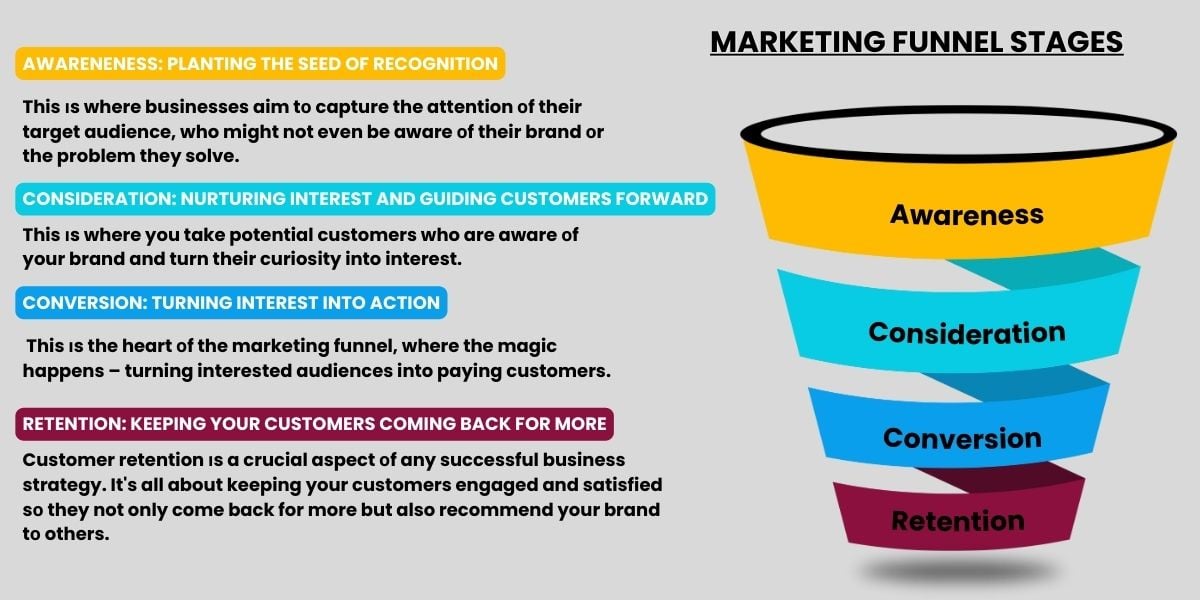
Imagine a funnel, wide at the top and narrowing at the bottom. This is a helpful way to visualize the marketing funnel, a framework that outlines the customer journey from initial awareness to final purchase and beyond.
Think of it like this:
- At the top of the funnel (awareness stage), businesses aim to grab attention and make potential customers aware of their brand and offerings. This might involve social media marketing, informative blog posts, or eye-catching advertisements.
- As potential customers become more interested (consideration stage), businesses can nurture that interest by providing valuable content, like ebooks or webinars, that address their specific needs and showcase expertise.
- Once potential customers are ready to make a decision (conversion stage), businesses can offer incentives like discounts or free trials to encourage the purchase.
- Finally, even after a purchase (retention stage), businesses can continue to foster customer loyalty through personalized experiences, exclusive rewards, and exceptional customer service, encouraging repeat business and positive word-of-mouth.
By understanding and implementing these stages in the marketing funnel, businesses of all sizes can do customer acquisition, build brand loyalty, and ultimately achieve sustainable growth in today's competitive digital landscape.

Exploring Each Stage of the Marketing Funnel: The Power of Sales Funnels
- Imagine a funnel: wide at the top, narrowing towards the bottom. This is a helpful way to visualize the marketing funnel, a framework that outlines the customer journey from initial awareness to final purchase.
✴️ The first stage of the funnel is Awareness. This is where businesses aim to capture the attention of their target audience, who might not even be aware of their brand or the problem they solve.
Here are some strategies businesses can use to generate awareness at the top of the funnel:
- Content marketing: Create informative and engaging content, like blog posts, articles, or videos, that addresses your target audience's needs and interests. This educates them and positions your brand as a thought leader.
- Social media campaigns: Use social media platforms to connect with your audience, share valuable content, and run targeted ads to reach new potential customers.
- Public relations efforts: Generate positive media coverage through press releases, influencer marketing, or community events to build brand awareness and credibility.
By implementing these strategies, businesses can attract potential customers, spark their interest, and begin building their brand reputation.
A strong example of awareness generation is Buffer's blog. They publish informative and valuable articles on social media marketing, attracting readers who might not be familiar with the brand yet. This raises awareness of Buffer and positions them as a trusted resource in the industry.
✴️Consideration: Nurturing Interest and Guiding Customers Forward
The consideration stage of the marketing funnel is where you take potential customers who are aware of your brand and turn their curiosity into interest. This is where you convince them to learn more about what you offer and why it's the best solution for them.
Here are some key strategies to nurture interest in the consideration stage:
- Email marketing: Send informative and engaging emails to educate potential customers about your brand, products, and services. Offer valuable content like industry reports, case studies, or educational webinars that address their pain points and showcase your expertise.
- Personalized content: Tailor your content and messaging to the specific needs and interests of each potential customer. This could involve segmenting your email list or using website personalization tools to deliver relevant content based on their browsing behavior.
- Targeted online advertisements: Utilize online advertising platforms to reach potential customers who are already searching for products or services related to yours. This allows you to target specific demographics and interests, ensuring your message reaches the most relevant audience.
HubSpot, a marketing software company, is a great example of using the consideration stage effectively. They offer a variety of free resources, such as ebooks and guides, that educate and engage potential customers. This valuable content helps build trust and positions HubSpot as a thought leader in the industry, ultimately driving potential customers further down the marketing funnel towards conversion.
✴️Conversion: Turning Interest into Action
The conversion stage is the heart of the marketing funnel, where the magic happens – turning interested audiences into paying customers. This is where all your previous efforts to raise awareness and generate interest pay off.
Here are some strategies businesses can use to optimize the conversion stage:
- Limited-time promotions: Create a sense of urgency and encourage immediate action by offering special discounts or deals that expire after a certain period.
- Free trials or samples: Allow potential customers to experience your product or service firsthand with free trials or samples. This can help them overcome purchase hesitation and build trust.
- Compelling discounts: Offer attractive discounts to incentivize purchase decisions, especially for first-time customers.
- Clear calls to action: Make it crystal clear what you want potential customers to do next, whether it's signing up for a free trial, subscribing to a service, or making a purchase. Use strong and direct calls to action (CTAs) throughout your marketing materials.
A great example of conversion optimization is Dollar Shave Club's referral program. They offer existing customers incentives, like discounts or free products, for referring their friends. This not only encourages new customers to try the service (conversion) but also fosters brand loyalty among existing customers.
✴️Retention: Keeping Your Customers Coming Back for More
Once you've converted potential customers into paying ones, the work isn't over. In fact, customer retention is a crucial aspect of any successful business strategy. It's all about keeping your customers engaged and satisfied so they not only come back for more but also recommend your brand to others.
Here are some strategies businesses can use to drive customer retention:
- Personalized experiences: Make your customers feel valued by offering personalized experiences. This could involve remembering their preferences, recommending products based on their purchase history, or tailoring your communication style to their needs.
- Exclusive discounts and rewards: Reward loyal customers with exclusive discounts, loyalty programs, or early access to new products. This shows them you appreciate their business and incentivizes them to keep coming back.
- Exceptional customer service: Provide excellent customer service by resolving their issues promptly and efficiently, addressing their concerns with empathy, and going the extra mile to exceed their expectations.
A masterclass in customer retention is Amazon, with its Prime membership program and personalized product recommendations. Prime members enjoy benefits like free shipping, exclusive deals, and access to streaming services, creating a strong incentive to keep their membership active. Additionally, Amazon uses data-driven insights to recommend products that individual customers are more likely to be interested in, fostering a personalized shopping experience that keeps them engaged.
By implementing these strategies, businesses can build strong customer relationships, encourage repeat purchases, and ultimately achieve long-term success.
Conquering Marketing Funnel Challenges: Best Practices for Success
The marketing funnel is a powerful tool, but it's not without its challenges. Here are some common hurdles businesses face and how to overcome them:
Challenge 1: Tracking the right data: It can be overwhelming to know what information to track.
Solution: Focus on key metrics that tell you how your campaigns are performing at each stage of the funnel. This might include website traffic, email open rates, conversion rates (e.g., how many website visitors become paying customers), and customer lifetime value (how much a customer spends over time).
Challenge 2: Choosing the right marketing channels: With so many options available, it's hard to know where to focus your efforts.
Solution: Consider your target audience and the stage of the funnel you're targeting. For example, social media might be a good fit for awareness, while email marketing could be more effective for nurturing leads in the consideration stage. A/B testing, which involves comparing different versions of your marketing materials to see which performs better, can also help you determine the most effective channels for your specific audience and goals.
Challenge 3: Creating content that resonates with your audience: Generic content won't connect with anyone.
Solution: Develop buyer personas, which are detailed profiles of your ideal customers. This helps you understand their needs, interests, and pain points, allowing you to tailor your content to resonate with them at each stage of the funnel.
By following these best practices and addressing common challenges, you can effectively implement the marketing funnel and achieve your business goals.
Remember, the key is to track your progress, experiment and test different strategies, and continuously refine your approach to reach and convert your target audience.
Conquering Marketing Funnel Challenges: Best Practices for Success
The marketing funnel is a powerful tool, but it's not without its challenges. Here are some common hurdles businesses face and how to overcome them:
Challenge 1: Tracking the right data: It can be overwhelming to know what information to track.
Solution: Focus on key metrics that tell you how your campaigns are performing at each stage of the funnel. This might include website traffic, email open rates, conversion rates (e.g., how many website visitors become paying customers), and customer lifetime value (how much a customer spends over time).
Challenge 2: Choosing the right marketing channels: With so many options available, it's hard to know where to focus your efforts.
Solution: Consider your target audience and the stage of the funnel you're targeting. For example, social media might be a good fit for awareness, while email marketing could be more effective for nurturing leads in the consideration stage. A/B testing, which involves comparing different versions of your marketing materials to see which performs better, can also help you determine the most effective channels for your specific audience and goals.
Challenge 3: Creating content that resonates with your audience: Generic content won't connect with anyone.
Solution: Develop buyer personas, which are detailed profiles of your ideal customers. This helps you understand their needs, interests, and pain points, allowing you to tailor your content to resonate with them at each stage of the funnel.
By diligently following these best practices and proactively tackling common challenges, you're setting the stage for a marketing strategy that's not only effective but transformative. It's about more than just pushing your business goals forward; it's about creating a connection with your audience that's both meaningful and lasting.
Navigating the intricacies of the marketing funnel can be like finding your way through a maze, but with the right tools at your disposal, reaching the end goal becomes a journey worth embarking on. Developing buyer personas is like having a map in hand. These detailed profiles shed light on who your ideal customers are, illuminating their desires, fears, and motivations. This invaluable insight allows you to craft content that speaks directly to them, engaging them at every twist and turn of the funnel.
Remember, the essence of mastering the marketing funnel lies in your willingness to adapt and evolve. Constantly tracking your progress, engaging in thorough market analysis, experimenting with different strategies, and tirelessly refining your approach are the cornerstones of not just reaching but captivating your target audience. By doing so, you transform the daunting task of navigating the marketing funnel into an opportunity to elevate your brand and leave an indelible mark on your audience.
The Future of the Marketing Funnel: Embracing New Technologies and Trends
The marketing funnel, like any dynamic ecosystem, is constantly evolving. As new technologies and trends emerge, businesses must adapt and innovate to remain competitive. Here are some exciting possibilities shaping the future of the marketing funnel:
- Hyper-personalization: Imagine tailoring the customer journey at an individual level, anticipating needs and preferences with uncanny accuracy. This can be achieved through advanced analytics, machine learning, and real-time data to create a truly personalized marketing experience at every stage of the funnel.
- Immersive experiences: The rise of virtual reality (VR) and augmented reality (AR) opens doors to engaging and interactive marketing experiences. Imagine allowing potential customers to virtually "try on" your product or explore your service offerings in a 3D environment. These immersive experiences can capture attention, spark emotions, and leave a lasting impression at the awareness and interest stages.
- Voice search optimization: With the growing popularity of voice assistants, optimizing your content for voice search becomes crucial. By understanding how people naturally ask questions and incorporating relevant keywords, you can ensure your brand is easily discoverable at the very beginning of the customer journey.

Embracing these emerging trends is no longer a luxury, it's a necessity for businesses seeking to thrive in the ever-evolving marketing landscape. Don't be afraid to experiment and explore these new avenues. Remember, the future of the marketing funnel belongs to those who dare to innovate and adapt.
Mastering Your Journey
In wrapping up our exploration of the marketing funnel—a concept both simple in its visualization yet complex in its execution—we’ve embarked on a journey from the broad awareness stage down to the focused point of purchase and the crucial beyond: fostering loyalty. Understanding and mastering each segment of this funnel is not just critical; it's transformative for businesses, particularly for new entrepreneurs and startup owners.
As you stand on the threshold of your entrepreneurial voyage, let this guide serve not only as a map but also as a beacon, illuminating the path through the intricate landscapes of customer relationships. Remember, the funnel is more than a pathway to sale; it's a cycle of creating lasting connections.
Stepping into the entrepreneurial arena can be intimidating, but armed with insight into the marketing funnel, you're better equipped to navigate the intricacies of customer relationships. It's not just about making a sale; it’s about building a journey for your customer where each touchpoint is an opportunity to strengthen that bond.
So, to all new entrepreneurs and startup owners, let this be a rallying cry: your vision, backed by a strategic approach to the marketing funnel, has the power to transform the marketplace. Embrace each stage of the funnel, not as hurdles, but as stepping stones towards building an enduring legacy.
May your passion fuel your journey, your strategy guide your path, and your determination push you through challenges. Here’s to your success, as you kickstart your venture and beyond. Remember, the world of entrepreneurship is not just about reaching the top; it’s about leaving a trail that inspires others to follow.
Discover the Right Tools for Your Startup
Take our 2-minute quiz to find tools tailored to your specific needs and goals.
Take the QuizTakes only 2 minutes


