
Exploring the Essential Elements of Business Planning
Explore the essential elements of business planning for entrepreneurs. Learn how market analysis, financial projections, and operational strategies contribute to success.

Starting a new business venture can be an exhilarating yet challenging journey. The success of the endeavor heavily relies on a solid foundation built with comprehensive business planning.
A well-structured and strategic plan can pave the way for triumph, while a lack of planning can lead to failure. In fact, studies have shown that entrepreneurs who invest time and effort into effective business planning have higher chances of success. In this article, we will delve into the essential elements of business planning and why they hold immense significance for entrepreneurs.
Market Analysis
One of the crucial elements of business planning is conducting a comprehensive market analysis. Market research helps entrepreneurs identify their target audience, understand industry trends, and evaluate competition. By gathering detailed insights into their potential customers' preferences, behaviors, and needs, entrepreneurs can tailor their products or services accordingly, resulting in increased customer satisfaction and loyalty.
To perform effective market analysis, entrepreneurs can employ various techniques. Surveys, focus groups,and interviews are invaluable tools for collecting valuable data directly from the target audience. Observing industry trends, analyzing competitors' strategies, and studying consumer buying patterns are equally vital. By incorporating these techniques, entrepreneurs gain a thorough understanding of their market, thus positioning themselves strategically and effectively.

Sample Market Analysis Template:
1. Executive Summary: 📄
- Provide a brief overview of the market analysis findings.
- Include key insights and highlights from the research.
2. Target Audience Analysis: 🔍👨👩👦👦
- Describe the demographics, psychographics, and buying behaviors of the target audience.
- Outline the potential size and growth of the target market.
- Identify any segments within the target market and their specific needs.
3. Industry and Market Trends: 📉
- Analyze the current trends and developments in the industry.
- Identify any macroeconomic factors that may impact the market.
- Research and highlight any emerging technologies or innovations that could influence the market.
4. Competitor Analysis: 🛍️
- Identify direct and indirect competitors within the market.
- Evaluate their strengths, weaknesses, opportunities, and threats.
- Assess their pricing strategies, product offerings, and market share.
5. Customer Insights: 👨🏻💻
- Present findings from surveys, interviews, or focus groups conducted with the target audience.
- Highlight customer preferences, behaviors, and needs.
- Identify any challenges or pain points customers may have and how your product or service can address them.
6. Market Potential and Opportunity: 📊
- Estimate the overall market size and potential for growth.
- Identify any untapped or underserved segments within the market.
- Evaluate the potential demand for your product or service and its potential fit within the market.
7. Conclusion: 📃
- Summarize the key findings and insights from the market analysis.
- Highlight any opportunities or challenges that may arise.
- Discuss how the market analysis findings will inform your business strategy and decision-making.
Remember, market analysis is an ongoing process, and it is crucial to continually monitor and update your findings as the market evolves. Regularly revisiting and updating your market analysis will ensure that your business remains competitive and aligned with the changing needs and preferences of your target audience.
Financial Projections
Creating realistic financial projections is another critical element of business planning. These projections include sales forecasts, expense estimates, and profit expectations, providing entrepreneurs with a clear vision of their financial prospects and ensuring they are well-prepared to meet their economic goals.
Accurate financial projections play a pivotal role in securing funding. Investors and lenders heavily rely on these projections to evaluate the potential profitability and financial viability of a business. Entrepreneurs who present well-researched and accurately projected financial data are more likely to attract investors, thus increasing their chances of obtaining the necessary funds for their venture.
To gather data for financial projections, entrepreneurs can tap into market research, industry benchmarks, and historical data. In addition to seeking guidance from financial experts or utilizing financial planning software can aid in making accurate predictions. Remember, it is crucial to be realistic and conservative in financial projections to prevent overestimation and set achievable goals.
For example, let's say an entrepreneur is starting a bakery. They would need to estimate their sales based on market research, considering factors such as the demand for baked goods in the area and the target customer base. They would also need to estimate their expenses, taking into account the cost of ingredients, equipment, and employee wages. Finally, they would project their profits by subtracting their estimated expenses from their projected sales.
Accurate financial projections are essential for securing funding from investors and lenders. These parties rely heavily on the projections to evaluate the potential profitability and financial viability of a business. Entrepreneurs who present well-researched and accurately projected financial data are more likely to attract investors and increase their chances of obtaining the necessary funds for their venture.
Operational Strategies
Effective operational strategies are the backbone of any successful business plan. Determining the optimal business structure, outlining organizational roles, and developing efficient processes are pivotal for smooth operations and resource management.
Entrepreneurs must carefully define their business structure, whether it is a sole proprietorship, partnership, or corporation. This decision affects aspects such as taxation, liability, and management. By choosing the most suitable structure, entrepreneurs set the foundation for their business's legal and operational framework.
Clearly outlining organizational roles is essential for ensuring that responsibilities are properly assigned and employees understand their positions within the company. With well-defined roles, entrepreneurs can promote productivity and prevent confusion or redundancy within the workforce. One more thing is to developing efficient processes, from inventory management to customer service protocols, streamlines operations and enhances overall productivity.
Real-life examples of operational strategies implemented by renowned entrepreneurs can serve as inspiration for aspiring business owners. Steve Jobs' emphasis on innovation and design at Apple or Richard Branson's focus on employee empowerment at Virgin Group are just a few examples of how strategic operational decisions can contribute to a business's resounding success.
1. Define Business Structure:Start by determining the most suitable business structure for your organization, whether it is a sole proprietorship, partnership, or corporation. Consider factors such as taxation, liability, and management. Choose the structure that aligns with your long-term goals and sets the legal and operational framework for your business.
2. Outline Organizational Roles: Clearly define the roles and responsibilities of each member of your organization. This includes assigning tasks, setting expectations, and promoting accountability. By outlining organizational roles, you ensure that employees understand their positions and can work efficiently without confusion or redundancy.
3. Develop Efficient Processes: Streamline your operations by developing efficient processes. This includes inventory management, customer service protocols, and any other operational procedures. Identify areas where improvements can be made to increase productivity, reduce waste, and enhance overall efficiency. Continuously evaluate and refine your processes to adapt to changing market conditions and demands.
4. Learn from Successful Entrepreneurs:Look for real-life examples of operational strategies implemented by successful entrepreneurs and business leaders. Study their approaches and learn from their experiences. For example, Steve Jobs emphasized innovation and design at Apple, while Richard Branson focused on employee empowerment at Virgin Group. Take inspiration from their strategic operational decisions and adapt them to your own business.
Business Planning Elements Relevance and Benefits
The relevance of these planning elements cannot be overstated. It involves studying the market, figuring out how to earn money, and making decisions about how the business will work. By doing all of this, entrepreneurs can increase their chances of getting money, lower the risks, and make smart choices.
Investing time and effort into holistic business planning offers a wide range of benefits, including:
✔ Increased chances of obtaining funding from investors and lenders: By including market analysis and financial projections in a business plan, entrepreneurs can demonstrate to potential investors and lenders the viability and potential profitability of their business. This increases the likelihood of securing funding to support business growth and expansion.
✔ Enhanced understanding of the target market: Through market analysis and research, entrepreneurs can gain a deeper understanding of their target market's needs, preferences, and purchasing behavior. This information can then be used to refine and improve the product or service offerings to better meet customer demands, leading to increased customer satisfaction and loyalty.
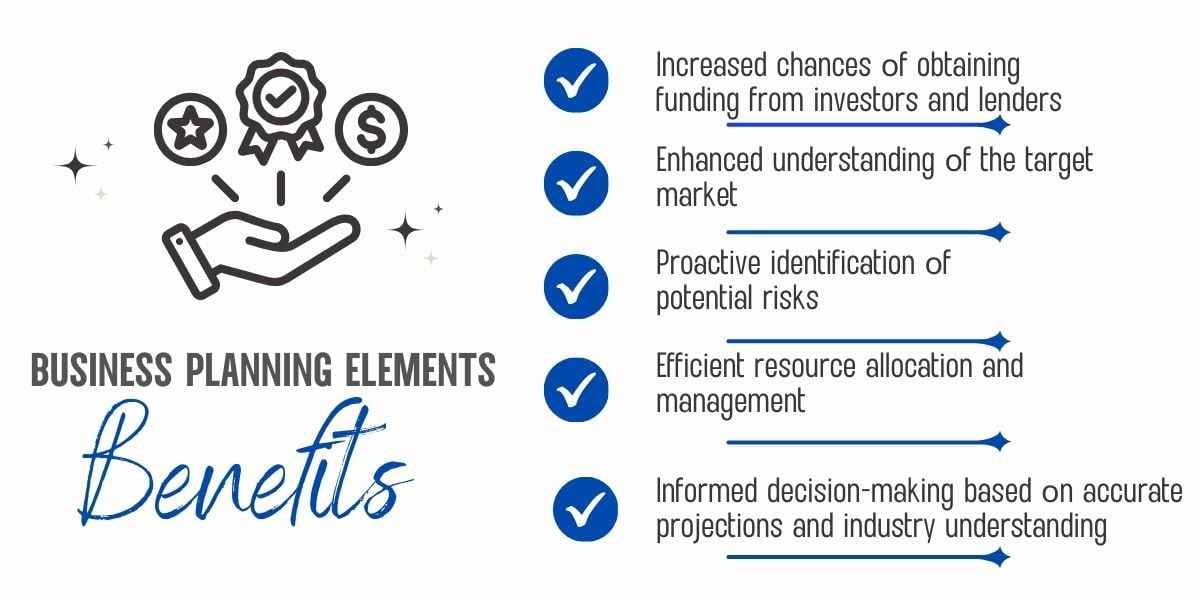
✔ Proactive identification of potential risks: Business planning allows entrepreneurs to identify potential risks and challenges that may arise in the course of their operations. By anticipating these risks, entrepreneurs can develop contingency plans to mitigate their impact and minimize disruptions to the business. This increases the resilience and adaptability of the business in the face of unexpected events.
✔ Efficient resource allocation and management: Through comprehensive business planning, entrepreneurs can accurately assess their resource needs and allocate them effectively. This includes human resources, financial resources, and physical assets. By optimizing resource allocation, businesses can maximize productivity, reduce waste, and minimize costs, leading to improved operational efficiency and profitability.
✔ Informed decision-making based on accurate projections and industry understanding: Having a good business plan helps entrepreneurs understand the industry and what's happening in the market. This understanding helps them make smart decisions and avoid costly mistakes. By relying on accurate projections and industry insights, entrepreneurs can make informed choices that increase their chances of success.
Tips to Adequately Write Down Your Business’s Products/Services in Your Business Plan
Describe in Clear, Simple Terms: Use simple, clear language that anyone can understand, avoid buzzwords and technical jargon. Your product/service should be comprehensible to anyone who picks up your plan.
Highlight Unique Selling Proposition (USP): What sets your product or service apart from others available in the market? Discuss this in detail. Your USP is especially important if there is strong competition for your product or service.
Discuss Development Stage: Is your product or service just an idea, or has it been rolled out? Being clear about the stage of development your product or service is in gives clarity to timeline projections.
Cover the Lifecycle: Discuss the lifecycle of your product/service. Offer insights on production, distribution, and any after-sales services associated with it.
Talk about Intellectual Property: If your product/service or its elements are protected by patents or copyrights, make sure to highlight this point.
Summing it up, the 'products or services' section is the one part of your business plan where you get to show off what your business will deliver to its customers.
It's not just a catalog; it’s a chance to further translate your vision and objectives into something that people can see and value. Approach this section as a mini-sales pitch, exhibiting your product or service's uniqueness, essential attributes, and benefits. It is a fantastic opportunity to convince investors that your business is a worthwhile investment.
The Power of Implementing Elements of Business Planning for Startups
Starting your own business, whether it's a lemonade stand or an innovative app, is an exhilarating journey that stems from your desire to bring something unique and captivating to the world.
The initial spark of an idea ignites your passion, driving you to embark on this entrepreneurial adventure. However, it is crucial to understand that a good idea alone is not enough to guarantee success in the competitive business landscape.
That's when the elements of business planning become super important. Grounding your idea in a plan helps you build a strong base for your project, giving you tools to overcome hurdles and reach your goals. It is like having a handy map to navigate your adventure as a young entrepreneur.
Including business planning in your project is like having a superpower for your young business. It helps you know where you're going, makes people trust you more, and helps you deal with problems. It also helps you use your resources wisely and come up with creative and cool ideas. With business planning, you'll have the energy and motivation to handle anything that comes your way on your business journey.
It's important to have a plan if you want to be successful in business. Spend time and work hard on creating a detailed business plan to guide you toward a successful future. Planning is a powerful tool that can help you achieve your dreams as an entrepreneur.
Discover the Right Tools for Your Startup
Take our 2-minute quiz to find tools tailored to your specific needs and goals.
Take the QuizTakes only 2 minutes


