
Mastering Business Planning Writing: Guide for Entrepreneurs

In today's relentlessly hustling and bustling business domain, the critical nature of a meticulously articulated business plan cannot be emphasized enough. Whether you are standing at the epoch of your entrepreneurial journey or an already established startup owner envisaging to steer your venture to unprecedented heights, honing the craft of business plan writing is indispensable.
This comprehensive guide aims to furnish you with profound insights and pragmatic tips on sculpting an efficacious business plan. It encapsulates key pointers that form a robust launchpad gearing your business up for an entrepreneurial triumph.
The Paramount Importance of Business Planning
Crafting a well-structured business plan plays a critical role in distinguishing businesses that rise above the noise and those that drown in the crowd. Here's an elaboration on reasons why this holds:
🔶 Charting Goals and Strategies:
A business plan serves as a strategic roadmap—guiding organizations to make informed decisions ensuring alignment with their overarching vision. Having your goals laid out with associated strategies not only serves as a reference guide but also, it empowers businesses to track their progress against set objectives. Here, having an expert get a business plan written or resorting to writing a business plan online can indeed be a precious resource.
Example: A fintech startup planning to disrupt the market might focus on goals like customer acquisition, platform development and regulatory compliance. Their corresponding strategies might include influencer marketing, agile development methodologies and hiring a compliance officer, respectively.
🔶 Unveiling Target Market:
A pivotal aspect of writing a business plan is conducting a thorough market research. This exercise aids in identifying the potential target market segment, comprehending customer predilections, unmet needs and sizing up the competition. Essentially, devouring current market trends enables entrepreneurs to position their offerings effectively, thereby gaining a competitive advantage.
Example: An eco-friendly clothing brand, through market research, might realize that their primary target market is environmentally conscious millennials. This will enable them to align their marketing strategy effectively towards this audience.

Business Planning: A Key to Rise Above the Noise and Steer Your Business to Success
Meticulously crafting a well-structured business plan can play a pivotal role in the lifecycle of any entrepreneurial venture. It acts as a blueprint for entrepreneurs to navigate through the fierce landscape of business, laying out the foundation stones - goals, strategies, market analysis, and more.
How a well-crafted business plan can help entrepreneurs is by providing a coherent structure and framework to systematically approach each facet of the enterprise. Let's deep dive into the various sections that are critical for crafting a business plan to start and sustain a successful business.
Charting Goals and Strategies: Navigate With a Roadmap
A business plan serves as a strategic roadmap – it guides organizations to make informed decisions that closely align with their overarching vision. Setting clear goals and strategies is essential for business planning as it defines where you want to take your business and how you plan to get there. This concentration on goal-setting and strategic planning helps ensure that day-to-day operations align with long-term objectives.
Example:
A local cafe might aim to become the leading coffee destination in the community within five years. To achieve this, they could set interim goals such as expanding the menu, creating a loyalty program, and partnering with local businesses for cross-promotion.
🔹 How to Craft the Goals and Strategies Section:
- Define Key Objectives: List the overarching goals of your business within specific time frames.
- Establish Milestones: Translate these goals into tangible milestones to track progress.
- Strategize: Determine the approaches and tactics to meet each milestone.
- Resource Allocation: Assign resources and personnel to implement the strategies effectively.
- Unveiling Target Market: Understand Your Customers Better
By conducting thorough market research, entrepreneurs can uncover invaluable insights about their potential customers - insights that are crucial for guiding product development, marketing strategies, and service enhancements. Understanding the target market is not just about knowing who they are, but also about recognizing their intrinsic motivators and needs. This detailed knowledge enables entrepreneurs to craft offerings that resonate deeply with their audience.
Example:
An app development company might discover that their target market prizes user-friendly design and privacy. In response, they prioritize these aspects in their development plan, aligning perfectly with customer desires.
🔹 How to Conduct Target Market Research:
- Customer Profiling: Identify the demographics, psychographics, and behavioral patterns of your ideal customer.
- Competitive Analysis: Review the market space to understand where competitors excel or fall short.
- Differentiation: Articulate what makes your offerings unique and compelling.
- Data Collection: Employ surveys, focus groups, and data analysis to gather actionable market insights.
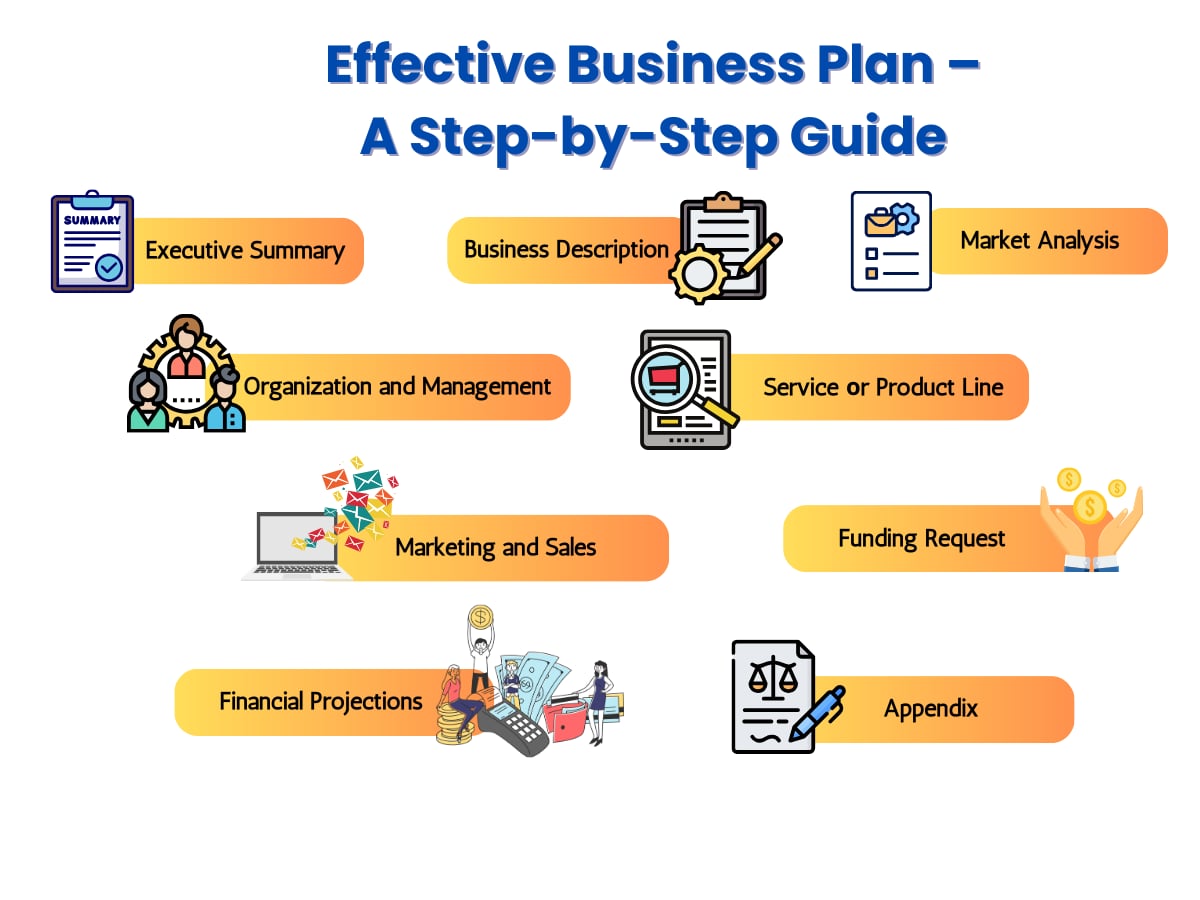
How to Create an Effective Business Plan – A Step-by-Step Guide
📝 Executive Summary
This section serves as an elevator pitch for your business. It should convey the essence of your venture, highlighting what sets you apart in the marketplace while summarizing the key components of your plan. Crafting a compelling executive summary is vital, as it's often the first (and possibly the only) part of your plan that investors or stakeholders will read.
Example:
A tech startup could introduce their groundbreaking AI platform in the executive summary, summarizing their unique value proposition - an AI that not only predicts user behavior but also assists in making life-enhancing decisions.
📝 Business Description
Your business description outlines what you do, why you do it, and whom you do it for. Here, the focus should be on communicating the essence of your business's existence, your vision, and the specific problem your product or service rectifies.
Example:
An organic skincare line would detail its commitment to sustainability and how its products provide a chemical-free alternative to skincare routines, filling a niche in the beauty industry.
A thorough market analysis offers credibility to your business plan. It showcases that you understand the trends, dynamics, and economics of your industry. This section proves that you are not entering the market blindly but with a clear and educated perspective.
Example:
An e-commerce clothing store might analyze the surge in online shopping and leverage data to pinpoint trends in fashion purchases, using this data to tailor their inventory and marketing strategy.
📝 Organization and Management
Detailing your organizational structure communicates to stakeholder's who is managing the business and their qualifications. This section should emphasize the team's strength and readiness to drive the company towards its mission.
Example:
A digital marketing agency would outline the experience of its founders in SEO and content creation while highlighting its agile team structure that allows swift adaptation to emerging trends.
📝 Service or Product Line
Explaining your products or services in depth is essential to demonstrate the value you offer to the market. This should include the lifecycle of your offerings and any R&D activities that could lead to further development and growth.
Example:
A software development company might discuss its flagship project management tool, detailing its features, benefits, and ongoing updates planned for future releases.
📝 Marketing and Sales
In this section, explain how you plan to attract customers to your business and convert interest into sales. Your strategy should be data-driven and align with the established goals and analysis of your target market.
Example:
A startup gym may use targeted social media campaigns and partnerships with health food stores to increase visibility and sales, alongside an aggressive pre-launch membership sign-up promotion.
📝 Funding Request
If external funding is required, state the amount needed, how the funds will be used, and your proposed terms for repayment or investment. It's essential to be clear and realistic about your funding needs to build trust with potential investors.
Example:
A renewable energy startup might need $2 million for equipment and installation costs, providing detailed forecasts showing how those funds will lead to profitable growth.
📝 Financial Projections
This section articulates the financial future of your business. Proper financial planning demonstrates to stakeholders that the business has a roadmap to financial sustainability and growth.
Example:
A mobile gaming company can project their revenue for the next five years based on user acquisition costs and average revenue per user, taking into account market trends and planned game releases.
📝 Appendix
The appendix should include any additional documents that support the claims made in the business plan. From legal agreements to detailed market research data, this section acts as the repository for due diligence material.
Example:
An import/export business might include trade licenses, contracts, and letters of intent from potential partners or clients in the appendix.
By meticulously crafting each section of the business plan and ensuring it's tailored to appeal to investors or stakeholders, entrepreneurs can significantly improve their chances of steering their business to success. A well-crafted business plan is a dynamic tool, evolving as the business grows, ensuring the business's vision stays clear and the path to success remains well-charted.
Experiences of Successful Businesses
Adding further insights to our business plan writing guide, let's take a moment to glean from the experiences of successful businesses that attribute their triumphs to a well-crafted business plan. These real-world examples show how strategic planning, market understanding, and dedicated execution can propel your business forward.
Company A: Strategic Clarity and Resource Attraction
Company A's journey toward immense success was charted through the meticulous analytical process of their business plan, enabling them to clearly identify market trends and cement robust strategies for growth. By creating a plan that showcased their strategic approach and presented clearly defined objectives, Company A was able to secure invaluable resources, as well as attract talented individuals to join their cause. Today, Company A continues to thrive, building upon the solid foundation laid by their business plan.
Company B: Attracting Investments and Rapid Scaling
Armed with a comprehensive business plan that encapsulated their value proposition, thorough competitive evaluation, and realistic financial projections, Company B managed to attract significant investments and rapidly scale their operations. Their success is a testament to the compelling power a well-written business plan brings to the table, not just in attracting financial support, but also in driving the growth and expansion of their business.
Navigating Entrepreneurship: Final Thoughts on Business Planning
The art of writing a business plan is more than just a skill; it is a necessity for all new business owners, aspiring entrepreneurs, and startups. At the heart of every thriving business lies a comprehensive and well-structured business plan, serving as a guiding compass. It aids in clear delineation of objectives, formulation of effective strategies, and identification of target markets.
As you navigate the intricate corridors of entrepreneurship, knowing how to make a business plan should be one of your primary armors. Make use of a small business planning template, if necessary. Remember, every step, every element you input into this plan, greatly influences the direction and pace at which your venture progresses.
To paraphrase a popular adage - success happens when preparation meets opportunity. By embracing the steps furnished in this guide, gleaning from real-life success stories, you have the opportunity to design an effective business plan.
This crucial document might seem daunting, but it's your map. It clearly shows your current location (your market as it is now) and your ultimate destination (your business goals). And most importantly, it outlines the route to traverse from the former to the latter.
So, don't be overwhelmed. Breathe. Take one step at a time. And trust the process. Entrepreneurship is a marathon, not a sprint. Equip yourself with the necessary knowledge. From understanding market dynamics to financial projections, each stride you take brings you closer to a better, more prosperous version of your business.
Leverage these insights, take action, and embark on building your entrepreneurial legacy. Remember, with your well-crafted business plan in hand, you are indeed on the path of success.
Startups and esteemed businesses alike all started from the same place - an idea. Allow the wisdom embedded in this business planning guide to propel that idea into reality. Success, after all, is no accident. It's hard work, perseverance, learning, and, most of all, loving what you're doing. Happy planning!
Discover the Right Tools for Your Startup
Take our 2-minute quiz to find tools tailored to your specific needs and goals.
Take the QuizTakes only 2 minutes


