
Sales Strategy and Planning: Factors for Business Success
Discover the vital role of sales strategy and planning in driving business success. Learn the key factors for effective sales planning and strategic execution.

Sales strategy and planning play a crucial role in the success of a business. From startups to established companies, having a well-structured sales plan can make a significant difference in achieving growth and profitability. In this article, we will explore the importance of sales strategy and planning, effective techniques, and how to implement them successfully.
Importance of Planning in Sales Strategy
Before diving into the intricacies of sales strategy, it is vital to understand the significance of planning. Planning allows businesses to set clear goals, define target markets, and identify key performance indicators. Without proper planning, sales efforts may lack direction and may not yield desired results. Effective planning maximizes sales opportunities, streamlines operations, and ensures long-term success.
Effective Planning Techniques

Sales planning is an essential aspect of any business strategy. It involves determining a set of processes, practices, and metrics that allow a company to sell its products or services most effectively. In this comprehensive guide on effective planning techniques, we will walk you through the primary steps and provide an updated "how to" section in each one.
1. Building up a Comprehensive Market Research
Market research is the heart of strategic planning. By providing crucial insights into customer preferences, industry trends, and comprehensive competitive analysis, you're better able to tailor your sales strategies to meet customer demands efficiently.
To conduct effective market research:
- Start by defining the problem or opportunity you want to address.
- Determine the demographics you want to research.
- Use methods such as questionnaires, focus groups, personal interviews, and observation to collect data.
- Analyze the collected data to draw meaningful insights that will guide your strategy.
The power of market research could lead your enterprise to uncover favourable markets, identify potential threats and untapped opportunities.
2. Understanding your Clients
Defining a target audience decisively is vital to crafting impactful sales strategies. Gathering all possible details about your potential consumers—demographics, needs, and pain points—allows businesses to create captivating and targeted sales messages.
To define your target audience:
- Identify who can benefit most from your product or service.
- Think like your customer: What do they value? What problems do they need solving?
- Survey your current customers to determine common demographics and interests.
- Monitor customer comments and reviews for additional insights and patterns.
By understanding your clients on a deeper level, you can craft messages that speak directly to them, meeting their needs and solving their problems effectively.
3. Blueprinting for Success
Goals play an instrumental role as they form the foundation of a successful sales plan. Set up your sales objectives to be specific, measurable, achievable, relevant, and time-bound (SMART). This guiding principle ensures that the efforts are targeted aptly and progress can be tracked effectively.
To set realistic goals:
- Understand your previous sales performance.
- Consider your business growth strategies and how your sales can support them.
- Define clear, achievable milestones.
- Set a timeline for when targets should be accomplished.
- Remember, successful goals are as dynamic as your business—be prepared to adjust and course-correct as necessary.
4. Designing Sales Workflow
Establishing a streamline sales process is invaluable. It ensures consistency in your approach and further offers your sales representatives a blueprint to follow—from prospecting to closing deals.
To establish sales processes:
- Outline each step of your sales process, from lead generation to follow-up.
- Identify key performance metrics at each stage.
- Provide training and resources to help team members understand and follow the process.
- Regularly review and refine your process based on performance and feedback.
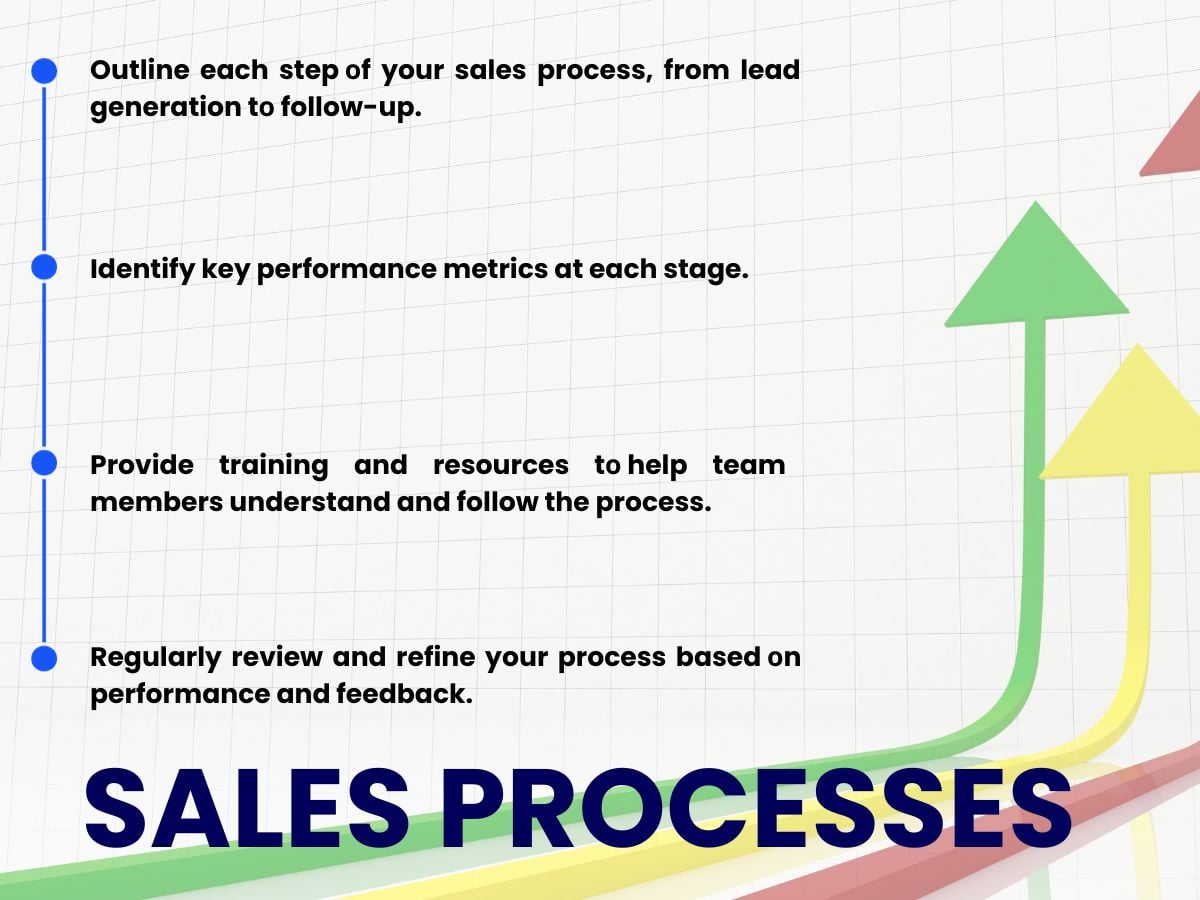
Formulating an efficient sales process not only drives in successful business deals but also aids you to avoid gaps or overlaps in your sales strategy, boosting your overall efficacy.
Equipping yourself with these effective planning techniques can guide you towards success. So, adopt them and evolve through constant learning and market dynamics.
Implementation Strategies
1. Choose the Right Sales Strategy:
There are various sales strategies to choose from, including consultative selling, relationship selling, and value-based selling. The selection of an appropriate strategy depends on the business model, industry, and target audience.
2. Training and Development:
Equipping sales teams with the necessary skills and knowledge is vital for successful implementation. Providing comprehensive training programs and continuous development opportunities enables sales representatives to perform effectively in their roles.
3. Leveraging Technology:
Utilizing sales tools and technologies can streamline processes, automate tasks, and enhance productivity. CRM software, sales analytics platforms, and communication tools enable businesses to monitor performance, track leads, and optimize their sales efforts.
The Link Between Sales Strategy and Business Goals
Aligning your sales strategy with your broader business goals is like a football coach designing plays to win the match. The coach's strategies (the plays) are formed with the bigger goal of winning the game in mind. For instance, if you own a bakery and your business goal for the year is to sell 100,000 pastries, your sales strategy might involve creating special holiday packages or bulk discounts to sell more pastries quickly.
Sales Forecasting, Target Setting, and Monitoring
Imagine a weather forecaster. He or she uses past weather patterns and current atmospheric conditions to predict what the weather will be like in the future. That's a bit like sales forecasting! As a business, you use historical sales data and knowledge about your market to predict how many products you'll sell in the future.
This helps you set targets for your sales team, kind of like a running coach setting a time target for his runners. If your targeted sales are lower than expected, you may need to take actions like boosting your marketing efforts or providing additional training for sales representatives.
Data Analysis and Market Research
Data analysis and market research are like detectives piecing together clues. For instance, by analyzing how many cupcakes your bakery sold last summer, you can predict the demand for the same in the upcoming summer. This analysis helps you plan to make enough cupcakes without wasting resources.
Similarly, market research helps you understand what your customers like to eat. Let's say you find out that chocolate cupcakes are the most popular, you might decide to introduce more chocolate-based desserts into your bakery menu. These clues (data and research) help your business decision-making and, ultimately, impact your sales.
Business Planning and Implementation
Formulating a Business Plan:
A business planning format usually encompasses an executive summary, company description, market analysis, organization and management, services or product lines, marketing strategy, funding request, and financial projections. Such a format encourages comprehensive exploration of the business's potential and challenges ahead.
Key Elements of a Business Plan:
Key elements include a thorough market analysis, understanding of the competition, a realistic sales and marketing strategy, and a clear snapshot of your business operation processes. These elements help in creating a roadmap for success.
Execute the Business Plan:
The process of execution requires continuous evaluation, adjustments according to current circumstances, and a high level of commitment. Without proper execution, even the best laid plans fail to realize their potential.
The Role of Research and Development
Innovation and Business Growth: Research and Development (R&D) plays a key role in fostering innovation, enhancing competitiveness, and driving business growth. It helps businesses stay ahead of the competition by introducing new products or improving existing ones.
Importance of R&D in Business Strategy: R&D helps identify new opportunities within the market, and enables formulation of strategies to capitalize on these opportunities. It's an essential element in strategic planning, particularly in fast-paced, competitive industries where businesses need to adapt and innovate constantly.
R&D and Market Development: R&D isn't only critical for new product development. It also helps companies gain a deeper understanding of the market and their customers, thus informing decisions related to market development strategies.
Marketing Strategy Development
Defining Marketing Goals:
Think about a basketball team. Their main goal is to score as many points as possible to win the game, right? In the same way, a business needs to have clear goals to guide its actions. Your marketing goal could be something like reaching more people (increasing your customer base), making sure more people know about your brand (brand awareness), or selling more products (increasing sales). It's like your target in the basketball game. Let's say, for example, you own a lemonade stand. Your marketing goal could be to sell 100 cups of lemonade a day.
Developing a Marketing Plan:
Once you've defined your goals, it's time to come up with a plan to achieve them. Going back to our basketball team, they need to set out a game plan to maximize their scoring chances. Similarly, for your lemonade business, you need to have a plan on how you'll sell those 100 cups of lemonade daily. Will you offer a special discount? Or, will you make sure your lemonade stand is more noticeable by using bright, attractive signs and decorations? Your marketing plan should detail who your customers are (target demographics) and how you'll reach them.
Execution and Measurement:
Having a plan is great, but it’s not enough to score your goals. You need to put that plan into action, just as the basketball team need to play the game following their tactics. Here, you'll start selling your lemonade following your marketing plan. But, it’s also important to track your progress. Are you selling as many cups of lemonade as you planned, or do you need to try something new? This is where analytics come in. Analytics are like the scoreboard in a basketball game. They tell you how well your plan is working so that you can make adjustments or changes as you move forward.
So, consider your marketing strategy like a game of basketball, where you have a goal, a plan to reach that goal, and a way to measure your progress. And don’t forget, both in basketball and business, practice and adjustments are key to winning the game!

Empowering Business Success Through Strategic Planning and Execution
Irrespective of the business's size or industry, planning and strategic decisions are the lifeblood of any successful venture. The ability to plan effectively and develop robust sales, research, and marketing strategies is a crucial ingredient in the recipe for business success.
Whether you are a seasoned business owner or a budding entrepreneur, careful planning is imperative. An effective business planning format is your roadmap, helping you focus on the big picture, make informed decisions, and prepare for future regulatory, economic, or market shifts.
Entrepreneurs should understand the power of thorough planning in every aspect of their ventures, particularly with regard to sales strategy and planning. Remember that a well-crafted and effectively executed sales strategy can serve as an engine that propels your business towards its goals.
It’s crucial to understand the invaluable implications of a solid sales strategy. It can help you define your business’s unique selling propositions, identify your target market, and structure your sales teams. It can also foster a deep understanding and segmentation of your target audience, enabling you to craft compelling sales messages.
Moreover, today’s dynamic business environment mandates the need for businesses to leverage technology and data analysis. The adoption and implementation of advanced technological tools can streamline your processes, optimize your efforts, and enhance overall productivity.
Similarly, data analysis and market research are vital for getting insights about customer trends, behaviors, and key market statistics. They aid in formulating sound strategies that keep your business relevant and competitive.
Intellectual property is another key consideration, especially for innovative businesses, as it can provide a significant competitive edge. By protecting your unique business ideas, techniques, and creations, you can prevent competitors from using them, thus ensuring the sustainability and profitability of your business.
Maintaining an entrepreneurial spirit amidst these tasks is critical. Remember, the drive, passion, creativity, and resilience synonymous with entrepreneurship are your best allies. These qualities will keep pushing you forward to overcome hurdles, seize opportunities, and make a mark in your business journey.
Therefore, no matter how challenging the task seems, remember that meticulous planning, execution, and constant improvement are integral to your success. Embrace these elements, pave your path to success, and let your business thrive in this era of endless possibilities and fierce competition. Let's make your entrepreneurial dream a reality!
Discover the Right Tools for Your Startup
Take our 2-minute quiz to find tools tailored to your specific needs and goals.
Take the QuizTakes only 2 minutes


