
SWOT Analysis Templates: Plan Your Business Success
Unlock your business potential with SWOT analysis! Master this strategic tool to identify strengths, weaknesses, opportunities, and threats, and chart a course for sustainable success.

Launching a venture is exhilarating, but navigating the complexities can feel overwhelming. To chart a clear course towards sustainable success, entrepreneurs need a powerful tool: SWOT analysis. By leveraging this valuable insight, you can craft targeted strategies that propel your business forward.
SWOT analysis is an iterative process, not a one-time exercise. Continuously revisit and refine your analysis as your business evolves and the market landscape shifts. With this commitment to strategic planning, you'll equip your venture with the tools and insights needed to thrive in the dynamic world of business.
So, are you ready to unlock the full potential of your business? Let's embark on this journey together!
What is SWOT Analysis?
SWOT analysis is a strategic planning tool used to identify and evaluate the internal and external factors impacting a business or project. The acronym SWOT stands for:
• Strengths – the positive attributes or resources that differentiate a business from its competitors.
• Weaknesses – the negative attributes or liabilities that hinder a business from achieving its goals.
• Opportunities – the external factors that present potential opportunities for a business to grow and excel.
• Threats – the external factors that pose risks or challenges to a business, such as economic changes or competitor actions.
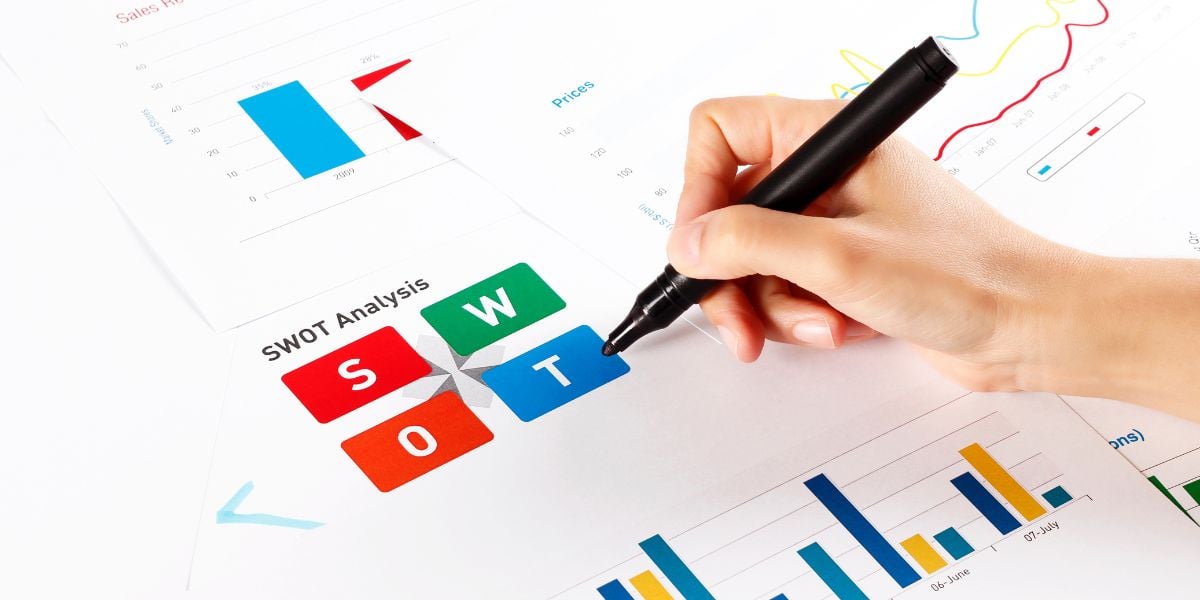
Chart Your Course: Mastering the Essential Stages of Business Planning with SWOT Analysis
Starting a business is exhilarating, but navigating the complexities can feel overwhelming. To ensure a successful launch, entrepreneurs need a roadmap. Here's where the essential stages of business planning come in, empowered by the powerful tool of SWOT analysis.
🚩Why is SWOT Analysis Crucial?
Conducting a SWOT analysis offers several advantages:
- Provides a Holistic View: Gain a comprehensive understanding of your business, including its potential and limitations.
- Uncovers Hidden Challenges: Identify potential roadblocks before they derail your progress.
- Informs Strategic Decisions: Make informed choices based on a clear understanding of your strengths and the competitive landscape.
- Develops a Focused Roadmap: Craft a strategic plan that leverages your strengths, capitalizes on opportunities, and mitigates weaknesses and threats.
The Essential Stages of Business Planning with SWOT Analysis:
🚩Define Your Business Idea: Clearly articulate your product or service, target audience, and unique value proposition.
🚩Conduct Internal Analysis: Identify your strengths and weaknesses.
- Strengths: What unique skills, resources, or advantages does your business possess?
- Weaknesses: What areas need improvement, such as limited funding, lack of experience, or operational inefficiencies?
🚩Conduct External Analysis: Identify opportunities and threats.
- Opportunities: What market trends, gaps, or unmet needs present growth potential?
- Threats: What competitive pressures, economic changes, or technological advancements could hinder your success?
🚩Develop Strategies: Use the SWOT insights to formulate actionable strategies. Here's how:
- Leverage Strengths: Utilize your strengths to exploit opportunities. For example, leverage your strong team expertise to develop a cutting-edge product.
- Improve Weaknesses: Address your weaknesses to minimize threats. For instance, if you lack funding, explore alternative financing options.
- Capitalize on Opportunities: Seize market opportunities that align with your strengths. For example, enter a new market with unmet needs that your product perfectly addresses.
Mitigate Threats: Minimize potential threats by leveraging your strengths or addressing weaknesses. For example, counter competitor tactics with innovative marketing campaigns.
🚩Create an Action Plan: Translate your strategies into concrete steps with timelines and resource allocations.
🚩Monitor and Adapt: Regularly review your SWOT analysis and action plan, adapting them as your business evolves and the market landscape shifts.
SWOT analysis is not just something you do once; it's a process that you keep doing over time. Keep updating your strategies based on new things you learn and how the market changes. This way, your business plan's key components can stay up-to-date, helping your business succeed in the long run.
Additional Tips:
📚Involve diverse team members for a broader perspective.
📚Use data and research to support your analysis.
📚Prioritize issues based on their impact and likelihood.
📚Celebrate successes and learn from challenges.
Mastering the essential stages of business planning with SWOT analysis, you'll equip your venture with the tools and insights needed to navigate the exciting and dynamic world of entrepreneurship.
The journey of a thousand miles begins with a single step. Take that first step today, and watch your business thrive!
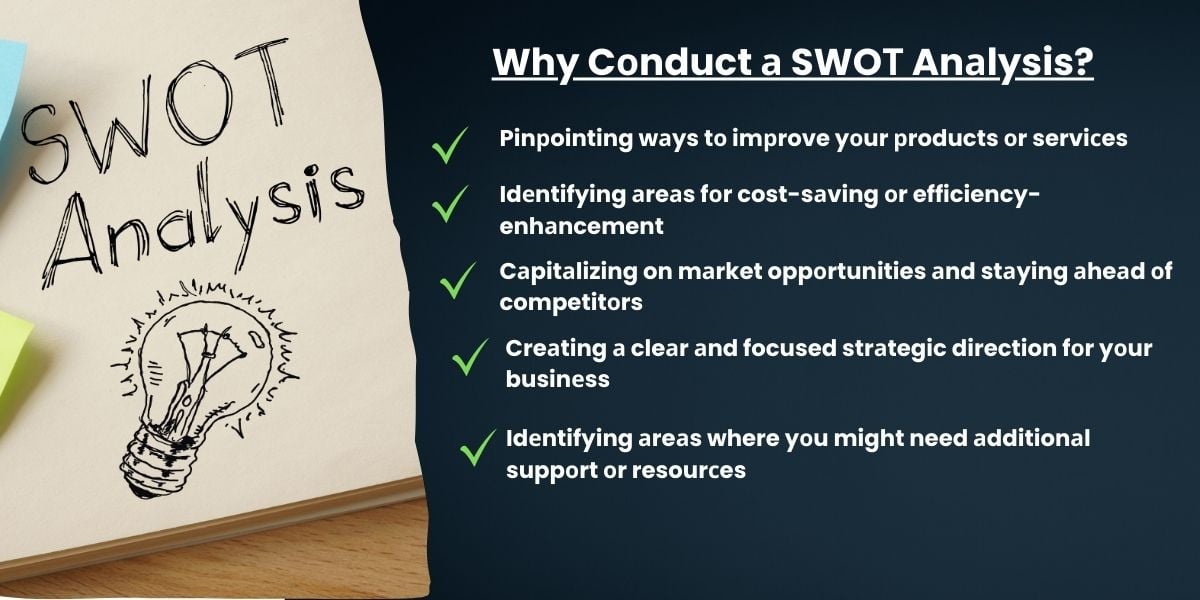
Why Conduct a SWOT Analysis?
Conducting a SWOT analysis helps businesses understand their current state and navigate the competitive environment. It also helps identify potential pitfalls in the decision-making process and create a roadmap for future growth.
The main benefit of a SWOT analysis is that it gives you a holistic view of your business, highlighting both its strengths and weaknesses, as well as the opportunities and threats that exist in your industry.
It can help you uncover hidden challenges or barriers that may stand in the way of your success, and develop a clear plan to navigate around them.
A SWOT analysis can also assist in:
📚Pinpointing ways to improve your products or services
📚Identifying areas for cost-saving or efficiency-enhancement
📚Capitalizing on market opportunities and staying ahead of competitors
📚Creating a clear and focused strategic direction for your business
📚Identifying areas where you might need additional support or resources
Creating a SWOT Analysis Template in Word
Microsoft Word is a popular tool for creating SWOT analysis templates. Here’s how to create a basic SWOT analysis template in Word:
1. Open a new Word document and select the “Insert” tab.
2. Select “Shapes” and choose a square shape. Insert four squares on the page.
3. Label each square as Strengths, Weaknesses, Opportunities, and Threats.
4. Add bullet points under each category to list the relevant factors.
5. Customize your template design by adding graphics, text boxes or colors.
Dive Deeper: Tailoring Your SWOT Analysis for a Powerful Marketing Plan
While a basic SWOT analysis provides a valuable foundation, delving into specialized templates can elevate your marketing plan to new heights. Here's how:
Imagine having a secret weapon to identify your business's best moves and avoid pitfalls? That's what SWOT analysis templates can do for your marketing! Here are 3 awesome options to choose from:
1. The "Impact & Probability" Grid:
Think of this like a game board where each square shows how likely something is to happen (probable or not) and how big an impact it could have (huge or small). This helps you prioritize your marketing attacks!
For example, a super cool new marketing idea (opportunity) might be unlikely to work (low probability), so you might wait before investing heavily. But a small threat like a competitor offering a similar product (low impact) might need immediate action!
2. The "Strengths & Weaknesses Fixer":
This template is like your friendly marketing coach, helping you identify what your business does well (strengths) and where it needs improvement (weaknesses). Imagine you're known for amazing customer service (strength), but your social media presence is weak (weakness). .
This template helps you focus on promoting your strength while fixing your weakness, like launching fun social media contests to engage your audience.
3. The "Competitor Spyglass":
Ever wonder what your competitors are up to? This template lets you peek into their world! By analyzing their marketing campaigns, brand image, and target audience, you can discover their weak spots and strengths.
Then, you can create marketing strategies that exploit their weaknesses and capitalize on opportunities they might be missing. Think of it as outsmarting the bad guys in a marketing movie!
Remember, these are just starting points. Feel free to mix and match them to create a SWOT analysis that's perfect for your business. With these tools in your arsenal, you'll be well on your way to marketing success!
Don't be confined to these specific templates. Adapt and combine them to suit your unique needs.
✴️Additional Tips:
📚Involve your marketing team: Diverse perspectives lead to richer insights.
📚Support your analysis with data: Back up your claims with market research, customer feedback, and competitor analysis.
📚Focus on actionable strategies: Don't just identify issues; translate them into concrete marketing plans with clear goals, tactics, and timelines.
📚Continuously monitor and adapt: The marketing landscape is dynamic, so revisit your SWOT analysis regularly and adjust your strategies as needed.
By incorporating these specialized SWOT analysis templates into your marketing plan, you'll gain a deeper understanding of your strengths, weaknesses, opportunities, and threats, enabling you to craft targeted and effective marketing strategies that propel your business forward.
Remember, a well-crafted SWOT analysis is not just a one-time exercise; it's a continuous process that fuels your marketing success journey.
Tips and Best Practices for Conducting a Successful SWOT Analysis
1. Involve Team Members – A successful SWOT analysis requires input from the team members. Include individuals from different departments and levels to get a diverse perspective.
2. Gather Data and Identify Trends – Use qualitative and quantitative data to identify trends and patterns in the business landscape. This could include customer feedback, market research, and financial data.
3. Use a Structured Process – A structured process with clear steps and timelines helps businesses stay on track and ensures a comprehensive analysis.
4. Prioritize Issues – Take the time to rank the identified factors in order of importance. This helps businesses focus on the issues that require immediate attention.
5. Act on the Results – A SWOT analysis is useless if the results are not acted upon. Use the results to develop an action plan with clear objectives and timelines.

Real-World Examples of Successful SWOT Analyses
SWOT analysis templates are used across various industries to identify opportunities and mitigate risks. Here are some examples:
1. Coca-Cola – The beverage giant used SWOT analysis to identify the negative perceptions associated with sugary drinks. Based on the results, they launched a marketing campaign promoting reduced sugar options.
2. Tesla – Tesla used SWOT analysis to identify the strengths and opportunities for growth in the electric car market. Based on the results, they invested in expanding their product line and establishing a robust charging network.
3. Microsoft – Microsoft used SWOT analysis to examine its cloud computing offerings and identify areas for improvement. Based on the results, they invested in enhancing their security protocols and increasing their bandwidth.
SWOT analysis templates for Word are powerful tools for businesses to make informed decisions and plan for the future. They provide a structured way to identify and evaluate internal and external factors that impact business success. By following best practices and using the templates available in Word, businesses can conduct a comprehensive SWOT analysis and act on the results to achieve their objectives.
Charting Your Course to Success with SWOT Analysis
By empowering yourself with the knowledge and tools of SWOT analysis, you've taken a crucial step towards navigating the dynamic world of business with confidence. Remember, this isn't a one-time exercise, but rather an ongoing journey of self-discovery and strategic adaptation.
Regularly revisit and refine your analysis, allowing it to guide your decisions and fuel your growth as your business evolves and the market landscape shifts.
"The best way to predict the future is to create it." - Peter Drucker
SWOT Analysis: Your Compass for Business Success. Navigate with Confidence, Adapt with Agility, Thrive in Every Direction.
Remember, the path to entrepreneurial success is paved with both challenges and triumphs. Embrace the journey, leverage the power of SWOT analysis, and watch your vision transform into a thriving reality.
Discover the Right Tools for Your Startup
Take our 2-minute quiz to find tools tailored to your specific needs and goals.
Take the QuizTakes only 2 minutes


